Tuesday, February 27, 2018

"Sky, Land and Sea" (하늘과 땅, 바다): North Korea joins the space race

"Sky, Land and Sea" (Hanŭl gwa ddang, pada) is a short story by Chŏng Ki Jong that appeared in Chosŏn Munhak in 2015. The story depicts the events leading to the launch of the Kwangmyŏngsŏng-2 satellite/ICBM in April 2009.

Chŏng, author of the novel Ryŏksa ŭi Taeha reviewed previously in this blog, passed away in 2016. As one of North Korea's most famous chroniclers of the previous leaders' exploits, it was symbolically important that he was able to pen a story about the new leader before passing away. Chŏng never disappoints; this story features more fascinating glimpses of the U.S. leadership in action.

The Plot

The story opens as Kim Jong Un steps out of his car one early spring day to pick some azaleas blooming on a ridge by the roadside. The flowers remind him of his mother, who had always loved azaleas as a sign of spring. KJU begins speaking to the azalea sprig as if it was his late mother.
"Oh mother! If the bastards fire even one shot on our satellite, I swear I will mercilessly crush their strongholds. And I'll be sure to tell you the good news of our victory. Just wait, Mother!"
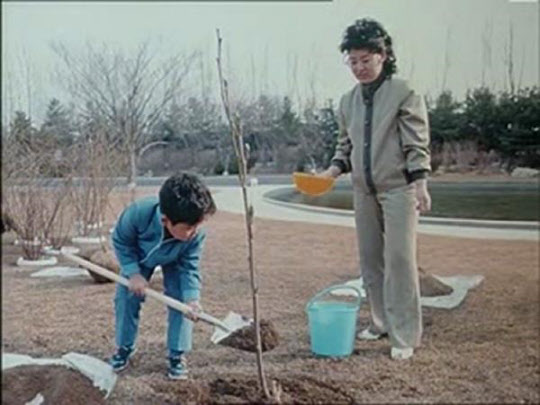
Young KJU planting a tree with his mother. Src: Namu Wiki
Smiling, he carries the sprig down the hill and rejoins his companion, KPA Deputy Chief of Staff Kim Ha Chŏn [possibly Kim Kyŏk Shik or Kim Myŏng Kuk].

KJU competently drives up a rough mountain road the 503rd Air Base to observe a night flying drill led by hot-shot squad leader Han Se Woong. We learn that Kim Ha Chŏn has a long-standing beef with Han, whom he considers a cocksure show-off (멋따기나 좋아하는).

Years ago, when KJU and Han were both students at Kim Il Sung Military University, Han once complained that the military history curriculum was irrelevant to modern warfare. KJU stoutly defended "the profound Juche tactics of the Great Leader and the General" that had defeated America time and again. Chastened, Han apologized, "I was just boasting, I don't even know the first principles of military arts. Forgive me!"

KJU touring airforce corps 1016 in March 2015
Src: Chosun Shinbo
Kim Ha Chŏn, who it turns out is Han Se Woong's father-in-law, was enraged to learn of the incident. Ever since this incident the two men have been estranged. Now Han's wife and Kim's daughter has just been hospitalized in serious heart condition requiring surgery. She begs her father to reconcile with her husband, to no avail.

After observing Han's squadron competently execute the flying maneuvers, KJU advises him, "Confidence is very good, but your target can constantly change. It's not fixed. At times, your target won't be what you expected; you will need to be aware of not only your assigned target but everything in the sky, land and sea (하늘과 땅, 바다)."

In the command center, KJU delivers a detailed lecture on how commanders must be prepared to "seize the opportunity" to strike the enemy when it counts most (적들에게 강타를 안길수 있는 타격의 기회).
   "In a war, opportunity does not always present itself to you. See here, the Yanks and Japs and their south Korean puppet friends who are threatening to shoot down our satellites. Do you know how massive their forces are? What can we do to demolish such a massive force in a single blow (일격에 타격소멸)? Never forget, opportunity comes and goes in an instant. It's just one time in a thousand! Being decisive in the moment, evaluating all the surrounding conditions and seizing the opportunity - this is fundamental!"
KJU picking targets like a boss. Src: Sky News

Later that evening, KJU delivers a detailed situation analysis to the Central Military Command, with KJI in attendance. KJU gives a detailed account of recent movements at all enemy bases in south Korea, Japan, Guam and Hawaii, as well as an analysis of the strategic and tactical tendencies of all the US top military minds, including the President Obama, Defense Secretary Gates, and PACOM Admiral Timothy Keating (the last is described as "a raging war-monger who calls himself the 'God of War'").

KJI and KJU discuss plans in the event that the enemy tries to intercept their satellite launch, which North Korea has already announced they will consider an act of war.

They decide to instruct all army, navy and AF units to make preparations to strike at enemy bases throughout region at a moment’s notice, if there is the slightest hint of a strike against the satellite launch. In addition, KJU proposes mobilizing the airforce to conduct an attack drill over the East Sea, where the enemy fleet is deployed. That way, if the enemy makes the slightest twitch toward an attack, the fighters will be in place and ready to sink the whole fleet into the sea.

"The MiG-29 is North Korea’s most formidable and
modern aircraft, but Pyongyang has only a handful of jets."
Src: The National Interest
(At this point in the story, it is worth noting that the North Korean air force's most advanced fighter is the MiG-29).

KJI thinks this is a fantastic plan and gives his approval. KJU suggests that Han Se Woong lead the squadron.

----
The day of the launch arrives, a warm spring day without a cloud in the sky. KJU and KJI arrive at the launch command center. KJU holds his cellphone close at hand; from this one phone he can command all divisions of the KPA, including Han Se Woong's squadron that is even now hovering over the East Sea, ready to attack the enemy fleet at a moment's notice. He keeps a grim eye trained on the enemy's movements.
   The enemies were in an uproar.
   In Prague, U.S. President Obama stood before a great crowd gathered in the central square surrounded by stately old structures and delivered a speech proclaiming U.S. leadership in a grand epoch-making effort to rid the world of nuclear weapons. No sooner had his speech concluded than he was handed a dispatch on North Korea. The satellite launch was imminent. A squadron of North Korean fighter jets were conducting a very realistic attack drill in the airspace above the allied flotilla of destroyers in the Korean East Sea. What should be done? Should they shoot down the fighter jets first?...
   The telegram from the US PACOM commander was uncommonly belligerent: "Intercepting the satellite launch is practically impossible. Instead we should do a pre-emptive strike against their launch site, major cities and key military posts. We can fire hundreds of cruise missiles at once. And our nuclear submarines are already in the area, awaiting the DEFCON 3 order."
   Obama couldn't help gnashing his teeth at the stupidity of PACOM Commander Keating's response. "No, that's unacceptable! Unacceptable, I say!" he screamed at the embassy's CIA comms officer. "Order them to terminate the operation immediately. Our carriers and destroyers are to stand down and not interfere with the North Korean tactical attempt. If the missile launches, track it and report it without a fuss!"
  It was classic Obama expediency [역시 오바마다운 림기응변].
North Korea's Launch Control Center, April 2009.
Src: KCNA via Yonhap
In the command center, the young scientists and technicians are brimming with excitement at the Leader's presence and anxiety over the possible enemy interception. KJI asks them many questions about the design, the solar panels, the materials, and the physics, even though of course he knows it all already.

Moving to a map of the region, KJI taps a pointer  over Japanese airspace. "This space here is what the Japs are most worried about. Right? That's why they're fussing and frittering about interceptions. But I've instructed the General here [KJU] to prepare a devastating counterattack if they make any attempt at an intercept. So don't worry, comrades, and just go about your duties."

At 11:19 AM, KPA Vice Marshal Kim Kwang Hyŏk [probably Kim Yong Chun] appears on the small screen to announce that all is ready, and the Leader gives the order to launch. The countdown concludes and the rocket leaves its platform in a pillar of fire. The room erupts in cheers.

Then there is a tense moment when the red line of the rocket on the screen appears to stop abruptly. Was it intercepted? KJU picks up his phone, ready to make the call that will start "a merciless war, setting all of sky, land, and sea ablaze at once!" But just in the nick of time, they receive confirmation from one of their patrol boats of a successful signal transmission. The "interception" was just a computer glitch.

Soon after, cheers erupt again as strains of the revolutionary songs "Song of General Kim Il Sung" and "Song of General Kim Jong Il" sound over the loudspeaker.

KJI roundly congratulates everyone and honors the whole team with a commemorative group photo. Everyone wants KJU to be in the picture, but he humbly refuses. 
Official KCNA photo of KJI with officials and team at launch control on
April 5, 2009. Note KJU is conspicuously absent (perhaps he was the one
taking the picture?).
Src: Hangyoreh
A young cadre sheepishly remarks that he was worried about a possible enemy intercept. KJI blithely replies, "If the enemy had tried to intercept our satellite, they would surely have been terrified by the merciless counterstrike our General (KJU) had planned. Truly, he displayed extraordinary military knowledge and tactical brilliance, not to mention guts and courage under fire. Truly a general among generals!"

KJU doesn't hear this, as he is talking on his phone with the doctors who have just operated on Kim Ha Chŏn's daughter, Han Se Woong's wife. Her heart surgery was a success.

The story ends with KJU once again clutching the azalea sprig and speaking to his late mother, telling her the good news of the successful launch.

April 2009 Missile Launch

It's been sort of lost in the sands of time after the endless stream of more successful launches in recent years, but the April 2009 missile launch was a big deal for North Korea. It was unusual in the degree to which the North announced and promoted the launch before it happened, hoping to attract foreign buyers for its missile technology. This left them vulnerable to greater embarrassment if the launch should fail - which it did. More recent launches have returned to the pattern of being conducted as stealthily as possible.
Related image
The Kwangmyŏngsŏng-2 launch at Musudan-ri, April 5, 2009.
Src: AP


But the launch was effective in a different way - it established beyond doubt the toothlessness of all the regional powers, including the US and China, toward North Korea's missile development. The advance notice gave them all abundant time make their displeasure known and articulate dire consequences for North Korea, and yet the launch proceeded nonetheless. It was also the first big test from North Korea for the Obama administration.

Recall that at that time the Six-Party-Talks were freshly dead and there was still hope that they might be revived. So far North Korea had only doneN one nuclear test, the dud in 2006. It would conduct its second, far more successful, nuclear test one month later on May 25, 2009.

In April 2009, KJU was more than a year away from being formally designated successor, and it is impossible to know how much involvement he actually had in the launch operation. But it is interesting to note that, with this story, the Party has apparently chosen this failed launch as something to attach to his legacy. The North Korean media, of course, reported that the launch was successful and that the satellite is now in stable orbit, beaming patriotic songs across the universe.

The NYT has a good recap of the lead-up to and fallout from the launch. The names of the U.S., Japanese and ROK destroyers in the flotilla are listed accurately in the story. Needless to say, no North Korean fighter jets were reported in the skies over the fleet that day.

KJU's Mother Ko Yong Hŭi

This is the first story I've read that mentions KJU's late mother, Ko Yong Hŭi, who was KJI's third or fourth wife (depending on which marriages you count) and died of cancer in 2004.

Ko Yong Hŭi
According to Yonhap, a propaganda film about Ko was produced in North Korea in 2011 and aired in 2012, entitled "The Great Mother of Sŏngun, Ko Yong Hŭi." The azalea theme can be seen in this film as well. However, according to prominent defector Kang Myŏng-do, the film was probably intended for viewing only by upper level cadres and military officers, not the general public. I was unable to find it on North Korea's official Youtube channel. There is no record of her being officially mentioned or acknowledged as KJI's wife in North Korean media prior to her son's ascension, and notably this story does not mention her by name or offer any biographical details.

According to Kang, the main reasons why Ko is given a low profile are: 1) She was never formally married to KJI or approved by his father; 2) She was a famous dancer and some people might recognize her from old movies; 3) She was born in Japan.


Fast & Furious: Pyongyang Drift

KJU piloting a North Korean plane
This is the third time we've seen Kim Jong Un take the wheel when he feels the need for speed (he drove twice in A Promise of Fire). Each time, he is accompanied by a nervous cadre who clutches the handle and begs him to slow down. This seems to be a part of his unique hagiography, setting him apart from his father and grandfather. One of the earliest pieces of North Korean propaganda about him to find its way South was the claim that he could drive a car when he was three years old. North Korean state media has regularly shown him behind the wheel in tanks, fighter planes, boats and other vehicles.

For more details and adorable photos of young KJU see this YTN clip.

UPDATE: KAF pilot killed in maneuvers?

Several months after translating this story, I came across the following article: http://www.koreatimes.co.kr/www/news/nation/2016/12/116_174525.html.
Apparently in March 2015, around the same time this story was written, North Korean media reported about KJU bestowing a posthumous honor on a fighter pilot who died in scouting reconnaissance maneuvers a day prior to the 2009 launch. At the same time, Kim also honored 13 surviving flyers of KAF Unit 447 with the title "Hero of the Republic" for their role in the launch. There is very little information about how the KAF was involved in the launch preparations or how the one pilot died. However, the timing of this report, six years after the event and coinciding with Chong's story, adds an interesting wrinkle. Why did KJU choose to honor the pilots six years after the event? And why did this story, published in the same year by North Korea's most famous living writer, devote so much attention to the Air Force pilot character? We can only speculate at what the connection might be.


Saturday, January 27, 2018

"Red Persimmon": North Korea's female gunners learn to love their new Leader

"Red Persimmon" (붉은 감) is a short story by Kim Yŏng Hui that first appeared in Munhak Shinmun in November 2013 and was also included in the anthology Bul ŭi Yaksok (A Promise of Fire). The story follows the members of the all-female "Persimmon" artillery brigade as they struggle to cope with their grief over the death of Kim Jong Il, culminating in a visit by new leader Kim Jong Un. As an added bonus, this story is filled with enough woman-as-fruit metaphors to make Georgia O'Keefe blush.
Kim Jong Il with Persimmon Brigade commemorative stamp.
Src: dprktoday.com

The Plot

The story opens with young recruit Myŏng-ok arriving at the “Persimmon Brigade”, where she specifically asked to be assigned. After making fun of her short stature and lack of singing talent, the brigade chief asks why she requested this assignment. She clumsily explains that her mother was a member of the unit, and had her photo taken with the General (Kim Jong Il), and Myong-ok has vowed to follow in her mother's footsteps.

We soon learn that this story is not exactly true. In reality, Myong-ok's mother had almost been assigned to the Persimmon Brigade, but ended up working as a medic at the division headquarters. When she saw the images on TV of the brigade women meeting the Dear Leader, she was filled with remorse and forever after regretted missing the chance to get her picture taken with the Leader. But Myong-ok is determined to join this brigade and get the photo op her mother never had, and the Persimmon Brigade is her best shot since he's always visiting there.

The brigade women welcome her, telling her she has a lucky name. It turns out that two of the previous brigade commanders to meet the Leader were both named Choi Myong-ok. Suddenly realizing that her mother must have chosen that name deliberately in hopes that she would one day meet the Leader, Myong-ok is touched. She tearfully confesses she lied about her mother being a former Persimmon Brigade member. The women laugh away her nervousness and inform her that she is not the first to lie about her connections to the brigade.

That night Myŏng-ok sleeps in the barracks with her new brigade mates. She dreams of meeting the General and handing him a ripe red persimmon.

A short while later, everyone is devastated to learn that the General has died. They all want to run off to Pyongyang to sob and scream over the General, but the commander points out that they cannot leave their post unattended [there is a slight inconsistency here with the story "Him in December" from the same anthology, in which the Persimmon and Wildflower brigades both show up at KJI's funeral]. With puffy eyes, they leadenly go about their duties.

Her dream evaporated, Myong-ok struggles with her arduous duties and begins missing home. She was mostly raised by her grandparents as her parents were always busy working. Once, after the land reform, her grandparents had attempted to send a gift of hand-made silk clothes for Kim Il Sung and his wife. KIS refused, saying that the farm couple should keep the silk clothes for themselves, since they worked hard to “feed the nation.” She recalls that her grandparents had recently worried that the General looked unwell, and her mother spent months in an alpine region collecting a special kind of moss and mixing a Korean medicine packet to send to him.

Coastal artillery women training.
Src: rfa.org
Startled from reverie by a sudden sea swell, Myong-ok looks out from her watch post and spots a strange shape in water. She is suddenly alarmed, recalling that this is the same spot where a young cadet once netted an enemy spy boat. She sounds the alarm and the brigade chief comes running - but the “enemy ship” turns out to be nothing more than a rocky outcropping. From that day on, Myong-ok's squad leader works her extra hard.

---

Some time later, KJU arrives on a visit to the Persimmon brigade. Staring at a stone memorial to the Leaders, he thinks of all the visits his father and grandfather made here over the years.

By tradition, each year the new recruits plant a persimmon tree. Some of the oldest trees date back to his grandfather's first visit in 1972.
   As the persimmon trees grow, the young recruits mature into female soldiers. Eventually they leave and a  new squad enters with their bright red conscription papers. How many times has the cycle repeated? Just as the fresh young buds ripen into bright red persimmons in the fall.
   Comrade Kim Jong Un reached up to gently caress a pair of persimmons hanging together like brothers. He recalled  how the brigade soldiers ran out to greet him, crying and clinging to his clothing.
KJU visiting the Persimmon Brigade. Src: Chosun Shinbo
The female gunnery brigades had always had a special place in Kim Jong Il's heart. It was on a visit to the all-female Pine Tree Brigade in February 1995, just after his own father’s death, that KJI first announced the dawn of the Songun (military first) era.

As KJU walks the same gravel paths his father and grandfather once trod, he contemplates the tremendous devotion they both poured into developing this fighting force, and he worries that he cannot carry on their legacy with the troops.

---

While the rest of the brigade runs through drills for their new Supreme Commander, Myong-ok is stuck on cooking duty.

How quickly her luck has turned sour! Just a short while ago she had been in swimming practice and her squad leader had praised her progress. Indeed, she had been inspired to work harder after meeting her namesake, former commander Myong-ok, who had gone on to graduate from the People's Economic College and become a respected Party member.

Persimmon Brigade women. Sign reads: "Doing our duty
for respected Supreme Commander Kim Jong Il!"
During her visit, ex-commander Myong-ok told them all the story of how KJI got them to begin swim training.

KJI decreed that coastal troops must follow example of the famous wartime gunners of Wolmido, and learn to swim well. He even ordered new swim uniforms made for them, and came back to observe their progress. KJI praised their perseverance and promised to visit again “when persimmons are ripe.”
"We didn't think of it as merely a promise to come back at picking season. Persimmons are a fruit that withstands cold winds and only ripens to sweetness after the frost. In that sense, we believed He was promising to return when we had matured through harsh training into peerless fighters (일당백의 만능병사) and correct human beings."
After that, young Myong-ok took her namesake's words to heart and devoted herself to conquering her training.

---

Returning to the present, KJU continues his tour with the brigade's Executive Officer. He recalls that his father always spoke highly of the women of the Persimmon Brigade; how they could handle the heavy guns and swim as well as any man.

They tour the brigade facilities, including the barbershop modeled after the famous Kangsŏngwŏn salon and the garden where the women grow their own vegetables. After his tour, KJU is treated to a musical performance by the women of the brigade. They perform “March of Korean Youth” and “The General and Our Persimmon Brigade,” and then regale him with stories of KJI’s visits.

Surrounded by loving soldiers, Kim Jong Un feels that "the nation's truest blessing is the 10 million soldiers united as one family." He recalls a foreign newswire report he read recently:
 "In 2012, newly elected leaders in many countries will make their first public moves. The world's youngest leader, Supreme Commander Kim Jong Un of North Korea, has already made waves by paying a New Year's visit to a military unit, greeting the troops and warmly grasping their hands. The world is paying close attention to Kim Jong Un's political style."
When the time comes to say goodbye, all the women gather round, reluctant to part with KJU.  Myong-ok is crying, so KJU offers her a hankie. There's a nice moment where KJU bonds with Myong-ok over the fact that they are both from Pyongyang.

Finally KJU gets in his car to leave. As the car pulls away, the women run after it, and suddenly Myong-ok runs out in front. KJU sees Myong-ok stumble running after the car, and orders the driver to stop. He then decides to take separate commemorative photos with each soldier before he leaves, a rare and time-consuming honor.
From left - Veteran independence fighters Choe Yong Gon, 
Kim Chaek, Kim Il, Kim Il Sung and Kang Gun;
North Korea, 1949.


After KJU leaves, everybody cries. Myong-ok recalls that KIS’ most treasured possession was an old photo of himself with his war buddy, Kim Chaek. Now that they have all taken a photo with the leader, they have essentially become his war buddies as well.

The story ends with more persimmon=woman ripening metaphors.


North Korea's Female Soldiers

The story mentions that the all-female coastal artillery brigades were formed long ago by Kim Il Sung to harness the untapped power of half the population to “push one wheel of the revolution" (혁명의 한쪽스레바퀴). The three most famous female brigades in North Korea are the Persimmon Brigade (감나무중대), the Pine Brigade (다박솔중대), and the Wildflower Brigade (들꽃중대). These brigades feature prominently in several legendary stories of the Leaders' compassion for the troops.

Apparently, the story about KJI visiting and promising to come again when the Persimmons are ripe is fairly well-known in North Korea, and effectively made the brigade a household name. The South Korean TV show "Now on My Way to Meet You" (이제 만나러 갑니다) did a brief segment on the Persimmon Brigade which can be viewed online here (relevant section starts at 12:13).

Not long after this story was published, the North Korean media site Uriminzokkiri published a feature article on the Persimmon Brigade. Since this brigade is famous for being one of KJI's favorites, it must have seemed important to depict their mourning over his death and their continuing devotion to the new Leader.

Beauty in Suffering

Several times throughout the story, the text repeats the refrain of the Song of the Persimmon Brigade:

Slender arms trained warrior-strong 
On the women who wield the heavy steel guns

The overriding theme seems to be that beauty is refined through hardship and purpose. There are allusions to the persimmon fruit, which "only gets its sweet taste after the first frost." While contemplating his father's concern for the women's chapped and frozen skin, KJU wonders:
If those women had been well-dressed in warm clothing, would the General have remembered them as fondly? If flowers are grown in a hothouse protected from the harsh sun and wind, would they touch the heart as deeply? ... Did not the General always feel that the sound of the fusillade firing accurately on command was the most beautiful song? And the women soldiers who lived as comrades-in-arms with their Supreme Commander, were they not the most beautiful in his heart?
Tears in North Korean Fiction

As has been observed elsewhere in this blog, North Korea's fictional characters are not afraid to cry, and the women of the persimmon brigade are no exception. The main character Myong-ok cries so frequently that her fellow soldiers seem to grow exasperated with her. 

There's a funny moment where the executive officer informs KJU that one of the young women is absent because the brigade sent her to represent them at the Youth Festival (Aug 28) celebrations in Pyongyang. Hearing this, KJU asks, “If that soldier knew she'd missed my visit, would she cry like the rest of them?" The officer replies, "Oh, that one would fall to pieces. She was always longing to meet the Supreme Commander." 

The leaders are usually an exception to the rule; I cannot recall seeing KIS ever depicted as crying tears of grief or anxiety, although he would perhaps cry tears of joy. KJI seemed similarly stoic, except when thinking about his father's suffering. In the new fiction since the 3rd generation succession, KJU seems much more fragile by comparison. His "eyeballs get hot" (눈굽이 후끈해지시였다) and several times he seems close to tears as he examines old photos of the brigade with KIS and KJI. 

As the brigade women sing to him during his visit, KJU thinks: "Yes, just as the Great Leader said, I believe in the soldiers and they will believe in me, and together we will walk the long road of revolution, until we achieve victory in the great battle for national unification." Here KJU seems weirdly tinged with self-doubt, and the sight of the women's faith gives him the strength he needs to carry on.

A common pattern seems to be emerging: In this story, as in "Him in December" and "A Promise of Fire," KJU's momentary depression is relieved by observing some common citizen's act of devotion. The message seems to be that the new leader, though gifted with the blood of Mt Paekdu,  is extraordinarily young and fragile, and he will need the full faith and support of the people to succeed.

Tuesday, December 19, 2017

"Silver Lining" (전화위복): Floods and Self-Sacrifice in Rajin-Sŏnbong

"Silver Lining" (Chŏnhwa Uibok) is a short story by Ri Myŏng that appeared in Chosŏn Munhak in January 2017.

The story opens on heavy flooding in the northeast around Rajin-Sŏnbong (aka Rasŏn). Meanwhile, Kim Jong Un is in his office reading reports of the Rasŏn citizens' heroic efforts to save city's famous statues and mosaic of the leaders Kim Il Sung and Kim Jong Il.

Kim&Kim mosaic in N Hamgyong
Src: Yonhap
Flashback to the previous day, when a citizen brigade is frantically stacking sandbags around the large mosaic of the leaders in the town square to protect it before the levee breaks. Captain Ŏm Tae Sŏn of the local fisheries division is overseeing the work when he spots a familiar female face half-hidden under a hood. It's Song Hwa, a girl from his neighborhood who is like a daughter to him. Knowing the area is not safe, he gruffly orders her back home to her family. Song Hwa protests that as a neighborhood resident it's her duty to help, and anyway she already got permission. She starts to show him her permit.

Just then, the thing they had most been dreading happens: the levee breaks. A huge wall of water rushes down the street toward them, sweeping debris with it. The crew standing around the mosaic takes up positions to shove branches and roots out of the way. Suddenly an enormous tree trunk sweeps toward them; just as it is about to collide with Captain Ŏm, Song Hwa steps in front of him. In an instant, the young woman is pulled under the tree trunk and swept away in the surging waters.

"Comrade Yu Song Hwa sacrificed herself while serving as a Youth Brigade team member. Comrade Ŏm Tae Sŏn has taken responsibility, confessing that his momentary hesitation was to blame for her death. He is a man over 50 with great strength who has made many contributions." Kim Jong Un reads the report solemnly to himself, pondering the grief of those who lost their homes or loved ones, and empathizing strongly with Captain Ŏm. If it would ease their pain in any way, he would gladly burn his body to a crisp (한몸을 깡그리 불태워도).

Just then, in walks Armed Forces Minister Pak Hyŏn Sŏk [probably a pseudonym for Pak Yŏng Sik], bowing apologetically.
Inchŏn landing reenactment, September 15, 2015.
Src: Yonhap

   "Comrade Supreme Commander, even after the North-South High-Level Joint Declaration, the southern authorities are darkening the path for inter-Korean relations. This September 12th, US imperialist ships of the invasion force (미제침략군함선) plan to conduct a joint exercise with south Korean armed forces on the pretext of 'reenacting the Inchŏn landing,' in fact a military excercise aimed at us. Here I have prepared a supplemental strategy document."
   "Thanks. I'll give it a look."
   Pak turns to leave, then hesitates and looks back. "Supreme Commander, it's late."
He glances at the clock on his desk. Somehow the hour hand has already passed 2. "On one side, the enemy threatens us with their nuclear cudgel. On the other, we are fighting a deadly battle against water. Somehow, I don't think I can sleep."
Urging the leader to take care of himself, Pak submits a supplemental proposal for flood relief and retreats.

KJU speaking before the KWP Central Military
Commission, August 21, 2015
Src: Yonhap
The next day, Pak listens as Kim Jong Ŭn delivers a speech before the KWP Central Military Commission. Kim leads with an analysis of the "August Crisis" (8월사변), North Korea's term for a series of incidents that occurred in August 2015. Interspersed with Kim's narration, Pak revisits his memory of the crisis:
   "Just as the 'Eulji Freedom Guardian' joint military exercises were culminating, there was a landmine explosion along the DMZ, strange suspicious cannon fire from the North,  36 rounds of artillery fired on North Korean territory,  the restart of psych-warfare broadcasts across the DMZ, a US aircraft carrier moving toward the Korean peninsula,  and suspicious movement of various strategic nuclear assets; with all this happening, the arrogance of the southern puppet warmongers (남조선괴뢰호전광들) was at its peak. At a time when the US was going crazy trying to destroy North Korea's socialist system, the KPA Supreme Command issued an emergency protocol that shook the whole world. The KPA Joint Chiefs' ultimatum: cease all propaganda broadcasts and other psychological warfare from the South, or we will conduct a forceful military strike."
   [Pak remembering] The whole world had its eyes turned to the Korean peninsula. How would the South respond to the North's demands? Acquiesce, and have peace. Stay silent, and have war!
   The US and the South were seeking to tear down and usurp the socialist system that we have chosen and defended with our lives. War was inevitable and it would break out on right here in Northeast Asia!
   It had been America's century-old ambition to seize the Korean peninsula as a stepping-stone to achieving hegemony over all of the Asia-Pacific. Now they were goading their puppets into starting a war on the peninsula. Now at last they had the opportunity to realize their long-held ambitions. According to the analysis of the world's Korea experts, war was fast approaching.
As the speech continues, Pak flashes back to that time. Late on the night of the ultimatum, Pak came to inform Kim Jong Un that there had been no response yet to their demands; the propaganda broadcasts continued, and in a few hours the North would have to make good on their threat.
   "Reports from the South indicated that people residing near the DMZ were fleeing, youths were avoiding military conscription, increasing numbers were applying to emigrate overseas, foreign diplomats were pulling out of Seoul, the National Assembly was in uproar. This showed the [South Korean] people had lost faith in their society and fallen into despair, the government has lost the faith of the people, and the social fabric was in shreds."...
   If the nuclear fanatics were to touch one inch of our sacred land, sea or air territory, we were prepared to launch a victorious fusillade upon the South. We must match aggression with aggression, nukes with even stronger nukes; the stronger we are the more we can assure peace in the region and the world...
    But thanks to the great general's nerves and resourcefulness, backed up by the mighty Paekdu Revolutionary Army, a solution was reached. Instead of a fiery resolution, there would be high-level peace talks between North and South!
   Pivoting from a "forceful military strike" to peace talks! The American imperialists were left utterly dumbfounded by these unprecedentedly brilliant tactics.
Pak comes alert as Kim's speech turns to the subject of the flooding in Rason. Kim announces that as the damage is far worse than expected, the KPA will be deployed to aid in construction. Pak listens with interest; this proposal is part of the report he had submitted.
   Suddenly Pak recalled a memory from the hard post-war years, when the Great Leader [Kim Il Sung] angrily scolded some workers who were ignoring the suffering of the people: "Are you not the flesh and blood of these people? How is it that women with babes on their backs are planting rice? If we live for the people, how can we accept that? On the plains of Manchuria during the anti-Japanese struggle we fell a dozen times, and got back up again, to fight for the people. Now that liberation has come, how can we allow them to suffer like this?"
   And on the heels of that came a memory of the General [Kim Jong Il] boarding that train on the last day of his life: "Why do you doctors always try to stop me? Don't I know my own illness better than anyone else? I have to keep going, the people are waiting for me! My illness is nothing compared to their troubles, so don't try to stop me."
Continuing his speech, Kim Jong Un announces that the flood recovery effort will be completed by the time of the Party's 70th Anniversary day. The assembled officials are astonished; putting flood relief above national defense? And finishing it all in just one month? Kim explains "By the power that led us to triumph in the Five-Day War [apparently another name for the August 2015 crisis], we will triumph in this 30-day battle and restore everything to its original state."

---

Pak Hyŏn Sŏk, who has taken command of the housing construction effort, is overseeing the loading of a freight train with supplies headed for the flood zone. He scolds soldiers for packing too many creature comforts such as bedding and snacks, saying "Do you think we're going camping? Load the tools first!"

Flood damage relief work in Rasŏn shown on Chosŏn
Central TV, August 2015. Src: FRA
Upon arrival, Pak leads a rally for the relief team; he orders singing and dancing around the construction area to get the workers' blood pumping. A series of construction "battles" unfold using the principles of "socialist competition." The cement team churns out a 10-li field full of cement blocks in record time. The marines beat expectations by completing their assigned wall-building in just three days. This launches a competition between military units.

When Pak asks how the marines completed their walls so quickly, the team leader cryptically remarks, "When it comes to beating time, the secret is three-dimensional warfare [립체전]." He explains that this is a new tactic of labor developed by one of the marines, a young man famous for his ability to sleep standing up.

Pak promptly arranges a meeting with this super-worker, whose name is Ŏm Ju Ho. Something about the marine's boyish face seems familiar, and then his snaggletoothed grin jogs Pak's memory: he last saw Ŏm on pigpen cleaning duty aboard a submarine chaser patrolling the West Sea. Ŏm confirms that he had been given pigpen duty as a punishment for being late. Pak had sought out Ŏm after hearing he installed a new long-range sonar system that performed well in recent tests, but was surprised to find the young marine performing such a humble duty.

The next day, as the marines were filing out for a storm warning, Pak encountered a commotion at the front gate of the base.
   Surrounded by a crowd of children, a single marine stood with a woman clinging to his uniform, pleading about something. Thinking there must be a military-civilian relations problem, Pak went over to investigate. Seeing the stars on Pak's lapel, the woman sheepishly released the soldier and bowed deeply. The marine gave a crisp salute and ran off to join his regiment. Gazing after him regretfully, the woman muttered, "That comrade soldier... he saved my child's life. My child, who was on the edge of death."
   Through the woman's rambling account, Pak soon learned the whole story. The previous Sunday her daughter had fallen from a cliff while out collecting vegetables. An unknown marine had carried her all the way to the hospital and even donated his own blood to save her, then disappeared without a trace. Wanting to thank him, the woman had brought some children who witnessed the accident with her to the base so they could identify him.
   After calming the woman and sending her on her way, the unit commander clarified Pak's suspicions. "Last Sunday was the day I put Ŏm Ju Ho on communications duty, and also tasked him with delivering some magazines and books. But he took three hours to do it."
  "And the reason he was so slow?"
  "He said he had taken a shortcut through the woods and gotten lost."
  "So that's when he saved the child. And got punished for it..."
Pak sensed back then that Ŏm had extraordinary character, and now he finds him once again distinguishing himself in the flood relief effort. He asks Ŏm about the rumors that he sleeps standing up, and Ŏm explains that it is a habit from boyhood when he used to help his dad on his fishing boat. Pak asks to hear more about his father, and Ŏm replies that he is a ship captain in the local fisheries division. OMG, his father is none other than Ŏm Tae Sŏn!

Pak informs Ŏm that his father's heroic acts during the recent flooding have caught the attention of the supreme commander himself. A shocked Ŏm recounts how, when he stopped by his family home after being deployed to the region on flood relief duty, his father scolded him for leaving his post at the front.
"Listening to the radio lately, seems like the Yankee bastards are trying to mess with us again. Doing the Inchŏn landing and whatnot, just like the 50s. Right in front of your noses. And yet even you leave your post to come here! Just hearing that the army was coming here had me crying all night. At a time like this, with those jackals breathing down our necks, how can they worry about my humble home? Where else in the world can you find a leader like ours?"
Pak Hyŏn Sŏk felt deeply moved by the patriotism of this old worker who cared more about defending the front line than recovering his lost home. But at the same time, he agreed that the enemy could easily strike at such a vulnerable time.
   The US imperialists' invasion activities were growing ever more egregious. It wasn't just the Inchŏn reenactment in mid-September. Next month the nuclear-powered aircraft carrier "Ronald Reagan," loaded with dozens of fighter jets and accompanied by cruisers and destroyers, would sail into Pusan. And the south Korean puppet warmongers, nattering about "maritime security," had moved its missiles to sites on five islands in the West Sea including Yŏnpyŏngdo and Baekryŏngdo.
   The southwestern border had indeed become a time bomb [시한탄] where full-scale war could erupt at the slightest provocation. Pak Hyŏn Sŏk felt the ticking of that time bomb every hour of every day. For that reason, he felt that selfless and multi-talented soldiers like Ŏm Ju Ho were needed most desperately at the front.
---

The Kim Jong Il Youth Hero Medal
KJU's days have been filled with preparations for the KWP anniversary and reports on the flood relief work, but somewhere he found time to award the Kim Jong Il Youth Hero Medal posthumously to Yun Song Hwa, the young woman swept away in the flood.

Kim Jong Un and Pak Hyŏn Sŏk chat together in the car as they roll through the streets of the capital, past the construction site of Future Scientists Street [미래과학자거리]. Their conversation turns to the relief effort.

   "How are the soldiers getting on, living in such an unfamiliar area?" He [KJU] was always putting the soldiers first.
   Bak Hyŏn Sŏk swallowed his emotion and spoke lightly. "They faced some hardships at first, but now thanks to your gracious consideration they are getting special rations. Our energized soldiers are leading the charge [돌격전] night and day. Almost every day, the local residents try to bring gifts that our soldiers won't accept, causing some arguments."
   "It's a battle of love [사랑싸움] between soldiers and civilians. We must take this opportunity to show the noble ethos of our troops. Well then, how are the flood victims getting on?"
   "They're still living in tents, but their situation has stabilized. Food and daily necessities are being delivered regularly. When I visited, the shipments of fish and beef you sent had just arrived by boat and train."
    "Just a little while ago I read a letter from a little girl in Changsŏng county. She said she was going to take all her birthday gifts - notebook, pencils, and erasers - and send them to the people of Rasŏn. Right now the whole of our Party and society is devoted body and soul to the people of Rasŏn. Such is the virtue of our beautiful and gracious society."
   "Indeed, I hear some people are even jealous of the flood victims, with their nice new homes."
The Ma'ansan blanket factory
Src: dprktoday
They eventually arrive at a collection center where they inspect the goods prepared for shipment to the flood zone: plasma TVs, warm cotton duvets, "Ma'ansan" blankets, clothing and undergarments, glass tableware sets, and other household supplies.

KJU inspects them all and issues instructions to Pak: Make the duvets thicker, ensure the highest quality, send everything without delay. "But make it clear that these are aid materials, not gifts. If we call them gifts, people are likely to cherish them like family heirlooms and not really use them."

KJU and Pak then go for a walk along the Taedonggang for some fresh air. KJU brings up the Ŏm family and reflects on the selflessness exhibited by the old ship captain. "Through this recent flood, we have seen our people's true colors... Even in their distress, the people of Rasŏn thought first of protecting the images of the leaders. Despite losing their houses and all their possessions, their instinct was to protect the leaders [수령님들]. This is not just a matter of virtue. Even as they were flailing in the water, they understood that their fate and the fate of the leaders was one and the same."

KJU pauses, gazing up at a high-rise apartment building. From one brightly lit window comes the sound of a piano and a child's voice singing:
Grasping his loving hand
I can't lose the moment
Holding his cheery smile close in my heart
I dream of good fortune.
Our greatest gift
Our Leader is here
Our Leader who makes ten million wishes bloom
Inspired by this sign of the people's pure faith, KJU reflects on the Leaders who "wore down the soles of their shoes" [신발창이 닳도록] working to give the people a better life.

---

Pyongyang Central Tree Nursery
Src: Yonhap
Pak attends a tree-planting in front of the nearly completed housing for Rasŏn flood victims. He has brought a variety of fruit and vegetable seedlings from Pyongyang's Central Tree Nursery and Seed Farm [중앙양묘장과 채종농장].

Pak turns to Ju Ho, who is busily digging root beds, and asks him what kind of fruit tree he would like in front of his future home. Ju Ho replies that he has always been partial to the white apricot [백살구] because there was one in the yard of his childhood home. The white apricot is strongly associated with Hweryŏng, the hometown of "Mother of Revolution" Kim Jŏng Suk [KJI's mother].

The next day, Pak gets a visit from Captain Ŏm Tae Sŏn. Having heard so much about the man, he greets him warmly and praises his heroism during the flood.

But Ŏm is clearly feeling uncomfortable; he blurts out "I've committed an unforgivable crime!" He then confesses that one of his crew had been caught wrecking his own house, hoping to claim flood damage and get a new one built for him.

Pak is aghast at this show of bad citizenship, especially after all the selfless deeds he has witnessed. Indeed, he thinks, "just one loach can muddy a clear stream" [종개 한마리 맑은 강을 흐린다더니].

Hoping to make amends, Captain Ŏm begs Pak to let the troops accept a boatload of fish, but Pak points out that such a serious crime must be properly prosecuted.

Just then Pak's phone rings with amazing news: the Supreme Commander himself is on his way over to the construction site! In short order, KJU's motorcade arrives on the scene. Everyone is thunderstruck, none more so than Pak, who knows too well how packed the leader's schedule is with the KWP Anniversary imminent; yet here he is in the remote north of the country.

Without taking a moment's rest, KJU proceeds to ascend a high promontory from which he can survey the entire construction scene. In just ten days, the scene of nature's destruction has been transformed into a "fairyland" [선경마을] of orderly construction. KJU makes a little speech praising the achievements of the last 10 days and urging them to take care in construction "as if you were building your own homes." He particularly emphasizes making sure the electricity and plumbing work.

Suddenly Ŏm Tae Sŏn pushes through to the front of the crowd. "Leader!" he cries. "How can you be so kind to us, we who have only put more burdens on your shoulders?"

Pak introduces Ŏm, and KJU makes another speech reassuring everyone that a visit to the suffering people is well worth his time. He then turns to Ŏm and asks what happy coincidence brought the fishing boat captain to the work site that day. Ŏm stands frozen, unable to speak of the terrible act that his crewman committed. Pak Hyŏn Sŏk takes pity on him and begins to tell the sordid tale.

KJU  listens quietly to the tale, then everyone holds their breath as they await his judgement. But the young leader is magnanimous: "On the contrary, I see this man's destructive act as a sign of the man's faith in the Party. He could not have done such a thing unless he trusted in the Party like a mother. For people with such faith, we should move heaven and earth to do whatever they ask. Let's give this man a new home too, without discrimination."

Captain Ŏm is overwhelmed by the leader's generosity and vows to work till his boat is overflowing with fish every single day. KJU replies that it is people like the captain who make the nation great.

Notes and Links:

Satellite imagery shows Rasŏn port before and after the
flood. Src: RFA
Late-summer flooding seems to be an annual event in North Korea, but the flooding described in this story, which  hit the Rajin-Sŏnbong area in August 2015, was especially severe. A general summary of the damage in English from Reuters can be read here.

North Korean news footage from September 2015 promoting the military's role in the Rasŏn flood relief effort can still be viewed on Youtube.

This article from the South Korean media talks about the flood relief effort and how it interfered with plans for the KWP 70th Anniversary.

An RFA story (with audio) on the flood relief speed campaign can be read here.

South Korean news coverage of the "August Crisis" of 2015 and KJU's 48-hour ultimatum can be seen here. North Korean news coverage of the KWP Central Military Commission deliberations from that time can be seen here.

Militarized Flood Relief

A striking thing about this story is the frequent use of military language in reference to non-military tasks. In his speech on flood relief KJU talks about "going to war against nature's tyranny" [자연의 횡포]. He issues the order for flood relief in the name of Supreme Commander and orders the KPA Command to take charge of the flood relief headquarters. He explicitly connects flood relief effort with his earlier triumph in the August 2015 crisis, calling the recovery effort a "30-day war." Pak describes this order as the first "shots fired [포성] in the war for flood damage recovery [큰물피해복구전쟁]" and notes that soldiers from all over the country are departing their posts to head for the "point of combat" [공격지점], that is, the flood area. The marines are said to be "leading the charge" [돌격전을 벌린다] in rebuilding homes. The construction effort is praised as an "attack without gunfire" [포성없는 공격전] and a "war of love" [사랑의 전쟁]. To speed things up, KJU decrees that building materials be shipped using the "wartime transport system" [전시수송체계].

Military themes have been strong in North Korean fiction since Kim Jong Il inaugurated the military-first [sŏngun] policy in the 1990s. But the newer stories of the KJU era seem to take things one step further: even non-military tasks are elevated using military language. By leading a large-scale military construction operation and issuing commands in his capacity as Supreme Commander, KJU appears to burnish his image as an experienced military leader, without having to actually go to war.

An important key word in this story is "civil-military relations" [군민관계]. KJU inquires about how the soldiers are getting along with the locals, and the story features several anecdotes illustrating the extraordinary love and gratitude the locals feel for the soldiers. Various defector-run media outlets in South Korea have been claiming for years that the KPA is engaged in forced looting of civilian property, and as this story reveals, civil-military relations clearly remain a concern.


Speed Battle Agitprop

This story features many colorful phrases and slogans that seem to be rote features of speed-construction propaganda. Some that I found interesting include:

reaching astronomical figures 전문학적수자에 달하다
line-of-fire agitation 화선선동
unprecedented in the history of construction 지금까지 건설력사에는 례가 없다
with the speed of a lit fuse 화약에 불달린 기세로!
supersonic speed 초음속
100 days shrinks to one, a year shrinks to 10 days. 백날을 하루, 1년을 열흘로 압축

Quality Control Issues

As the above suggests, North Korean speed battles in construction have always tended to emphasize speed over quality. As a result, citizens are often less than enthusiastic about moving into some of the new state housing complexes despite their sparkly exteriors. For instance, Daily NK has some good reporting on the heating problems at the new Future Scientists Street complex. Tellingly, in KJU's speech at the construction site he specifically instructs the soldiers to make sure that the electricity and plumbing work properly and that there is an abundant supply of firewood at each new home before they move on.

KJU's magnanimity in forgiving the fisherman who destroyed his own home to get a new one can be understood in this context. North Korea is not really worried about a spate of literal home-wreckers lining up for new homes, because the reality is that most people are now justifiably wary of hastily constructed new housing.
Friday, December 8, 2017

A Promise of Fire (불의 약속): Kim Jong Un Plans a Fireworks Bonanza

"A Promise of Fire" (Bul ŭi Yaksok) is a short story by Kim Il Su that appeared in the anthology of the same name in 2013. Regular blog readers will remember Kim Il Su as the author of "Blossoming Dreams," reviewed here.

The story begins as Kim Jong Un is being driven to meet his father at a guesthouse in the countryside. Impatient to arrive on time, the young leader asks the driver to let him take the wheel. The driver protests that it's dark and the road is slippery, to which KJU cheekily responds "All the more reason why I should drive." He takes over and speeds confidently along the dark mountain roads.

Nevertheless, he ends up just missing his father at guesthouse. They see the Leader's ORV tracks in the falling snow, indicating he just left. A woman approaches looking distraught; KJU recognizes Mun Suk Hui, the provisions supervisor of the nearby army base that KJI had inspected that day. She has brought a single glove that KJI left behind. Together they stare at the old, worn glove and KJU contemplates how his father always insisted on wearing a pair of gloves until they fell apart, having no care for his own well-being.

He remembers visiting his father's room early that morning to welcome him back from a long inspection tour. He found the Leader slumped over his desk, his eyes squeezed shut.
   "Are you all right?"
   "It's just my leg's been bothering me a bit."
   "Shouldn't we send for the doctor?"
   "Don't bother. It would just make people worry for no reason."
   His eyes grew moist. the General was a human being after all. He had aches and pains just like ordinary people. But it tore at his heart to watch him suffer in silence alone.
   That was why Kim Jong Un had rushed to the General's guesthouse this evening. He was determined to convince his father to take a break, even just for a day, from his relentless schedule of guidance visits and inspections.
---

KJU reviews a demonstration of the artillery salute portion of the fireworks show planned by his aide Shin Hyŏk Jin, but is unsatisfied:
   "Today's test run went off smoothly without a hitch. But something is missing. There is nothing of our own there. It doesn't have our blood and vigor running through it.  In short, it is not our style.
   Let me explain. Is the Strong and Prosperous Nation (강성대국) something that somebody else comes in and builds for us? Does it just fall from the sky? No. It is built by the General and by the people's own hands under His guidance. This gun salute is our way of showing them the reality of the Strong and Prosperous Nation; how can we do that using other's technology (남의 기술) and not our own (우리의것)?"
   The more impassioned His voice grew, the more Hyŏk Jin's head drooped. He couldn't help but feel inadequate in front of this great man who always embraced a new world of creation. "I've been truly thoughtless," he muttered, revealing his inner thoughts.
   Regarding Hyŏk Jin, He assumed a tone of deep reflection. "I can't forget the General's words from a few years ago. 'Chagang Province is getting brighter and brighter. Those people know better than anyone just how precious a single point of light can be. So they labored to build the electric dams, singing patriotic songs to show their resolve to the enemies who crave our destruction, and now they have turned on the lights of paradise by their own hands (우리자신의 손으로). The night lights of Changjagang, built by Kanggye spirit (강계정신).'"
   As if a floodgate of emotion had been opened, His voice rose in agitation. "Comrade Hyŏk Jin, think about this. Why was the General so pleased with the Changjagang light display? Our night illuminations may seem plain next to other countries’ bright city lights, but they were built by our own hands with the same boundless spirit that overcame tremendous hardship. The General said that just seeing those lights gave Him new energy and raised His spirits."
Shin agrees to rework the fireworks show to incorporate Korean culture and technology.

KJU is up late working on the fireworks show, when he senses a presence behind him. He turns and sees his father, KJI, looking over his shoulder. "I didn't want to disturb you..."  KJU explains the problem he is having developing a new type of fireworks technology. KJI praises his son for thinking outside the box, and says he has faith in him that he will produce an excellent show. KJI and KJU call each other by their military rank (changgun and taejang respectively).

Overwhelmed with the sudden need to run, KJU goes out for a fast and furious drive around the capital with his faithful aide Shin, ending up at Unification Street.

Walking along the river, he tells Shin the story of his grandfather Kim Il Sung and the first Victory Day celebration, July 28th, 1953. Hurrying back from Wonsan, the original Great Leader reached the capital just in time to witness the celebratory artillery barrage from near the very spot where they are standing now. The truce had just been concluded; KIS looked across the river and saw the war-devastated landscape illuminated in the light of the explosions, and swore a vow upon the waters of the Taedong River, to give his people a bright future. [How does KJU know this story? Did he hear it from KIS himself, or from his father? He implies that it is not public knowledge]

Awed at the thought of the young leader’s patriotic drive inherited from his grandfather, Shin vows to create the best darned fireworks show the nation has ever seen. (Shin’s character seems to exist solely so that KJU doesn’t sound stupid talking to himself)

-----

Having finished inspecting a KPA unit, KJU heads toward Munch’ang foodstuffs factory, where Mun Suk Hui (the glove lady) works. He has been informed that the factory has made tremendous progress lately. Along the way he and Shin discuss the growing number of special illuminated cities in the country and their effect on the people. Shin notes that the people of Kangwon Province have made such great strides - the Wonsan Youth Power Plant, the new electric-powered towns, etc. - that they are joking about changing the name to Kangsõng (Great and Prosperous) Province. Likewise, with its brilliant light displays, Chagang Province should be renamed Charang (Pride) Province. Kim Jong Un notes that soon there will be night-time illumination displays in the cities of Pyongyang and Wonson as well, and he hints that his father is planning additional displays for Hoeryŏng and Namp’o. In a Kennedy-esque statement, he remarks, “We decorate our cities with illumination shows not because we are rich, but because we achieved everything through our own power."
Wonsan city light display (Src: Donga Ilbo)
KJU arrives at the factory and reunites with Foodstuffs Manager Mun; almost exactly one year has passed since last they met, with the glove incident. Kim congratulates Mun on how much her factory's output has improved. She responds with another fire analogy: “We’re just carrying the flame the General lit.” She informs KJU that she told the workers story of Leader’s lost glove, resulting in a “sea of tears.” The workers were then moved to improve efficiency and produce good results just to cheer up the General.

Illuminated city of Changjagang, on the Chinese border
Mun also relates a story told by one of the factory families’ sons when he was home from the army on a commendation leave. This young man had bunked with some of the people involved in the city illumination work. The day he departed to return to his unit, he announced that he was determined to configure a similar light display for his own neighborhood.

Kim Jong Un is moved and gives a rousing speech.
   "Now is different from the time when we lost the Suryŏng (Kim Il Sung), when the General departed Tabaksol crying bitter tears. The dark trials have passed and we have climbed the summit to greet the bright sunrise of the Strong and Prosperous Nation. We have overcome a thousand li of suffering and see before us ten thousand li of happiness. Happiness does not just come to those who wait; it comes through creation.
   "Kim Hyŏng-jik [KIS' father] once said: If my son's generation does not finish it, we must see the revolution through to the end in my grandson's time. And the General [KJI] said that even if it takes until the great-grandson's generation, it will be carried out. Those words fire my heart every day, every minute."
   His eyes, gazing at the assembled workers, gleamed with certainty and determination. "Today, you gave me good news to bring back to the General, and in return I want to show you something. Call it the groundbreaking ceremony for the Strong and Prosperous Nation, if you like."
That night they all watch the final triumphant rehearsal of the fireworks show; all has been perfected in terms of artistry, form and rhythm, with perfect timing to the music. It is a completely new kind of fireworks show.

Two months later, in April, crowds gather by the Daedong River for the big show. Kim Jong Il appears and the fireworks start; the brilliant lights explode in time to the strains of “Chosŏn’s Blessing” and “Footsteps.” Kim Jong Il praises his son for a job well done: “Displayed over the river with the Juche Tower in the background, it is indeed magnificent; very distinctive!” KJU replies, “These lights are the glimmer on the countless beads of sweat you shed on the path of Sŏngun.” [yuck!] “Now our people are laughing."

Pyongyang fireworks display
Src: Yonhap


Notes:

The night illumination of Changjagang, Chagangdo (불야경) has been hailed as one of “13 great sights of Songun, born from KJI’s benevolence and KJU’s love.” There are now similar light displays now in Pyongyang and Wonsan as well. More details from Yonhap here.

The new Wonsan light display is more strongly associated with Kim Jong Un, since Wonsan is being promoted as the new leader's hometown. For more details see Yonhap and RFA.

North Korea holds a fireworks show every year on the Day of the Sun (KIS' birthday), April 15th. KJU reportedly took charge of planning the April 2009 fireworks show as one of his first  first official experiences of executive leadership, and the resulting show entitled "Firestorm of the Strong and Prosperous Nation" (강성대국의 불보라) was said to display many technical advances including synchronizing fireworks with music from famous patriotic songs.

7/27 is North Korea’s “V-A Day” (War Victory Day), also celebrated each year with a massive fireworks show in the capital.

다박솔 초소 Tabaksol is the name of the artillery unit KJI was visiting when he announced the start of the Sŏngun era after KIS’ death, on Jan 1 1995. "Dabaksol" means a young pine tree, and this is part of a series of famous military units named after the flora surrounding their base. For more details see this article from Yonhap: http://www.tongilnews.com/news/articleView.html?idxno=18259


Light + Heat = Prosperity

This story uses fire as an allegory for national development in several different ways.
Speaking with Shin Hyŏk Jin and Mun Suk Hui, KJU remarks,
"We must show the people the reality of the Strong and Prosperous Nation that we are building, as soon as possible. If we can do that, then the people will go forth with a greater sense of optimism and faith in their bright future (광명한 래일). So I decided to draw them a picture in the sky with fire, a picture of the Strong and Prosperous Nation, for all our people and all the world to see."
When KJI encounters his son working working late into the night on the fireworks show, he pontificates on the meaning of fire and light:
"The time when our people felt the value of light most keenly was during the Arduous March [1990s famine period]. The hardest time for me was walking the pitch-dark streets of Pyongyang at night. There's that famous line in the poem that goes 'If I could give you just one bright beam of light' - that's how I felt then. I swore that I would find a way to give light to the people, even if I had to burn my whole body to a crisp [내 한몸을 깡그리 태워서라도]."
This last phrase is a fixed expression that is often uttered by the Leaders when talking about something they want to do for the people, akin to "I'd give my right arm to..." It's unintentionally ironic in this context, but probably not meant to imply that the light would come from KJI's burning body.

Later, when KJU reunites with Foodstuffs manager Mun and hears of the progress her factory has made, he makes the following speech:
"Fire bequeathed by the General! It's really a meaningful phrase. When our enemies predicted our 'collapse,' even putting up a signboard counting down to the day the last light of communism would burn out, who could have foreseen this bright day? But today nobody can ignore the growing brightness in our country and the new light of socialism. The Changjagang nightscape and the Wonsan light decorations illustrate how Korea has preserved the red flag of socialism, using the language of fire."
Clearly somebody is getting annoyed by the foreign media's repeated posting of satellite images showing North Korea cloaked in darkness. But the "communism countdown clock" reference is new to me - does anybody know what this might refer to? Post in the comments!

KJI Suffering in Silence

The glove incident at the beginning of the story is implied to be part of a pattern of KJI not taking proper care of his health. KJU recalls that whenever his mother would try to give his father new gloves, KJI would respond "These old ones are good for another few years if we just patch them up. Besides, I've grown attached to them."

As KJI reminisces about the people's suffering during the Arduous March, KJU is moved by his father "thinking only of the Fatherland and the people, when at that time He was suffering from a serious illness nobody knew about." In this way, the author implies that the ill health that eventually killed KJI had its roots in the stress of the 1990s famine.

Kim Jong Il = Winter; Kim Jong Un = Spring

Related to this is the recurrent theme that Kim Jong Il is now associated with snow and winter, while Kim Jong Un is associated with spring, flowers and warmth. As foodstuffs director Mun remarks, "Really our fire is built upon a foundation of tears. Our happiness today was born beneath the cold sleet and blizzards that the General fought his way through. Now when our people hear the news of the Wonsan city lights, we can't stop crying thinking of how they were lit by the strenuous labors of the General."


The Sad Leader

This story is a good example of the trend of depicting the new leader as emotionally vulnerable, even close to tears at some points. While North Korean fiction often features characters shedding tears (of shame, regret or joy), the leaders Kim Il Sung and Kim Jong Il are generally depicted as stoic or relentlessly cheerful. The new stories with Kim Jong Un seem to take a different approach: the leader is occasionally shown tearing up in moments of emotional turmoil, doubt or regret as he mourns his father and assumes the mantle of leadership. He is then invariably cheered up by observing some humble act of faithful devotion by a representative of the common people. The message seems to be that this new leader is indeed talented, but he is also young and vulnerable, and he will need all of the people's support to succeed.

One weird thing that struck me is that Kim Jong Il is still alive in this story, and yet people keep talking and acting as if they are already in mourning for him. KJU tears up almost every time his father’s name is mentioned. Other characters seem excessively emotional over things like gloves and the illumination displays finally being finished according to KJI's wishes. This led me to devise my own crazy fan theory for the story: It’s actually 2012, not 2011, and KJI is dead but KJU hasn’t absorbed it yet. He goes around telling people he will report their progress back to his father, and they all just humor him. In this light, his final conversation with KJI at the fireworks show is particularly striking, like Luke hanging out with Yoda, Ben and Anakin at the end of Return of the Jedi.