Showing posts with label Kim Jong Il. Show all posts

Saturday, January 24, 2026

Mount Osŏng (2012): Bush and the Axis of Evil

Mount Osŏng is an "Imperishable Leadership" series novel by Pak Yun that was published in 2012. Set in 2002, this novel handles the important tasks of introducing the US War on Terror and explaining how, despite its seeming preoccupation with the Middle East, the US military is still very imminently planning a conquest of North Korea. 

This one evaded my attention for a long time because it was never put up on any of North Korea's open websites to download, and none of my contacts had a digital copy either, just a pdf in a non-portable font. Without a digital copy to feed into my bespoke text analysis tools, I had to wait until I had time to read it the slow old-fashioned way, using my slimy human eyeballs like a caveman. 

Once I dipped my toes in, I was immediately kicking myself for not getting to this one sooner. I should have known better, since the same author also created a memorable depiction of the late Clinton era in Gun Barrel [총대] (2003). This author is a master of cleverly weaving together disparate real-life events from around the same time period into a fiendishly cloak-and-dagger plot with wily mustache-twirling villains and sexy femme fatales. In this case, the plot weaves together: George W. Bush’s “Axis of Evil” State of the Union speech, the 2002 World Cup jointly hosted by Japan and South Korea, the inter-Korean diplomacy of the Kim Dae-jung era, and the Second West Sea Battle.

On the US side, there are quality speaking parts for George W. Bush, Laura Bush, George H.W. Bush, NSA Condoleezza Rice, SecState Colin Powell, Henry Kissinger, Rev. Franklin Graham, Speechwriter Michael Gerson, SecDef Donald Rumsfeld, VP Dick Cheney, CIA Director George Tenet, CENTCOM Commander Tommy Franks, Assistant Secretary of State William Kelly, Barack Obama, and a couple of purely fictional goons named "Saul" and "Elsa" who do the administration's dirty work in Korea. George W. Bush, Gerson, and Powell each serve as POV characters in different chapters.

High-powered palaver down at the ranch

We first encounter W. relaxing at "Clifford Ranch" in Texas the weekend after the Axis of Evil speech. Several Cabinet officials gather there to comment on the speech and its ramifications, along with a glowering Bush Senior and "long-time Bush family friends" Henry Kissinger and Rev. Franklin Graham. The famously tee-totaling Bush Jr is depicted here sipping on Scotch poured by his indulgent wife Laura. Powell and Rumsfeld enter together and begin a heated discussion:

   [Rumsfeld:] "Gentlemen, the President's annual speech has thrown the world's media into a frenzy. This is truly the first sensation of the new century. Jiji, Reuters, NTV, CNN, and even Xinhua are all in awe and dismay. This could be called the first salvo of our neoliberal movement." Secretary Rumsfeld had abandoned his usual cool demeanor and was madly gesticulating.
   Bush felt a strange, inexplicable sigh of relief escape him. He locked eyes with Secretary of State Powell, standing behind the Secretary of Defense. Powell nodded and cautiously approached the empty seat at the table.
   "The problem, Mr. Rumsfeld, is that I think it’s too early for celebration. The idea to divide the world ideologically and propagate values through military superiority is not a new one. It’s a relic of the so-called Cold War. A few days ago, I met with Brzezinski, and he expressed concern about the lack of a new geopolitical strategy and expressed great discomfort with the new administration’s neoliberal approach and anti-terror policy. The strategy of deliberately targeting potential enemies on all sides and attacking them is doomed to failure."
   Kissinger's calm words left Bush inwardly dismayed. He sensed this was Kissinger's cunning attempt to indirectly criticize him by citing the views of Brzezinski, a renowned political scientist and special adviser on national security under President Carter.
   Abruptly, Powell glanced at Kissinger and retorted, "But Brzezinski's logic betrays a lack of strategic insight to accurately analyze and assess today's world. Hasn't it already been disproven by last year's shocking September 11th incident?"
   The moderate Powell stood in stark contrast to Vice President Cheney and Rumsfeld, who were considered hardliners in the political world. Bush felt immediately bolstered by Powell's astute diplomatic thinking in support of the president's foreign policy.
   Kissinger glanced at Bush Sr., sitting impassively in silence with a glass of wine, and at Graham, who was slicing a hamburger with a knife, a relaxed smile on his face. He licked his lips. 
   "Mr. Powell, I’m speechless at you applying such a dichotomy. In fact, we must recognize that the very concept of the war on terror itself bears a profound contradiction. Democrats regard it as a police action, while the current administration has revealed its intention to mobilize the military. The ‘axis of evil’ has been designated as the target of this test. Critics have argued from the beginning that since terrorism is a methodology, it cannot constitute a real concrete enemy of the US. While Al Qaeda may be viewed logically as a kind of secret organization, experts consider it more of a spiritual entity. This fact could render all strategies based on neoliberal principles meaningless."

Bush, Rice, Rumsfeld and Cheney at 
Crawford Ranch, Aug 2003 
(src: White House Archives)
The conversation continues for a full chapter. There's a lot of good material in here that illuminates how North Korea views the US War on Terror, the secret ulterior motive behind calls for economic reform in NK, the interplay of church and state in US politics, and W.'s feelings of inadequacy toward his father. The excerpt above is noteworthy not just because Kissinger is brought onstage as the voice of wisdom, but because they have him quoting Zbigniew Brzezinski to drive his point home; in real life, the two men were long-time rivals. North Korea would probably favor Brzezinski for his connection to Carter, but they have also been surprisingly generous in past depictions of Kissinger.

Rev. Graham is present to discuss his upcoming trip to North Korea; he thinks he can serve a diplomatic role since he is "our nation’s religious leader" and "For some reason, since the time of Chairman Kim Il-sung the Graham family had enjoyed Pyongyang's warmest welcome" (I've previously covered Rev. Billy Graham's depiction in a different novel). Condoleeza Rice contributes her insight on Pyongyang's internal politics. Bush Sr. offers historical perspective as the man who "ended the Gulf War and brought down the socialist Eastern Bloc" but left America's most formidable foe (guess who) untouched. 

But I can't get into those details here, because I must skip ahead to share an even more quotable scene. 

People of Color

Powell and Obama in 2010
(AP/J. Scott Applewhite)
In Chapter 10, a young upstart senator named "Obama" pays a visit to Foggy Bottom for an impromptu chat with Secretary Powell and Assistant Secretary Perry. Although it is noted that they represent opposing parties, they seem chummy enough – Obama praises Powell for breaking barriers as America's first black secretary of state, and Powell privately regards Obama to have "an IQ that was, if not Einstein level, then at least comparable to, say, Kennedy or Clinton." They proceed with a wide-ranging discussion that illuminates Obama's political philosophy and future aspirations, including this tidbit:

   [Powell:] "I hear you're pushing for a world without nuclear weapons? Those nuclear weapons are America's lever, the great hope of American-style governance. You’re a master of utopian pragmatism, but if you keep going on like this, you'll really get labeled a socialist! Fidel spoke highly of you, he says he thinks you’re a new kind of American politician. Better keep your feet on the ground."
   At Powell's friendly advice, Obama grinned, revealing his white teeth, and raised his Cognac glass. "You hit the nail on the head. There was even a cartoon in the paper labeling me Osama bin Laden's younger brother. Hahaha. If a confrontation with North Korea actually helps boost America's position as a world leader, I welcome it. But do you really think socialism will disappear from this planet so easily?"

There follows a lengthy discussion of late Soviet era intrigues, Perestroika, Yeltsin & Putin. Eventually Obama turns to the topic he came to discuss:

   "I met Jay Kim a few days ago, and he brought up something I think you’ll definitely want to address…"
   "Jay Kim?…" Powell looked up, thinking the name was somehow familiar.
   "You know, Kim Chang-jun, the Korean-American congressman from California's 41st Congressional District." 
   "Ah, the mayor of Diamond Bar! He's the Korean-American congressman who won a landslide victory over Democratic candidate Mom Macker [Bob Baker] by a margin of 59 to 35 percent, in a district with few people of color and a significant middle-class white population. What about him?"
   Obama smiled faintly at Powell's interest. "The 2002 World Cup, the greatest sports festival of the new century, will soon be held in Seoul. Coincidentally, our US team is in the same group as the South Korean team. Jay Kim is concerned that this could be the fuse that will trigger an eruption of anti-American sentiment."
   Powell had yet to grasp Obama's true intent, but he began to sense a faint flicker in the darkness. He tensed, like a rodent sensing a tectonic shift. Was this some kind of African instinct?
   "The World Cup... this summer... It's a very interesting concern," Powell muttered, his eyes blank.

Here is another example of how different events are massaged into a timeline to fit a narrative. In 2002, Barack Obama was still just a humble Illinois state senator, and Jay Kim was already long gone. It is of course possible that North Korea does not understand the concept of each state having its own legislature and assumes all "senators" work in Washington.

Jay Kim in Congress, Oct 1998

Kim was indeed the first Korean American elected to Congress, but he was primaried out in 1998 after some illegal campaign financing came to light. California's 41st is a majority white district, but it is also pretty solidly conservative. As the Republican candidate and a wealthy businessman, it was not surprising that he handily defeated his Democratic rival. Kim's positive portrayal here is surprising as he is not someone North Korea would normally approve of; he served in the South Korean military, was fiercely anti-communist, immigrated to the US, and remained a staunch supporter of South Korea's conservative party. In California, one of the issues he ran on was repealing the 10% luxury tax; he argued, “If you work hard and become a millionaire and buy a boat, what’s wrong with that? Is this a socialized country or something?”

As always, and especially with these high-profile Series novels, it is important to be mindful of what was happening at the time of publication. Though the events depicted take place in 2002, when this novel was published in 2012, North Korea would have been much more concerned with creating a coherent vision of why Barack Obama is bad than with relitigating Bush-era policies. This novel seems to particularly linger on American race politics in a way I have rarely seen before or since.

Sports and boats

Sports play a significant role in this novel, as several sports controversies contributed to the rising anti-American ferment in South Korea at that time. The novel even gives brief shout-outs to Olympic speed-skater Apollo Anton Ohno and comedian Jay Leno - if you don't know what they did to piss of all of South Korea in 2002, you can Google it. Of course, the novel devotes more attention (and deservedly so) to the tragic killing of two Korean schoolgirls by a US military armored vehicle that year and to Bush's Axis of Evil rhetoric, which rubbed many South Koreans the wrong way at a time when inter-Korean relations had been making historic progress. Overall, 2002 was a rough year for US-ROK relations.

This all coalesces in massive protests surrounding the US embassy in Seoul, which did happen in real life. In the novel, the unrest prompts the Bush administration to take the drastic measure of engineering a fatal clash between the two Korean navies in order to redirect South Koreans' hatred safely back toward the North again. This, of course, is the Second West Sea Battle, which in reality happened several months before the embassy protests. This skirmish, in which several KPA ships infiltrated south of the NLL and opened fire on a ROK patrol boat causing the deaths of six sailors, was the subject of the 2015 South Korean feature film Northern Limit Line (연평해전). The attack is widely believed to have been planned as retaliation for the KPA's heavy losses in the First West Sea Battle back in 1999, although undoubtedly the timing of the clash - during the World Cup finals - was also designed to darken South Korea's moment in the world spotlight.


Monday, December 22, 2025

Soccer scenes in North Korean novels

I'm willing to bet that in every culture, sports stories are used to impress values upon young people, or in other words to indoctrinate them. And what sport is more universally beloved across cultures than soccer? 

The Beautiful Game has been featured in many North Korean novels over the years. Here are some of my favorite scenes:

North Korean team training session during the
2010 World Cup in Johannesburg
Src: Frank Augstein/AP

Young Kim Il Sung teaches value of teamwork

The important novel 1000-ri Road of Learning (1971) by Kang Hyo Soon features a scene in which a very young Kim Il Sung observes a middle school soccer match in colonial Pyongyang alongside his schoolmates. Although he is canonically about 11 in this scene, he is referred to throughout as the Great Marshal (대원수님). 

I discussed the significance of this novel before a while back. As I explained then, it is not technically part of the "Imperishable History" Series, but the first edition was published one year before the first official Series novel, and it can be considered a precursor and model for what the Series would become. It is certainly an established classic of the leader representation genre, and I understand that North Korean schoolchildren usually read it in sixth grade, around the age that Kim was in the story.

   The spectators were watching intently, as the match was close from the start. Both teams, Kwangsŏng and Sŏngdŏk, attracted large audiences and were formidable opponents.
   15 minutes into the first half, Sŏngdŏk scored a goal with good form. The audience cheered and applauded. A middle-aged man, apparently a Sŏngdŏk parent, walked out in front of the students and did a little dance, swishing the fringes of his durumaki jacket.
   The game continued. The Kwangsŏng team, unwavering in their determination, encouraged one another and fought fiercely. Near the end of the first half, Kwangsŏng scored a goal. Thus, the first half ended 1-1.
   The second half began. Both sides were formidable. The teams pushed back and forth, sweating profusely, but neither could find a way to score. Then, with only five minutes remaining, the Kwangsŏng team finally got a shot in. Instantly, excitement boiled over in the stadium. In this way, the victory was won by Kwangsŏng School. 
   The Great Marshal thought about many things while watching the game.
   Clearly, in terms of individual skills, Sŏngdŏk was better than Kwangsŏng. However, the Sŏngdŏk athletes had grown arrogant after scoring that goal in the first half, and they then lost their lead to Kwangsŏng while busy showing off their individual skills. On the other hand, the Kwangsŏng team excelled in teamwork rather than individual skills.
   As a soccer team captain, the Great Marshal felt inspired to make a lesson of this. 
   He observed the Kwangsŏng School players in their black overalls and red shirts, and saw that Number 6 was the standout. Whenever the ball came to his side, he'd rush in to snatch it, and when it went to the other team, he'd dash over and kick it away. When the ball hovered around the center, he'd rush to steal it and kick it to a teammate. Number 6 also scored the final goal. When he scored, the crowd roared with joy, and the Kwangsŏng students banged drums, waved flags, and shouted cheers until their eardrums were about to burst. 
   "Dŏkbŏm, if you practice a little, you can probably kick like that Kwangsŏng number 6 player, right?" The Great Marshal asked.
   "No, I've still got a long way to go," said Dŏkbŏm, shaking his head.
   "Are those kids so special? If we work at it hard, we can do even better!" replied Yun Byŏng.
   "Yun Byŏng’s right. We’ve got to resolve ourselves to do better. Do that, and there's nothing we can't accomplish."
   These were the words of the Great Marshal.
   It wasn't just to watch a soccer match that the Great Marshal came into town with His comrades that day. His purpose was to stir their resolve and spirits by showing them the skills of great athletes.
A soccer match in colonial Pyongyang, July 1925
(src: 마니아타임즈)

The motif of teamwork triumphing over "arrogant" players "showing off their individual skills" sounded very familiar to me, and sure enough, a North Korean veteran athlete uses exactly the same language as this novel, almost word-for-word, in describing his team's triumph over Australia in the documentary "The Game of Their Lives." To be fair, it sounds like that is a pretty good summary of what actually went down. It's tough to say who inspired whom here - the Australia match happened in 1965, this novel was first published in 1971, and the documentary aired in 2002.

The little band of friends featured here does more than just kick some balls around - young Kim organizes them into an underground study group before leaving again for Manchuria. It was important for the Party to maintain the legend of an alternate domestic leftist group founded by Kim Il Sung and independent of Pak Hŏn Yŏng's Korean Communist Party. But KIS left Korea in 1925 at age 13 and did not return until after liberation. So, as unlikely as it sounds, this rambunctious gang of pre-teens goes on to form the core of a fabled Pyongyang-based faction of socialist agitators operating so deep underground that nobody heard about them until the 1960s. And what better way to have a young boy teach his mates the spirit of the collective than via sports analogies.

Even younger Kim Jong Il also teaches teamwork 

Fire Cloud (1991) by Pak Hyŏn is the second entry in the Imperishable Leadership series but the first in chronological order, set in 1950-53. And I can hear you asking: But that series focuses on the deeds of Kim Jong Il, so how can it possibly cover a period when he was only about 8-10 years old? Well, good question! Fire Cloud is probably the best book for examining how North Korea's novelists handle the tricky task of depicting one of their revered leaders in his Pokemon days. 

Kim Jong Il in 1950 
(Src: Sipa Press / Rex Features)
It seems like nobody definitively knows where the younger Kim spent the war years, but in this scene he is staying in a remote northern town along with his sister and a guardian. It is implied that this is somewhere well away from the fighting but still within North Korea's borders.

As always, the capitalized He/Him pronouns indicate the leader Kim (Kim Jong Il in this case), mirroring the honorific pronoun 그이 in the original. The author relies on these honorifics to an unusual degree in the text below to distinguish KJI from the other children. The author makes strenuous efforts to avoid having any of the children address KJI by a name, meaning ironically that they sometimes have to actually say "hey you" [야] to get his attention. It isn't even clear what name they might know him by, as it's implied that nobody in the village except a few trusted guardians know of his true identity. The omnipotent narrator however always refers to KJI as "young leader comrade" [어리신 지도자동지] with full honorific verbs.

This scene starts as KJI is called to join an impromptu soccer game by a hot-tempered young scamp named Ki Ryong, the local blacksmith's grandson. They're getting their butts kicked by another team led by a boy named Sang Su, and Ki Ryong is desperate for help:

   In the spacious front yard of Sang Su's house, beneath an old zelkova tree, the neighborhood children crowded together. They’d made goals out of some hats placed atop large rocks, and they were pushing and screaming, jostling each other, locked in a fierce battle.
   The two goalkeepers, who each had pieces of cardboard with the number 1 stuck on their backs, had already rolled on the ground several times and were looking just as ragged as Ki Ryong, but neither one took the time to dust off their clothes as they leaned forward, tensely watching the ball roll around.  
   Sang Su, wearing high-topped shoes with tightly tied laces, was locked in a fierce battle. Strong and a skilled runner, he led his team's attackers in a fierce charge, drenched in sweat. The other team's barefoot defense crumbled and fell back.
   Aghast, Ki Ryong ran over with Him in tow.
   The young leader, upon seeing the soccer field, felt relaxed, invigorated even. He swiftly removed His jacket, hung it on a zelkova tree branch, rolled up His pants, and ran into the middle of the field.
   "Hey! You came."
   "That’s enough of that, now let’s see what we can do."
   At the sight of Him, Ki Ryong's grim-looking teammates suddenly brightened, raising their fists and shouting at the opposing team.
   On the other side, Sang Su's gang grew uneasy.
   "Hey, if somebody new joins, somebody else has to leave. You can't just do that," Sang Su pouted.
   "You don't have to say anything, you can just leave now if you’re scared," Ki Ryong shot back with a soft fart. But he looked around his team, debating who to weed out. Deeming Nam Myŏng the weakest, he called him to leave. But neither Nam Myŏng nor any of the other kids were willing to quit. After a brief tussle, another boy joined Sang Su's side, evening out the teams.
   "All right, game on!" Play resumed. Ki Ryong moved swiftly to intercept the ball headed for Sang Su and passed it to the young leader, who drove it swiftly forward, but then made a sneaky side pass to Nam Myŏng, who was wide-open running parallel to Him. 
   "Why'd you pass it to Nam Myŏng? He'll lose it right away!" Ki Ryong shouted, startled to see Sang Su suddenly right behind and rushing to intercept. But Nam Myŏng denied him the steal, driving straight towards the goal.
   "Pass to me, to me!" Ki Ryong shouted again. So frantic was his urging that Nam Myŏng passed it over, and Ki Ryong suddenly had a clear shot to the goal. But Ki Ryong, seeing this perfect opportunity, got flustered and whiffed, stumbling and landing on top of the ball.
   The keeper on Sang Su's side quickly picked up the worn ball and tossed it far downfield to his teammates.
   "Some captain, couldn't even put that in!" Ki Ryong's teammates grumbled.
   Sang Su took the ball, and the ball was kicked back and forth, precariously close to the goal.
   From what He could see, it seemed that Ki Ryong's losses were not solely due to Sang Su's aggressive play. As team captain, Ki Ryong made no effort to coordinate but just drove the ball all by himself, hungry for a chance at the goal. But the ball kept getting stolen away from him, causing constant chaos.
   "Hey, stop just driving forward. Pass it, pass it. Pass to Nam Myŏng!" [KJI] shouted eagerly, but to no avail. Soon they were down another goal.
Boys playing soccer in Pyongyang, 2011
(src: Getty Images/alexkuehni)
   The whistle shrilled. "6-0!" Chang Gil proclaimed. [...] 
   With a thorny temper like a spiny crab, Chang Gil was the natural referee of this soccer field. He wore a dignified expression, fully exercising his authority and observing proper etiquette. He would place the ball on the imaginary center line, ensuring that the players were in their proper positions, and only then would he blow his whistle to resume play.
   "The ball is for everyone to kick, but you keep trying to hog it all yourself, and then you keep losing it," He scolded Ki Ryong as they followed Chang Gil, once more carrying the ball to the center line.
   "You can’t hold off all these kids on your own. You need to keep passing. If you keep it going back and forth, Sang Su's guys will get worn out chasing it."
   Feeling guilty but unable to think of an excuse, Ki Ryong just blinked and mumbled incomprehensibly.
   [KJI] devised a strategy: He, Nam Myŏng, and Ki Ryong would form a triangle, passing among each other as they advanced. The other four would defend in the middle, providing support.
   He took the ball at the center line, calmly drove it forward a few steps, and then passed to Nam Myŏng, who waited for Sang Su's teammate to converge on him and then quickly sent it to Ki Ryong. This time, Ki Ryong heeded His advice. Instead of going solo, he drew the opposing players toward him like Nam Myŏng had done. He ran with it almost to the goal, then kicked it back to Him. At a run, He intercepted the ball as it flew towards Him and kicked with all His might. The ball shot between the gatekeeper's legs like a bullet.
   "Goal."
   Ki Ryong, who had been fuming from so many losses, now skipped and cheered.
   After that first goal, the whole team’s spirits lifted, and they continued their attack with renewed vigor. Soon after, Nam Myŏng sent the ball soaring impressively again.
   "Hey, you're quite a good kicker," Ki Ryong poked Nam Myŏng in the side.
   Because Nam Myŏng was so quiet and reserved, Ki Ryong had thought he’d lack the power for soccer, and he'd given him a hard time for every bad kick. But now, to his surprise, he saw that Nam Myŏng was quite agile and had decent ball handling skills.
   Nam Myŏng simply wiped the sweat from his face and smiled.
   Once they started to get pushed back, Sang Su's forces had a hard time fending off attacks from their better-coordinated rival. After half an hour, the score was tied at 11-11. As the odds evened out, the gameplay became more intense, with players from both teams colliding and falling more frequently.
   Sang Su gathered his players to whisper about some tactic, and whatever it was, the team's moves changed. They’d shake off every attacker and surround the ball so that it was impossible to approach, then drive forward with a collective shout.
   Caught off guard by this bizarre attack, Ki Ryong scrambled to counter it. He tried grabbing Sang Su's arms with both hands, and when that didn't work, he desperately tripped him, sending them both tumbling to the ground. Several other boys fell on top of them in a heap, laughing. Just then Chang Gil came running up, eyes wide, whistle blaring.
   "What are you doing? That's a foul, a foul!" Chang Gil huffed and began rummaging through his pockets for something. When he couldn't find what he wanted, he pulled out the first thing at hand, a pocketknife, and solemnly held it up in front of Ki Ryong's nose.
   "What’s this?" Ki Ryong looked bewildered.
   "Don’t you know what this is? It's a referee's sign. You've got a warning."
   "Warning? What does that even mean?"
   "You don't know? Two warnings and you're off the field."
   "Is there even such a thing?"
   "Oh, come on. You don't even know the rules of soccer." Chang Gil gaped. "You tripped him on purpose. If this were a proper stadium game, you'd’ve been kicked out long ago."
   "Pfft, what for?"
   "What? Are you talking back to the referee? I'll send you off right now. Players must obey the referee no matter what. Don't you even know that?"
   Chang Gil's fierce scowl left Ki Ryong speechless, overwhelmed by his "sophisticated" soccer knowledge. As a referee, Chang Gil was indeed formidable. 

The gameplay continues until the boys' mothers begin calling them all in for supper. Sang Su has to almost be dragged off the field by his mother before he will accept defeat. Ki Ryong basks in the glow of victory until his own mother comes to fetch him. At last Kim Jong Il is left to walk home alone. None of the boys seem to realize that he has nobody to come for him – his mother is dead, and his father is far away at Central Command, desperately fighting for their country's future. The chapter ends poetically with young KJI sadly watching some geese fly southward.

The message here, once again, is practice teamwork, do not arrogantly try to seize all the glory for yourself, trust your teammates, learn their strengths, and also maybe try not to lose your temper on the field. Of course it goes without saying that it's the young leader who kicks in the only attributed goal. 

I liked the way he scored that goal between the legs of the goalkeeper, because that was my signature move in high school. I played forward, just like the young comrade leader, but I was an exceptionally clumsy child and could never master any kind of fancy footwork. So whenever I came up against a defender, I'd make as if planning some clever move but then just kick the ball straight ahead. It went right between the defender's legs every time, and then I'd just run past them. Of course I couldn't try that too many times in one game or they would catch on, but our team was so rarely on the offensive that it always worked out. Really demoralized the opponents too. I still feel kind of bad about it.

Soccer Fans on the High Seas

In between narrating the various Cold War crises of the late 1960s and engaging scenes involving major world leadersFate (2012) by Chŏng Ki Jong takes a break to cover North Korea's strong showing in the 1966 World Cup. First, we see Kim Il Sung putting off an important meeting with the new Hungarian ambassador to personally greet the players, whom he already seems well familiar with:

North Korea's 1966 World Cup team (Src: AP)
   The Great Leader, smiling brightly, looked around at each and every player sitting in the front row. “All our familiar comrades are here, eh? Pak Du Ik, Pak Sŭng Jin, Han Bong Jin, Ha Jŏng Won, and then Rim Sŏng Hui… and the comrade next to Rim Joong Sŏn is Ri Chan Myŏng, the keeper for our Korea! And this comrade is Ri Dong Won? No, no, it’s Yang Sŏng Guk. Ah, that’s Ri Dong Won over there, next to Comrade Kim Sŏng Il, right? So, Coach Yŏn Sŭng Chŏl, tell me. Have I correctly recognized all of our wonderful players?”

   Coach Yŏn Sŭng Chŏl sprung from his seat. “Yes, that’s all correct!” Yŏn shouted hoarsely, unable to control his overwhelming emotion. “Thank you, Great Leader!”

   Then, as if by plan, all the players whose names had been called stood up from their seats and shouted in unison: “Thank you, Great Leader!”

   Shouts loaded with emotion… The leader raised His hand again and told them all to sit down.

   “What? The entire nation knows your names, not just me. Come, sit. Sit down, I said. Actually, I should be the one thanking you, comrades. You have done a great thing. How incredible was that competition? Only one team can advance to the main tournament from all of Asia, Africa, and Oceania. I can't tell you how happy the entire nation is right now after hearing the news that our North Korean team will be going to the 8th World Cup Championship.”
   He recalled what happened in the Asian preliminaries of this 8th World Cup, which were held in the Cambodian capital city Phnom Penh in November 1965. “When you played against the Australian team, which boasted of being the strongest in Asia, we were all on edge from the start waiting for news. Actually, even though Australia is in the Eastern Hemisphere, almost all of them are Anglo-Saxon descendants, are they not. So it would not be an exaggeration to say that we were playing against the English team. Sports Guidance Committee Chairman, am I right?”
   The chairman of the Sports Guidance Committee straightened his back and answered, “Yes, Great Leader. That’s right. Also, I hear they went somewhere in England where the climate is similar to Cambodia’s and trained hard for two months before the match.”
   “Hmm… And yet, we beat the Australian team 6-1 in the first match. I hear that the Cambodians cheered enthusiastically when we won?”
   “Yes, that's right,” the chairman of the Sports Guidance Committee replied. "In fact, Prince Norodom Sihanouk of Cambodia had not forgotten that Australia fought in the Korean War as one of the 15 allied countries [추종국가]. So, considering that the two countries were enemies, he divided the Cambodian spectators into two cheering groups, wanting to ensure fairness. But when our team won, all the fans stood up and cheered.”
   He laughed aloud. “How refreshing. In the war, we defeated them with guns, but today, we’re doing it with a soccer ball.”

All of the players' names seem faithfully reproduced, except for no. 16 Ri Dong Won [리동원] whose real name seems to be 리동운, although that may be Wikipedia's mistake. Also, the team's head coach was Myŏng Nye Hyŏn [명례현], but Yŏn Sŭng Chŏl may have been some other administrator. I translated 책임지도원 as "coach" based on the context, but that could be the word for the party secretary in charge of the team.

It's true that FIFA rules that year only allowed a single team to advance to the main tournament from all of Asia, Africa, and Oceania for some BS reason. In protest of this rule, all of Africa and most of Asia boycotted, with the result being that Australia and North Korea were the only ones left to compete. Cambodia was chosen as neutral ground for the match, and the Cambodian fans were indeed split into two groups for fairness. The bit about Australians traveling to England for training is backwards though - in fact, that team was more English than Australian, and they chose a training ground near Cairns for its similarity to Cambodia's climate.

Later, the winning match against Italy is narrated in an interesting way from the POV of a leading character, Pak Yu Jin, who happens to be serving as political officer aboard a North Korean fishing trawler at the time. As the match plays over the shipboard radio, Pak and the crew listen with bated breath:


   “Our team's number 15, Yang Sŏng Guk, driving the ball, crosses the midline. Blocked by Italian No. 6, crosses left to Han Bong Jin, Han Bong Jin shoots with his left foot! Ah, crosses to number 8 Pak Sŭng Jin... Pak Sŭng Jin struggles as Italy's No. 3 player rushes at him... Brings the ball forward, and now number 9 takes it and shoots! This time the Italian keeper kicks the ball far over the halfway line on our side. Our No. 6 Rim Sŏng Hui runs in and intercepts... Italy's captain No. 12 moves in from the middle right to attack...” 
   His chest got so tight that it felt hard to even breathe. Beside Yu Jin, the captain kept grabbing his arm, crushing it. Behind him, [a sailor] pounded his back with hard fists, as if trying to crush him.  
   “Italy’s no. 9 and 10 are making short passes approaching our goal. Stealing past our numbers 5 and 3... Oh, that was too close. But here’s our final defender, number 2!... yes, good, finally stopped it... But the ball’s outside the line. Italy’s a strong team, and their numbers 9 and 10, who launched that joint strike, are the world-renowned Rivera and Mazzulta. Italy's number 6 throws the ball, number 9 connects, passing it back to number 10, and now they’re making short passes back and forth... Now here's number 10 coming in from deep to the right. Number 10 Mazzulta shoots! Ah, our Ri Chan Myŏng jumps up to meet it, but… the ball crossed over.”  [Probably: No. 14 Sandro Mazzola and No. 19 Gianni Rivera, both forwards]
   They'd lost all track of the flow of time. It was a game in which fate was staked, a game in which the honor, pride, and dignity of them all was staked.
   “Big brother,” [a sailor] said, sobbing. “I feel like I am going to die of suffocation and shaking. Big brother, what am I going to do?”
    “Shut up!” shouted Captain Tae Gyu, red-eyed.
    “Nearing the 34 minute mark, and so far, both teams have been fighting fiercely without a goal. It’s still a speed race for our team... Our number 11 Han Bong Jin passes to number 5 Rim Joong Sŏn, Rim Joong Sŏn to Pak Du Ik, Pak Du Ik to Pak Sŭng Jin... Pak Sŭng Jin breaks through the Italians’ defensive line. Italy's captain comes running in... Ah, he slides in to steal it... No, it's kicked away. Pak Sŭng Jin goes flying over him... But what’s this whistle? Is it a foul?!... Yes – 
Italy’s captain Bulgarelli gets a yellow card for deliberately kicking a leg. But… Now he's down and can't get up. While pretending slip during the steal, he kicked our player's leg, and Pak Sŭng Jin swiftly jumped over his body, but it seems he got hurt somewhere? The match has been suspended. Oh, finally, Italy's Captain Bulgarelli is being carried out on a stretcher."
Captain Bulgarelli injured on the field
   Pak Yu Jin jumped up and shook his fist and shouted, “Good job!― Pak Sŭng Jin!―” Never before had he shouted so loudly with such mad agitation. This wasn't just soccer, it was a war of fighting spirit, perseverance, and mental strength. 
   Then it happened. The dramatic words that Pak Yu Jin, the fishermen of trawler boat No. 56, and all people of our country would never forget for the rest of their lives finally passed over the airwaves.
   “Now at almost 41 minutes into game time, our team is on the attack again. Only speed, only attack... Ah, here’s a good chance... Number 7 Pak Du Ik gets the ball from the midfielder, rushes to the left flank, steals past Italy's number 3... Pak Du Ik has his arm grabbed by Italy's No. 3, but rushes through the gap like lightning and kicks with his right foot!
   “Shoo-oot!” The choked voice of the announcer passed through his heart like an electric current... By this point, Announcer Ri Sang Byŏk's tumultuous words mingled with the violent beating of his own heart.
   “Goooaaal! It’s in. Our Pak Du Ik finally made it to the Italian goal! Korea kicked a goal past the world-leading Italian team!
   Everyone got up from their seats. Who was the first to cry out with a choked voice? “Goal! Goal!”

I can't find the whole game online, but from the clips I've seen, this seems to more or less follow the action of the real game. The times in particular are accurate. I know that the Italian captain was carried out with an injury, and that was a big moment in the game. Here's some actual footage: https://www.youtube.com/watch?v=Bqd20eUv9BI

After the goal is scored, the narration skips pretty quickly to the end of the game, when the crew all jump up and hug each other tearfully. 

Soon after, the sailors are startled to see a Soviet ship speeding in their direction. Luckily, Pak Yu Jin studied abroad and speaks fluent Russian:

    At that moment, the sound of a whistle echoed from a Soviet maritime patrol ship cutting through the waves. As he struggled to hear, a high shriek sounded from the loudspeaker of the approaching patrol boat.
   "Корейская команда!― Силинейшая! Поздравляем Корейских футболистов с победой над  итальянцами!"
   Yu Jin waved to them. “Спасибо."
   "What did they say?" shouted the captain.
   "They said Korea is very strong," Yu Jin shouted back. "They congratulate the Korean team on beating the Italians!"

The captain instructs a sailor to invite the Russians aboard. With Yu Jin acting as sole interpreter, the two groups enjoy a bi-national celebration on the high seas. 

The Russian language above was rendered in hangul in the novel, and has been painstakingly transposed here into (probably flawed) cyrillic for legibility. Because that's the kind of full-service translation you can expect here at dprklit.

Here are some good articles about North Korea in the 1966 World Cup: 

https://www.history.co.uk/article/north-korea-the-secret-heroes-of-the-1966-world-cup

https://bleacherreport.com/articles/1998811-italy-world-cup-rewind-humiliation-at-the-hands-of-korea-1966

I also recommend checking out the aforementioned documentary The Game of Their Lives which includes interviews with the seven team members still surviving in 2002. 

Friday, December 8, 2023

Fate (#2): Kissinger and the EC-121 Incident

Following the recent death of Henry Kissinger, NK News has a timely piece on the controversial American diplomat's reaction to the 1969 EC-121 incident, one of his first major tests in his role as Nixon's NSA.

It reminded me that Kissinger makes a cameo discussing that very incident in the novel Fate, a relatively recent addition to the Imperishable History series published in 2012. This is the same novel that featured KIS' interaction with Che Guevara, which I previously covered on this blog. 

The scene opens with a favorite trope: the US president being awoken early in the morning (6:57 AM, to be exact) with news of a crisis brought on by North Korea. The same author had previously used this same device in Ryŏksa ŭi Taeha to depict Clinton being awoken from a happy dream of his Arkansas childhood to the bedside phone ringing and the news that NK just announced its intention to withdraw from the NPT.  The 2015 novel Dignity, by a different author but in the same series, has President Johnson being awoken from a more prurient dream about groping his mistress to news of the USS Pueblo's capture. 

"Bad news, boss."
I suspect this trope is intended to mock the US leader as groggy/off balance, particularly in comparison to the North Korean leader who is always depicted working late into the night and rising early in the morning. But it also has the benefit of probably being often historically accurate, given the time difference and the time of day when most NK-related crises tend to happen.

No word this time on what Nixon was dreaming about; the president just answers grumpily:

   “What now? The Soviet Union or China?”
   “Neither, Mr. President.” It was Kissinger, the special adviser for national security. “It’s North Korea. We have just received a report that the reconnaissance aircraft EC-121, with 31 crew members, was shot down by North Korean fighter jets in the Korean East Sea.” 
   “Shot down? One of ours?
   “Yes, Mr. President.”
   “North Korea again?”
   “Yes, Mr. President.”
   Nixon froze, gripping receiver tightly. The EC-121 was a four-propeller reconnaissance aircraft of the US Navy. It was the latest large-scale reconnaissance aircraft, with a mass of more than 60 tons, a range of more than 7000 km, and a 24-hour flight time. It had launched from Yokota Base in Japan with an important mission to reconnoiter military movements in northeast China and the Far East of the Soviet Union, with a focus on North Korea. It had flown similar missions tens or hundreds of times in the past, but the Soviet Union had never summoned the courage [용단] to shoot it down.
   Nixon pursed his lips. He had no intention of following in the footsteps of the previous president, Johnson, who stepped down after last year’s "Pueblo" scandal gave him the reputation of most incompetent president ever... 

So thinking, Nixon immediately orders a bristling array of military hardware into the region. These are listed in detail: four aircraft carrier groups ("one more than was mustered for last year's Pueblo incident") and their escorts, as well as "hundreds" of fighter jets and bombers put into readiness at US bases in South Korea and Guam. 

Nixon's NSC in 1969
(Src: Bettmann/Corbis)
The National Security Council meeting the following day is also depicted. Nixon begins: "Today, we must discuss how to deal with communist North Korea’s reckless and grave provocation – that is, how to inflict an unprecedented retaliatory blow against North Korea, which intentionally damaged the honor of the United States of America and sacrificed 31 Americans."

Defense Secretary Laird is first to respond and also the most bloodthirsty, proposing to "strike 12 important points in North Korea with nuclear weapons, and then destroy all airfields in North Korea with more destructive nuclear weapons to annihilate their air power."

The State Department and the CIA oppose such a massive retaliation. They argue that "the US, currently suffering from the Vietnam War, did not have the strength to launch such a large-scale military action, and it would not get any popular support but would only give the hardline leadership of North Korea an opportunity to wage all-out war and take over South Korea." There is no discussion of whether such a move would violate international law or US treaty commitments such as the recently-signed NPT; even the diplomats seem only constrained by their weakened position and cowardly fear of North Korea's reaction.

Amid this discussion, they get the report that partial wreckage and two bodies have been recovered, along with an urgent telegram from ROK Ambassador William Porter urging no retaliation against North Korea. Porter's telegram argues that "North Korea had completed preparations for an all-out war since last year's Pueblo incident and was waiting only for the right moment for national reunification." 

Buoyed by this support, Secretary of State Rogers offers his own proposal: to save face by continuing  EC-121 reconnaissance flights with fighter jet escorts. Nixon considers this to be "a truly fragile plan to restore America's lost prestige" and "not even worth discussing." 

Src: Boston Globe
Finally Kissinger speaks up:

   “Mr. President, never forget this, that the Soviet Union, North Vietnam and China are watching us right now.”
   “It’s not just those countries. The whole world is watching us now, comparing us with the Johnson administration...” These words came from the Secretary of Defense.
   Nixon clenched his fists for the third time. “Then, Kissinger, tell us your idea.”
   “I propose retaliation, strong retaliation.”  Kissinger spoke rapidly without hesitation, as if reciting foreign language homework. “Only strong physical countermeasures can show off the confidence of the US at home and abroad, boost the morale of its allies, and dampen the courage of the radical North Korean leadership.”
   "Hmm…” Nixon was of the same opinion. However, he had more arithmetic and pragmatic calculations in mind than Kissinger, a scholar born to a Jewish family that fled to the US to avoid Hitler's extermination of Jews in Germany. In the event of a retaliatory strike, [Nixon] was concerned about what consequences it would bring to him, who had just ascended to the presidency.
   The meeting continued until late at night...

Thus, the thing that ended up happening in real life – continuing to run recon flights but with escorts – is shown being mocked and dismissed by the president as an unthinkably cowardly choice, before he backs down and goes with it. Kissinger as NSA is shown urging "strong retaliation" but does not actually mention a nuclear strike, as the SecDef does. Positioning Kissinger as the final and most forceful speaker makes him seem like the most capable person in the room, although if you pay attention, his words lack any detail and could be interpreted in multiple ways. 

Writing this scene in 2012, the author would be aware that Kissinger's reputation has not aged well in the eyes of the world. He's just the sort of low-hanging fruit that a North Korean novelist would typically put in an exaggerated mustache-twirling villain role. Thus it is interesting that he seems to get the most respectful treatment of all the players in the scene. He is too hawkish to be a real "good guy," but he at least seems to have his head on straight, and the biographical detail about him escaping the Holocaust seems to lend a more sympathetic motivation to his hawkishness.

Although Kissinger had a lifelong adversarial relationship to North Korea, they did have one noteworthy thing in common - they both wanted the 1968 Paris Peace Talks to fail, and for purely self-serving reasons. In that respect, I suppose one could argue that Kissinger did North Korea a solid. Perhaps this is their belated way of saying thanks?

Src: Nixon Foundation
Nixon did in fact convene an emergency NSC meeting that day to discuss the incident; the actual discussion can be found summarized here. In the summary neither Kissinger nor Laird come off sounding particularly hawkish. Nobody seems to have said anything about nukes, although the NK News article notes that "The incident did prompt the Nixon administration to consider contingency plans for future incidents with North Korea" including nuclear strikes on NK airfields.  It must be mentioned that some sources claim that Nixon did initially order a nuclear strike on North Korea as a knee-jerk reaction under the influence of rage and alcohol, and that Henry Kissinger was the one who talked him down.

The novel also briefly depicts KIS getting the news about the EC-121 downing – on his birthday, no less. KIS inquires about the name of the pilot who fired the shot, and it turns out to be one of the story's lead fictional characters, a young KPA fighter pilot who also appeared in earlier scenes dogfighting with the USAF in Vietnam. 

Separately, leader-in-training Kim Jong Il shares the news with ailing Vice-President Kim Il, another major character in this novel, who at the time is bedridden recovering from major surgery. "Comrade Kim Il," KJI soothes, "everything is going well, so why are you fretting? Smile. The Great Leader has performed his own 'major surgery' with the shooting down of the EC-121 spy plane that you were so worried about, so do not worry anymore." He then shares the text of Nixon's press statement announcing no retaliation, and the two men joke that "under the giant mountain was just one tiny mouse" (태산명동에 서일필, from the Chinese idiom 泰山鳴動 鼠一匹).


Wednesday, April 13, 2022

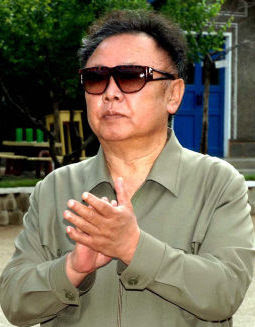
Sunglasses in NK Fiction: Symbol of Badassery or Overwork?

The propaganda video promoting North Korea's latest missile launch has caught a lot of attention in the "North Korea is so weird" media circles. In this video sunglasses play a major role: Kim Jong Un not only wears them, but removes them in dramatic fashion at a climactic moment.

This reminded me of a passage I recently came across in the 2015 novel "Shine the Dawn" [ 아침은 빛나라 ] by Rim Bong Ch'ŏl. Part 1 Chapter 4 follows the adventures of Ryonha Machine Tool Factory engineer Ri Jŏng and senior researcher Ahn Shi Hak as they travel to Singapore to demonstrate their new CNC technology at a trade show.

Strolling the streets one evening after dinner,  Ri spotted a stall selling some sunglasses of the sort gangsters wear [깽들이 끼고다니는것과 비슷한 안경], and he bought a pair. Ahn Shi Hak's eyes widened, wondering if his companion had such proclivities.

When Ri showed up the next day wearing the glasses to an interview, Ahn fumed, saying it was inappropriate for a diplomatic venue...

It was only during Ri’s meeting with a Singaporean broker that Ahn got a vague sense for why Ri had stubbornly insisted on wearing those sunglasses. His counterpart was wearing the same kind. They were glazed like the kind a blind man wears, and gazing into them gradually one’s opponent would be overcome with anxiety. It was like stepping on the bottom of an unknown well.

To compare it to a battle, it was like one person lying down in a trench with only his gun poking out, while the opponent was up on the parapet shooting with his whole body exposed. Their counterpart, whose company had branches in various parts of Southeast Asia specializing in electronics and machinery trade, had clearly done his research on them.

The salesmen and the foreign broker get down to business. At a key moment in the negotiations, Ri whips off his sunglasses and coolly stares down his opponent. The move has the desired effect, throwing the broker off guard.

From the above, it would seem North Koreans, like South Koreans and Japanese, have an impression of sunglasses [색안경] as something that only foreign gangsters wear. 

This may seem puzzling given that the leader Kims - and only the leader Kims - are often shown wearing sunglasses. Actually Kim Il Sung never wore them, but Kim Jong Il began wearing them from the 1990s (reportedly for medical reasons). This excerpt from the 2002 novel Successor by Paek Nam Nyong gives some idea of how this was interpreted domestically. In the novel's first chapter, which takes place in the 1970s, KJI has just returned from a guidance tour of remote Chagang Province, and his father was waiting up for him:
   The Great Leader walked back over to the sofa where Comrade Kim Jong-il was sitting and stopped.  “Take off your glasses.”
  "Hmm?... "
  Comrade Kim Jong-il hesitated for a moment and then took off his tinted lenses [연한 색안경].
  “Your eyes are bloodshot. You’re not in good health. You knew I’d be worried, so you put on sunglasses.”
  “It’s nothing.”
    The Great Leader could not take His loving eyes off Comrade Kim Jong-il. “It’s been ten years since you started working with the Party Central Committee…” When the Great Leader thought of Comrade Kim Jong-il working so hard to lighten His burden, dedicating so much energy to pulling the locomotive of the Party and revolution without rest, His eyes welled up with tears.
I haven't seen any overt references to KJU wearing sunglasses in stories, but he appears with them in domestic media images often enough. This 2016 article recounts how KJI wore sunglasses to conceal his bloodshot eyes and prevent people from worrying about him, and the implication may be that KJU now suffers the same problem.  

With these few exceptions, sunglasses are generally only worn by foreign characters (often associated with looking "like a mafia boss" [ 마피아두목처럼]), or occasionally by blind people.

Monday, January 11, 2021

Ryŏksa ui Taeha (#3): WarBot3000 disappoints President Clinton

This post continues my selective translations of Chŏng Ki Jong's epic novel Ryŏksa ui Taeha (력사의 대하) , which offers a narrative account of the first North Korean nuclear crisis in 1993. The following excerpt is translated from Part 3, Chapter 13, available online here

Like my previous excerpts, this chapter is narrated from President Clinton's perspective. The chapter follows the inner thoughts of the leader of the Free World as he prepares a dastardly attack on North Korea, with a science-fictiony twist as a computer war simulation goes awry...

The Plot

Clinton spent a sleepless night before the planned launch of Operation Focus. All was in readiness, the C3I command system awaiting his transmission of the secret code. It would start with the stealth fighters taking off from Anderson Air Base on Guam to demolish the Yongbyon nuclear facility. After that all will depend on the NK’s response, which will surely be swift and merciless.

But just lately he can’t shake the feeling that NK’s military minds are on to him. The declaration of quasi-war, the withdrawal from the NPT, and now these massive military exercises… Watching them via satellite TV from the situation room (국방성작전보고실), even the head of the Joint Chiefs - who had eagerly pushed to move up the operation date - turned pale and muttered in agitation.

As a saxophone player, Clinton applied his knowledge of music and particularly rhythm to the military analysis. In the exercise formations he perceived the gutsiness, resourcefulness and iron will of the NK commander.

Clinton asked his people to run the computer war simulations (전자전모의전쟁) again, inputting the new satellite data. Over a sleepless night, his awe and grudging admiration for NK’s tactical prowess turned slowly to anger. He arose red-faced and entered the 1st floor dining room thinking only of one thing: obliterating NK from the face of the earth.

'Leda and the Swan' by Paul Cezanne, 
c.1882 
He was unaware of Hillary watching him as the waiter wheeled in a cart piled with coffee, cream, sugar, toast, poached eggs, sandwiches, and strawberry jam. He just stared vacantly at the Cezanne on the wall, “Leda and the Swan.” 

“Dad!” Chelsea tapped her plate for his attention. “Breakfast time! Behave, little children, no fussing, don’t spill!” She imitated her former kindergarten teacher to tease him. 

Clinton just nodded absently, then shocked Hillary by ordering a whiskey.

“What’s with you today?” Hillary asked. “A drink first thing in the morning?”

"I'm trying to boost my courage. Today is a very busy day…” He trailed off. 

He had a solo meeting this afternoon with French President Francois Mitterrand, followed by dinner. There was also a State Department meeting on Middle East issues, a meeting with the Asia wonks on trade frictions with Japan, and finally an operational gathering of the Defense Department and Joint Chiefs to issue the "Operation Focus" order. After a few bites of breakfast, he worked out his schedule with Thomas McClarty, his chief of staff.

He added, “I’m thinking of doing the talk with Mitterrand at Mount Vernon.” Mount Vernon was a National Park and the site of the first US President George Washington’s grave. “Prepare the yacht. And check if the greens are mowed. Mitterrand likes golfing.”

McClarty informed the president of “a troublesome matter” (시끄러운 일) – the ROK foreign minister keeps asking for a meeting. “He’s been waiting at the door for 2 days now, says he’s got a message directly for the president.” The man was persistent, even sending a request via "HHS Secretary Donna” (which must be Donna Shalala). Knowing the female official Donna was close with the president’s wife, he had apparently decided to forego formal diplomatic procedures and go around the back door.

Sensing Bill's displeasure, Hillary offered to stall the man by saying Clinton has to visit his mother-in-law at Walter Reed Hospital. It was a plausible excuse, and Clinton agreed. 

He asked Hillary's opinion about bringing up NK sanctions at this afternoon’s presser with Mitterand, but Hillary had another concern. “There’s a bigger issue, Bill. What's behind NK’s hard-line stance? I’ve been reexamining the order given by the KPA supreme commander, and it emphasized 'the united power of the Leader, the Party, and the people.' To us it sounds a little strange and totally new. But shouldn't we look into it?”

“Whatever,” Clinton looked gloomy. “I’ve got a war to start today.”


That afternoon Clinton talked with Mitterand aboard his yacht Chelsea on the way to Mount Vernon. He asked for France's cooperation in the UNSC on sanctions for NK, including "military punitive measures (군사적응징) as well as the obvious economic blockade.” When pressed, Clinton admitted only that he was considering a pre-emptive strike to destroy NK’s nuclear facility.

Mitterand: “Then it’s war?”

“That depends on NK’s response.”

“They won’t back down. They’ll strike back far harder than you can imagine.”

Mitterand meeting Kim Il Sung in Feb 1981

Mitterand chose his words carefully: “I am the only Western leader to have visited NK. I met with Premier Kim Il Sung at length and we exchanged views on many topics in world affairs… My strongest impression was that NK is a very independent nation with great unity between its people and political leaders...  There’s no other like it on this planet. You must tread carefully. They can’t be pressured.” 

Mitterand spoke at length about his impressions of NK, noting it "was never a satellite state of a greater nation like the Eastern European countries and some parts of Asia were" and  "As they don’t believe in God, their faith in the Party and Leader is absolute." (하느님을 믿지 않을지언정 당과 수령은 절대화하고있다.)

“Finally, there’s the matter of North Korea’s military power,” Mitterand went on. “A while back we had a Japanese delegation that was very uneasy about it. They said the KPA’s firepower far exceeds our expectations. They’ve been building up their military force ever since Kim Jong Il took charge of the KPA, so basically for 20 years...

Mitterand and Clinton at the White House in
March 1993.
"As I said, North Korea will never back down. So threats, blackmail, and war are not solutions. And we still haven’t found a solution for the situations in Bosnia-Herzegovina and Somalia, have we? Also, in war against North Korea we would have to be prepared for millions of sacrifices. Would the people accept that? Our allies will turn away too. That’s the way it is." He recommended instead "a long period of serious diplomatic maneuvering, compromise, and ideological offensives.”

Clinton was shocked by Mitterand's words. For the first time, he began to think about the word "compromise."


After the banquet with Mitterand, Clinton went back to the Defense Department's operations room. The defense minister and the chairman of the Joint Chiefs of Staff were waiting for him. From their gloomy looks, he immediately sensed that the news was not good. 

Reluctantly, he said: “Alright, Let’s see it!”

On the big screen, the North Korea war simulation appeared. First all the U.S. military bases and forces across Northeast Asia were introduced, along with both sides’ troop numbers, locations of military and coalition forces, tactical bases, transport routes, communications networks, and numbers of various weaponry. 

The U.S. capabilities included more than 1,000 planes, 250 ships, various strategic weapons, and standby infantry troops. The simulation played out various battles with NK forces across air, ground, and sea, including missile strikes, anti-aircraft battles, and guerrilla combat with NK special forces, all depicted via complex symbols and arrows as if a real war were being fought on the screen.

Lieutenant General Wilkeson narrated everything - the areas of operation, the designations of various forces, the tactics and battle formations. The simulation lasted 40 minutes, but Clinton stayed riveted the whole time.

At last, it was finished. The simulation showed that two weeks after beginning hostilities, the North Korean troops would have advanced deep into the South, annihilating more than 400,000 U.S. troops and winning the war. The estimated material losses for the US would reach $80 billion.

Clinton was aghast. What the hell? Who could imagine that the U.S. military, which boasted of being the world's strongest, would suffer such a devastating defeat? Although they had accurate figures from each branch for U.S. troop numbers, weaponry, and operational plans, they had only input their best guess of North Korea’s numbers and tactics. In fact, they knew very little about their forces and tactical capabilities.

But even so, to reach such a miserable defeat in just two weeks. How could it be? Clinton had believed that the post-Cold War era was a period of de-ideology, a time of realism and power. Power-oriented times! How could the U.S., the world's only superpower, be outfoxed every step of the way in a nuclear showdown with this tiny country, North Korea?

Even the French defense minister had warned that North Korea was completely different from Iraq, saying, "It's not much use if the US strikes the suspected nuclear site... A military attack would just trigger retaliatory strikes from NK, turning the entire Korean peninsula into a sea of fire.” The computer had just backed up his words with scientific data. They couldn’t ignore this result from a computer developed with state-of-the-art science and technology. The machine had no emotions and did not care about anybody's feelings, even the US president. It just produced scientific, absolute calculations.

Clinton despaired. He felt that he had lost the absolute power he had believed in. For a realist like him, it was the last straw. His whitened lips were twitching. The unexpected shock left him speechless, sitting stiffly in his chair, his generals motionless behind him.


Random trivia

The thing I love about reading Chŏng Ki Jong stories is tracking down the random easter eggs he puts in from time to time, trying to guess how he hit upon these eccentric factoids, why they appealed to him, and why he chose to alter certain seemingly minor details. This chapter is particularly rich in such bits and pieces.

• Leda and the Swan

Investigating this led me down a fascinating rabbit hole. Apparently the question of which Cezannes have hung in the WH and how they got there is the subject of some intrigue. I couldn’t find a straight answer about whether any Cezannes hung in the Clinton WH. But it seems fairly certain that “Leda and the Swan,” at least, was never there at any time, which makes me wonder why the author goes out of his way to mention it specifically.

• Presidential Yacht Chelsea:

This novel repeatedly mentions that Clinton had a presidential yacht named Chelsea, explaining: “Historically, other US presidents had named their yachts after their political idols or their hometowns, but Clinton chose his daughter’s name, following the fashion started by world-famous billionaire Onassis who named his yacht Christina after his daughter (now infamous in Greece for having been seduced by a Soviet spy).” 

Apparently presidential yachts in fact used to be a thing, but the last was retired in 1977, and none of them was named by a president. I can’t find any evidence that Clinton ever had any kind of boat named Chelsea.

The Christina Onassis KGB story is another one that I did not know; it is puzzling that this story takes such a long walk just to brush up against that old bit of 1970s tabloid gossip.

• “Brutus”

At one point Clinton is contemplating the “women problems” that plagued his campaign: “One Arkansas opponent claimed in court that he’d had affairs with 5 women; then a certain nightclub singer 프루투스 revealed in the weekly magazine 명배우 that they’d carried on a 12-year affair from 1977 to 1989.”

It's passages like this where I really earn the big bucks as a translator. I was able to figure out that 명배우 was Star, and the second part clearly refers to Gennifer Flowers, but I couldn’t figure out why he was calling her 프루투스. Finally it hit me – Brutus! It's a Shakespearean reference, with weird North Korean spelling. I'd like to see Google Translate figure that one out!

Anyway, it's interesting that apparently NK readers are expected to have enough familiarity with Shakespeare and/or Roman history to immediately associate this name with backstabbing, without any further context or clues. 

• Mount Vernon Country Club

The chapter says Clinton took Mitterand on his yacht to go golfing at Mount Vernon. I can’t figure out if the two ever golfed together; but Clinton never visited the Mount Vernon historic site as president.

Clinton's press conference with Mitterand in March 1993 can be viewed here

• USS Augusta

Thinking on historical precedents, Clinton recalls:

    When Truman ordered the atomic bombing of Hiroshima and Nagasaki, immediately after signing the order he boarded the USS Augusta bound for Europe for the Potsdam Conference. He wanted to distance himself, so that when the news of the devastation came three days later, it would seem far away and unconnected to him.

This timeline is a little twisted. Truman was on the USS Augusta when the first bomb was dropped, but he was heading home from Europe, the Potsdam Conference having already ended the week before. The timing of Potsdam is pretty important and a well-trod subject among WWII historians. Also notable, there was no “order” signed by Truman authorizing final use of the bomb; after Trinity he had simply authorized Stimson to use it at the first tactical opportunity. Truman had drafted a press release announcing the bombing before setting sail, which may be what the author is referring to.

Depiction of Hillary Clinton

This chapter provides another revealing exchange between Bill and Hillary, as she helps him dodge the South Korean foreign minister:

      Watching Hillary, Clinton thought to himself that she was his real chief aide. She could handle anything. They met at Yale, in the university library. Back then she was a mousy girl always sitting in the far corner with a stack of books, and he almost didn’t spot her. But she turned out to be infinitely talented, clever, and calculating.

During last year’s election campaign, he’d faced many attacks. The worst concerned his dodging of the Vietnam draft. Second was his active opposition of the Vietnam War while on scholarship at Oxford, when he protested at the US Embassy. Then there were the women problems…

Just when even Clinton, with all his clever words, was floundering, Hillary stepped up like the lawyer she was and skillfully washed away all the stains of his impropriety.

It’s a fact that behind every great politician are trustworthy aides. If you look at the great men of history, Lincoln had Seward and Grant, and Churchill and Roosevelt had their core aides. But no other U.S. president had an aide as selfless, absolute, and wise (사심없고 절대적이며 현명한) as Hillary. Clinton himself had confessed that without Hillary's help, he would never have become president.


This novel's depictions of Hillary are generally positive, if a little bit manipulating. She is shown as having more respect for NK than her husband, seems to have read more on the subject and is generally the angel on his shoulder telling him to be careful. This contrasts to the later depiction of her in the novel 2009 as an "old woman" who is disrespected by her state department underlings. Her long presence in US politics makes her a relatively familiar character in NK fiction and therefore a useful subject for analysis of North Korean changing views of women in positions of power.