Showing posts with label historical awareness. Show all posts

Thursday, April 23, 2026

Female Journalist (2014): A rare American heroine in a North Korean novel

Moon Myŏng-ja with Kim Il Sung
in 1992

Female Journalist (녀기자) is a novel by Cho Sŭng Chan first published in 2014 that covers the life of Korean-American journalist Moon Myŏng-ja. I was eager to obtain a copy because the title kept popping up in my research, and I had been told by several sources that this is one of the more popular domestic novels in North Korea - partly because they are fascinated by the scenes set in America. Somewhat unusually for a non-Imperishable Series novel, it had a second printing just two years after the first.

It is also worth noting that this novel is one of 11 North Korean novels selected by the Inter-Korean Economic Federation and Unification Agricultural Cooperative (남북경총통일농사협동조합), a South Korean left-wing civic group, for a planned book series to be sold in South Korea. This ill-fated endeavor was shut down because the group had failed to get permission from the Ministry of Unification to import and distribute materials of North Korean origin, as required by law. In March 2024, a court ruled them in violation of the Inter-Korean Exchange and Cooperation Act and fined them 3 million won (about $2000 USD). Last December, an appellate court upheld the ruling but reduced the fine.

Moon Myŏng-ja's memoir: Park Chung-hee
 and Kim Dae-jung as I Saw Them
(1999)

Moon herself wrote a memoir that was published (in Korean) in 1999. It is long out of print, although some excerpts can be found online, and the Japanese version is still available from good old Amazon. Although Female Journalist makes her out to seem pretty fanatically pro-communist (and some of her later writings back that up), Moon's published memoir offers no hint that she particularly admired North Korea's leaders or ideology – indeed, they are hardly mentioned. But she was certainly very opposed to the murderous regime that ruled South Korea until 1986.

Here's what is definitely true: Moon Myŏng-ja (a.k.a. Moon Myŏng-ju, a.k.a. Julie Moon) was born in North Kyŏngsang Province in 1930, went to Japan during the war to study at Meiji University and then Waseda University's Graduate School of Law, and served for five years as Tokyo Bureau Chief for the Korean women's magazine Yŏwŏn before getting hired as Washington correspondent for Chosun IlboShe joined the White House Press Corps in April 1961, just two months after Helen Thomas, and for decades they were in a close two-woman race for longest-serving White House correspondent. The pivotal moment in her life came in 1973 when she reported on the abduction of exiled dissident leader and future president Kim Dae-jung from Japan by KCIA thugs. Soon after, she was warned by friends that the authorities were waiting to arrest her if she returned to South Korea, so she had no choice but to apply for political asylum in the US. She later became a naturalized US citizen. Officially, she is the first American journalist to have done standalone interviews with two sitting DPRK leaders: Kim Il Sung in 1992 and again in 1994, and Kim Jong Il in 2000. And yet, I asked several American journalists with deep knowledge of North Korea and found that none of them had ever heard of her. Even in South Korea, I could find no in-depth media profiles of her, in either Korean or English. 

Christmas 1998 photo from Moon's memoir

There is so much meat to analyze in this novel. Normally when I read a foreign-setting story like this, I am left endlessly puzzling over the provenance of odd details and mistakes. In this case, I can confidently assume that they used Moon's own memoir as a baseline – she would have given them a copy when she visited in 2000 if they didn't already have one. They wouldn't have even had to have it translated. One need only look at how Moon described things in her memoir to see exactly what the North Korean author had to work with and pinpoint where he let his imagination take over.

Crimes of Fashion

For instance, there is this scene, which takes place during Park Chung-hee's first visit to DC after seizing power in the 5.16 coup:

   When the day of Park Chung-hee’s arrival in Washington came at last, Moon Myŏng-ju went out to the airport with her colleagues. The airport was crowded with officials from the US government who had come to greet him, officials from the South Korean embassy, their families, and reporters from various countries.
   When the plane finally arrived and the door opened, a short, skinny, unkempt man wearing sunglasses slowly descended the stairs. It was Park Chung-hee. Upon closer inspection, he was dressed in a shabby outfit with his pants not even creased, and he looked awkward meeting and greeting the American politicians, just like a country bumpkin who’d come to Seoul.
   How can this be the representative of my country?
   She felt indignant at the thought of her country’s democracy being trampled because of this brat. She wanted to go right up and tell him to straighten up his act. But she couldn’t act rashly at such a venue, so she just kept stewing to herself.
   She was unable to meet Park Chung-hee that day. After getting off the plane and greeting the American officials, he quickly got into a waiting car and left. The next day, Park held a banquet at the South Korean Embassy to which Moon was invited. It was a golden opportunity to meet him. She waited in the banquet hall until Park entered, once more wearing tinted lenses. As he approached, Moon stepped forward.
   “Chairman Park, it’s nice to meet you,” she greeted him politely. Park Chung-hee halted. The ambassador following alongside him blanched, fearing whatever poisonous words Moon might utter. Undaunted, Moon said everything that was on her mind.
   “It’s rude to meet a foreign head of state while wearing sunglasses. Is it because you lack confidence that you do this?” 
   The ambassador was taken aback and tried to interrupt, but it was no use. Park struggled to maintain his composure, saying “You said you are Reporter Moon?” 
   “Yes, Mr. Chairman!”
   “I forget, is that considered rude here?”
   “Maybe not in Seoul, but here it is. Please don’t wear them tomorrow!”

As my devoted followers may recall, I covered the Korean cultural taboo against sunglasses in a previous post. The above excerpt puts an interesting new twist on it, seemingly implying that this is not a Korean taboo at all but a standard Western rule of etiquette that only uncouth country bumpkins might not be aware of. I had thought this scene was a purely North Korean invention, but then I found a nearly identical scene in Moon's memoir. According to her own recollection, she did scold PCH for wearing sunglasses when he arrived in Washington in 1961. 

PCH meeting the Kennedys in Nov. 1961, wearing
the forbidden lenses. I will concede that it is odd
to wear them indoors, but that distinction was not
made in the novel

Reading this, I cannot help but wonder once again what today's North Koreans make of their current leader's penchant for shades. And a very small part of me wonders if the author was trying to say something, writing such a thing at a time when KJU's tastes in this regard were already established.

Kim Jong Un in April 2014 (src: The Atlantic)

Because the above excerpt so closely mirrors Moon's memoir, it's a good opportunity to compare how various expressions by Daegu-native Moon were revised by the North Korean author:

Moon’s memoir:

NK novel:

서울 온 촌놈

서울에 온 촌닭 한가지

깡마르고 까무잡잡한 

강마르고 가무잡잡한

선글라스색안경

색안경

바지선도 세우지 않은 후줄근한 차림

바지주름도 잡지 않은 후줄근한 차림

Loose Lips Sink the State Department's Media Surveillance Program

Another section that closely follows Moon's memoir, but mysteriously deviates on a few key details, is the following:

   One day, just as Moon Myŏng-ju leaving the Library of Congress after checking some information, she encountered Thomas Hubbard. A stocky man of average height, he greeted her with a grin. He had a friendly and easygoing personality, and Moon had known him for a long time. He was friendly, but his words were often vague and lacked substance.
   "Reporter Moon, I heard you're breaking news constantly these days?"
   "Hmm!" She ignored the question as Thomas fell in step beside her.
   "You think I don't know? Another anti-Park article, I hear. Saying that he embezzled a ton of money by stealing US military supplies?" 
   "What?" Moon Myŏng-ju stopped dead in her tracks. That article wouldn’t be published for another few days. "Where did you hear that?"
   Thomas's eyes widened in confusion at Moon's question. "What's wrong?"
   "Out with it. Where did you hear that?" To her fiery, pressing questions, Thomas reluctantly replied that he'd seen it at the State Department.
   At the State Department?!
   Something clicked in her mind. This was an alarming revelation. Did the State Department review every article written by foreign correspondents?
   That evening, she went home and said to her husband, who had just returned from work, "Honey, it seems that Telex sends all articles by foreign correspondents over to the State Department. I just heard from Thomas..."
   Before she could even finish, her husband gave her a dumbfounded look. "Didn't you know that already?"
   "But what about American democracy, which claims to guarantee freedom of the press? Is it all a lie?"
   "Huh, you've wasted your time as a correspondent. You're so clueless about the US, you're just bumbling around, that's the problem!"
   That was true. Moon had been oblivious about the US. At that moment, she could not think. But the fact that the State Department was reviewing every article by foreign correspondents felt like a big deal, and she could feel the illusions and expectations she had long harbored about America being shattered. 
   I need to wake up and look at the world. How many slick and flowery words are running rampant in this world, distorting the truth?

With hangulized foreign names I always have to use my judgement, and 하바드 could be either "Hubbard" or "Harvard". If the former, though, this could refer to real-life person Thomas Hubbard, a long-serving State Department officer who played a leading role in several complicated negotiations with North Korea in the 1990s and then was US Ambassador to South Korea from 2001-2004. Hubbard is mentioned briefly in the North Korean novel Gun Barrel [총대] as "presidential special envoy Hubbard" [대통령특사 하바드] spelled the same way. 

Moon's memoir is no help solving this mystery. It includes a nearly identical scene, down to the later conversation with her husband and her self-realization that she has been "oblivious" about the US. The only differences are 1) the article in question concerned ROK press intimidation and had nothing to do with military embezzlement, and 2) the person who told her about it was actually the reporter Spencer Davis, who was AP's State Department correspondent at the time. 

Left: AP reporter Spencer Davis;
Right: Former Ambassador Thomas Hubbard

Why would they swap out Davis for Hubbard? Did they prefer for this revelation to come from a State Department worker rather than a fellow reporter? If this is intended to be that Thomas Hubbard, he would have been a freshly minted junior foreign service officer at the time. Is this an attempt to write an origin story for someone who would go on to be so involved with Korea? If so, why didn't they do more with this character? I have wracked my brain but cannot come up with any satisfactory answers.

As for the monitoring of foreign reporters' cable dispatches, from what I can find online, this was part of Operation Shamrock, a WWII relic that kept operating in peacetime because nobody cared enough to shut it down until it was publicly exposed in 1975. It can be thought of as an early precursor to the NSA surveillance scandal. Once again, one wonders what the North Korean writer may have been subtlely trying to say here, given that government monitoring of communications is standard operating procedure in their Republic, particularly for foreign journalists.

Creative License

Moon with Kim Jong Il in 2000

To be clear, large portions of the novel do not overlap at all with Moon's memoir, particularly the parts dealing with her personal life and the scenes set in North Korea. There's an interesting scene where she's arguing with her husband over whether to abort her second child for the sake of her career, hinting at North Korean views of wifely duty and the proper balance between career and family. There is also a harrowing early scene where she gets abducted from Tokyo and brutally tortured by agents of Syngman Rhee, which I can find nowhere in her memoir - but that doesn't mean it didn't happen. 

Moon's memoir focused on her work as a journalist and various political events in the US and South Korea that she witnessed. This novel has a different focus, centered around the occasion of her first visit to Pyongyang in 1992 and her emotional encounter with Kim Il Sung. While there, she reunites with a cousin (likely fictional) who went North before the war, and the story unfolds through the mechanism of her telling him the story of her life, interspersed with periodic cut-aways to the present whenever he prompts her with clarifying questions.

As Moon regales her cousin with her life story, she also shares some of her observations about American society and the immigrant experience, including the following:

   “The Los Angeles Times published data from the city police department stating that among the 70 or so ethnic groups living in the city, Koreans had the highest crime rate. Reading the article, I was initially ashamed, then enraged. To think that South Korean society itself was so rotten and decaying that even those who emigrated abroad were violently breaking the law and disrupting society, drawing criticism and disgracing the nation.
   "At around that time, The New York Times published an article about a Chinese national charged with child abuse, sparking a huge public uproar. It turns out the child abuse charge stemmed from the parents of the family raising their voices and swearing at their child while bathing him because he was whining. An American neighbor witnessed this and reported it to the police, resulting in a week-long detention and a fine. In the East, swearing at your child while bathing them is not considered a crime, it's a sign of love. But under American law, that's considered a violation of human rights and subject to legal action! Faced with such absurdity, something suddenly occurred to me. I rushed down there and studied the Los Angeles Police Department's report on "Koreans' Crimes" and met with several of the individuals involved. There were some who’d done real crimes such as prostitution, drugs, illegal entry, and shoplifting, but more than half of them received legal punishment for ridiculous things like the Chinese person's 'child abuse crime'.
   "One Korean immigrant, who hadn't been there long and didn't speak English, was sentenced for an outrageous crime, fined hundreds of dollars, and couldn't even protest.
   "This is how Americans view Asians, and especially our people."

This particular anecdote does not appear anywhere in Moon's memoir, but again the memoir focused mainly on political events. Perhaps she wrote about this elsewhere; it certainly sounds like something that might have happened. It's just interesting to wonder what North Korean readers made of this.

Sources and links

Over at Jaju Shibo, the columnist 중국시민 has an in-depth analysis of this novel as part of their regular North Korea literature series, worth a look if you read Korean. 

Moon's memoir itself is worth a read. I was unable to obtain the out-of-print Korean version, but I found the Japanese version on Amazon. After Moon's death, a sort of "director's cut" version was posted online with permission from her husband. Based on the Japanese edition, I confirmed that the online version is largely true to the original (with some omissions). Skimming through it, I encountered some passages that gave off a strong feeling of deja vu. Sure enough, some sentences and even whole paragraphs reappear nearly verbatim in other KWU novels published after 2002. North Korean authors seem to rely on this book as a resource particularly for describing Washington DC, the White House, the Press Corps, and various government institutions and people.

Moon's interviews with the North Korean leaders are hard to track down. They were only published in Korean, all for Wŏlgan Mal, the same journal that published her memoir. A leftist bookseller has put some old issues of Wŏlgan Mal up online but not those ones apparently. I found a seemingly full transcript of the Kim Il Sung 1994 interview that Wŏlgan Mal reposted online when Moon died in 2008, and Seoul Shinmun posted her interview with Kim Jong Il in 2000 in the leadup to the first inter-Korean summit. Both interviews show the North Korean leaders in a favorable light, but the 1994 one is less obsequious and asks some cautiously challenging questions about food shortages. The 2000 interview is so fawning and so closely mimics the North Korean media's style that I almost wonder if Moon wrote it all herself.

Looking over the totality of her writings, it is hard to say what her true feelings were. I get the sense that she was a woman stuck in a bitter and unhappy exile, who missed her homeland but had long since abandoned hope of a future the South, and who was inclined to accept whatever good face that North Korea put on for her without looking deeper, lest she alienate the first fellow Koreans with real political power to ever treat her favorably.

Friday, October 17, 2025

Great Love (1987): North Korean writer 'ships Hitler-Queen Victoria romance

Reading North Korean literature, one encounters more than the usual share of falsehoods. Most of these have obvious background motives - making a Party policy seem more successful, justified, or necessary. Making the country's actions seem more important, its people more envied in the eyes of the world. Making their continued isolation and resistance of reform seem like a very prescient and wise choice. Then again, some falsehoods are not exactly "lies" so much as honest mistakes, likely stemming from limited or poorly translated resource materials, amusing but understandable.

But every once in a while, I come across a real head-scratcher, such as the one that stopped me in my tracks recently while reading the 1987 novel "Great Love" [위대한 사랑] by Ch'oi Ch'ang Hak.

What might have been?
The novel is the 11th entry in the important "Imperishable History" series of novels narrating the life of Kim Il Sung. Set in colonial Manchuria in summer 1937, most of the action is centered around Kim and his band of guerrillas. The novel also tangentially covers the Marco Polo Bridge incident [7.7사변] and the outbreak of the second Sino-Japanese war, and includes some interesting character sketches of Kwantung Army officers involved in the "punitive force" that hunted down resistance leaders in Manchukuo.

One of the more morally ambiguous Japanese characters in this novel is the journalist Kobayashi, a veteran reporter newly deployed as a war correspondent on the Manchuria front. As often is the case, the Japanese journalist character seems less bloodthirsty and more intelligent than his military counterparts and serves as a relatively honest witness to their machinations and foibles, while nonetheless dutifully parrotting their lies. When we first encounter Kobayashi, he is fresh off of a long multi-country tour with his newspaper's CEO [사장님] and newly arrived on the Manchuria front. 

Arriving in camp, he is swiftly taken under the wing of "punitive force" Commander Umiyama. Weary of life on the front and desperate for news of the wider world, Umiyama eagerly quizzes Kobayashi on his recent world tour. This produces the following interaction:

   [Umiyama:] “Kobayashi, you must have seen so much. Which country did you visit first?”
   “England.”
   “England…”
   “Our CEO had been wanting to meet Queen Victoria for some time. England has been expanding overseas since the 16th century, and its colonies are 200 times the size of our own territory. It seems that our CEO found it strange that the storied old British Empire has a queen in a skirt.”
   Umiyama scooted closer to Kobayashi, growing animated. “Your CEO has great curiosity. So, how was it meeting her? She must be a great person, being the queen of the British Empire. Who was it that seduced Antony across the sea? Ah, yes, that was the Egyptian Queen Cleopatra. How does she compare?"
   “Well, there was nothing really special about her. Nothing really stood out. If there was one thing I could mention, it was that when she held out her hand, her fingernails were very long.”
   Kobayashi spoke casually, as if he had just visited a new elementary school teacher in a neighboring town. After all, accompanying the CEO of a large newspaper with a worldwide circulation, he had dealt with more than a dozen emperors, presidents, and prime ministers.
   “Well, how did such a woman become the queen of the British Empire? Is her skirt swish that strong? The British have strange tastes, I guess.” Umiyama tilted his head in puzzlement.
Queen Victoria in 1887
   “The throne is hereditary. That country has very strong hereditary traditions and customs. So strong, in fact, that despite being a constitutional monarchy, there is no written constitution –  traditions and customs take the place of the constitution. Chamberlain handles politics, and the woman lives a luxurious life as a symbol, attended by her servants, but that doesn't mean she is indifferent to politics. The queen secretly fears Hitler. So our CEO suggested that she should follow Cleopatra's example and cozy up to Hitler. To that, the queen answered that she was not beautiful enough to seduce Hitler, and anyway one of Hitler's peculiarities is that he avoids women. Haha!” Kobayashi laughed loudly and heartily.  [...]
   “It seems you had a nice conversation with the queen. So what was your impression of Hitler, whom the queen fears so much?”
   “Well, what can I say? He is representative of all the modern-day gangsters and madmen who are obsessed with self-confidence. That madman thinks that he alone can rule this world. Mussolini is similar to Hitler in temperament, but he is a bit more stupid… That gammy-legged Roosevelt in the White House showed a hint of arrogance and cunning…” [...]
   The more he talked, the more Umiyama clicked his tongue in wonder. “Ah, reporters have such mighty tongues. Even when the president refuses meeting requests from ministers, still he’ll talk to a reporter.”

Ex-King Edward VIII (Victoria's great-grandson) 
and his wife Wallis Simpson meeting Hitler in 1937
Even the casual student of European history will appreciate just how fanciful the above conversation is. Queen Victoria died in 1901 - it's one of those dates that is easy to remember. Her grandsons were grown men when they famously declared war on one another in 1914. Even for a woman of her considerable abilities, Queen Victoria would indeed have had a hard time seducing Hitler from beyond the grave.

Of course, the typical North Korean writer has limited resources and cannot just hop over to Wikipedia to check dates. The author of this novel, however, was a member of the ultra-elite 4.15 Literary Production Unit, the highest ranked writers in the country, who enjoy extraordinary privileges. They reportedly have offices in a gated complex in the suburbs of Pyongyang featuring an extensive library of foreign literature and source material. Furthermore, the editorial review process an Imperishable Series novel must undergo prior to publication is notoriously arduous. And even a North Korean encyclopedia will accurately relay the basic facts about the life and death of major historical figures. It is unlikely that this was an unwitting mistake. It is also unlikely that it would have gone completely unnoticed by educated North Korean readers.
Entry for Queen Victoria in the Grand (North) Korean 
Encyclopedia [조선대백과사전] (1999)

So, why lie? North Korean historical novels, as works of fiction, are free to take liberties with details, imagine conversations between historical individuals, or invent characters like Kobayashi to place amidst the action. However, they are not in the business of fantasy world-building or "what-if?"-style alternate history. Why not just stick to talking about the real monarch, who at that time was George VI?

Empress Cixi and her
iconic fingernails
My best guess is that the author wanted to write something about Queen Elizabeth II, but knew that that would be even less believable, and figured Victoria would be a more forgivable anachronism. Neither queen was known to have particularly long fingernails, but the detail brings to mind Empress Cixi, who was perhaps another inspiration here. The author seems to want to say something about the folly of modern constitutional monarchies, and perhaps a king was just not as compelling as a target of mockery.

The other part of the above conversation that may have history buffs scratching their heads is the unsparingly hostile attitude that these Japanese characters display specifically towards the leaders of Italy and Germany. Especially in the pivotal year of 1937, one might expect these men to have warmer regard for their new allies in the Anti-Comintern Pact. Yet the journalist Kobayashi seems to go out of his way to disparage Hitler and Mussolini even more than other world leaders, and the Kwantung Army commander raises no apparent objections. It really makes me question the author's priorities here. Any American novelist writing about this time period who wanted to make a Japanese character look bad would probably go for the low-hanging fruit of having him speak admiringly of the Nazis. Perhaps the author feared that readers would not be sophisticated enough to pick up on the idea of an unreliable narrator; or perhaps the priority was to show how duplicitous the Japanese privately are even toward ostensible friends, at the cost of making them seem less enthusiastic about fascism.

Incidentally, the titular "Great Love" refers not to Hitler-Victoria but to the love that motivated  Kim and his fellow guerrillas to care for young war orphans under their wing.


UPDATE 11/25 - On a recent visit to the archives, I checked out the 2021 reprinting of Great Love and discovered that this conversation has been neatly edited to eliminate mention of Queen Victoria. The relevant changed text now reads:

   "Our CEO had been wanting to visit England for some time now. After all, England has been expanding overseas since the 16th century and has many colonies. To our CEO, Great Britain must have seemed like a mythical land. But even Great Britain seemed terrified of the newborn Germany." Kobayashi laughed loudly and heartily. [...]
   "So, what was your impression of Hitler, whom even the British Empire fears so much?"

The book was first published in 1987 and a second printing in 1991 kept the Queen Victoria conversation intact, so apparently nobody thought to change it until the third edition came out in 2021. I'd love to have been a fly on the wall for that conversation.

It's probably just a case of someone belatedly noticing the historical incongruency. But a more excitable North Korean affairs analyst might speculate that there is a good reason for the Party to be less keen about mocking the idea of a female hereditary monarch in 2021 than they were in 1987.

Wednesday, July 24, 2024

Fate (#3): A small North Korean child averts diplomatic disaster with Fidel Castro

In honor of the North Korean diplomat whose defection from the Cuban embassy was recently reported in Chosun Ilbo, as well as Cuba's diplomatic recognition of South Korea this year, I thought I'd revisit some scenes from a novel that depicted a fictional North Korean ambassador to Cuba in the late 1960s.

Fidel Castro and Kim Il Sung both loved a
good photo op with children
The novel is Fate (2012) by perennial blog favorite Chŏng Ki Jong, previously excerpted here and here.

A major character in this novel is Jang Jŏng Hwan, a decorated veteran who fought against the Japanese as a partisan in Manchuria and later worked at Panmunjom as a senior KPA negotiator. At the novel's start, he is a high-ranking official in the People's Security Department (민족보위성), the equivalent of a police commissioner. He has a much younger brother-in-law working in the Ministry of Trade, a Soviet-educated technocrat who makes trouble by advocating integration with Comecon – but that is another story. 

Mid-way through the novel, Jang is blindsided when Kim Il Sung unexpectedly appoints him, an old soldier with no diplomatic experience, as the new ambassador to Cuba. "You shouldn't be surprised," Kim tells him. "Since the crisis in the Caribbean [i.e. the Cuban missile crisis], many embassies of other countries stationed in Cuba closed their doors and evacuated by boat or plane, but our Korean embassy alone remained in place. Not only that, but everyone grabbed their guns and prepared to fight alongside the Cubans in the decisive battle. You have no idea how much the Cubans appreciate us since then. Koreans are the true comrades-in-arms who fight shoulder-to-shoulder with Cuba. Also, [the current ambassador]'s health deteriorated suddenly, and he had to be called back. So I've decided to send you. Think about how pleased they will be when we send our seasoned veteran, one who went nose-to-nose with the Americans at Panmunjom, as ambassador. It will be a great encouragement to their struggle."


The DPRK Embassy in Havana

A few chapters later, we catch up with Jang working in his new office at the DPRK embassy on the Malecon in Havana, Cuba. The Great Leader has spared no expense to support their young ally, but it means a lot of extra work for the embassy. 

Bearing up under the unfamiliar muggy heat, Jang pores over paperwork for importing "dozens of cars, tractors and countless agricultural machines from the Motherland," as well as North Korean youth brigades coming over to improve Cuba's agricultural production. There's more talk of how North Korea alone remained as Cuba's faithful partner, while all the other cowardly socialist nations ran away at the first sign of trouble from the US.

From outside, Jang hears his five-year-old son Hyŏn Il chattering loudly in Spanish with someone in the front garden. Jang himself has not learned much Spanish yet, but young Hyŏn Il immediately soaked it up like a sponge at his Cuban kindergarten.

Hyŏn Il is riding his bicycle around the yard when a stranger enters the compound in Cuban uniform, introducing himself as “Fidel’s adjutant” to the skeptical boy. Hyŏn Il does not know exactly who Fidel is, but he remembers a bit of a song they sang in kindergarten: 

    I love morning, I love today
    I love tomorrow, I love Fidel

Still suspicious, Hyŏn Il asks, “But if you’re here, where’s Fidel?”

Fidel Castro with Che Guevara and
his daugher Aleida in 1963

In short order Fidel arrives and rescues his adjutant from this young interrogator. Hyŏn Il fetches his father, and Fidel and Jang shake hands warmly. But the official interpreter is not around, and neither understands the other's language. They attempt some bilingual banter anyway:

   “Ambassador, it's been a while. Are you getting used to the Cuban weather? How is your health?”
  “Ah, Comrade Prime Minister. Seeing you here so suddenly, there must be some urgent business...”
  “Ambassador, I said, are you getting used to the weather?”
   It was such a pity. 
   At that moment Hyŏn Il, who had been sitting astride his bicycle tilting his head back to watch them, spoke up.
   “Dad, say it's hot, but not too bad.”
   Jang looked surprised. What was the kid saying? But the next moment, he sighed in relief. “Oh right, you know how to do greetings, huh? Then, please give a nice greeting to Prime Minister Fidel for me, okay?”
   “Okay.” Hyŏn Il nodded, then turned to Fidel and stuttered, “My father has very good for Fidel, um… yummy food give you.”
   Greatly impressed by young Hyŏn Il’s bold and inventive Spanish, Fidel scooped him up in his arms.
   “How brave you are. What is your name?”
   “Jang Hyŏn Il. I’m the strongest one in our kindergarten.”
   “Really?”
   “Yes. I'm the shortest, but the best fighter.”
   “Hah! A general’s son for sure.”

Interpretation secured, they all go inside to chat some more. Fidel holds Hyŏn Il on his lap and the lad tugs playfully on his sideburns. The author is clearly having fun with the device of a diplomatic meeting interpreted by a five-year-old:

   “Ambassador, there’s something I’d like to ask you privately, and that is why I came without telling anyone.”
   Jang looked a question at young Hyŏn Il. Rolling his eyes, the boy thought for a moment and interpreted: “Came alone! Secret!”
   “Oh, is that so?”
   Then Jang realized what he must do. “Comrade Prime Minister, wait a moment!” He pulled out the phone and dialed a number. “Jang Jŏng Hwan here. Where is the cultural attaché? Find him right away and send him to my office. Then contact Comrade Raul Castro and let him know that Prime Minister Fidel is here.” Fidel had come without informing anyone, but when the head of state visited the embassy, Jang Jŏng Hwan could not just let it pass without informing the host country.
   Fidel asked young Hyŏn Il what his father was saying. Hyŏn Il interpreted, “He say tell Comrade Castro, Fidel is here.”
   Fidel, who had been in the middle of lighting a thick reddish Havana cigar, suddenly threw his head back and burst into laughter.
   “Wait, how can Castro and Fidel be different people? Isn’t that just one person?”

   Hyŏn Il was getting frustrated but held firm. “No, there is Raul and then there is Fidel…”
   “Aha– That’s right. You speak the truth.”

Meanwhile, the embassy staff were busying themselves preparing a meal for the unexpected guest. Five minutes later, the cultural attache/interpreter arrives, along with a female embassy staff member carrying tea and coffee. Hyŏn Il slips away.

After the official interpreter arrives, Fidel gets down to business. He tells Jang that he has come in hopes of "getting to know Korea better," and in particular he wishes to view some of Korean propaganda films, whose quality he has heard much about. 

They set up an impromptu film screening in the embassy garden, where the staff have set out a variety of Korean foods. Fidel watches enthralled, sucking on a cigar, never taking his eyes off the screen. The movies continue until 3am. Fidel has high praise for the North Korean cinematic arts: "I’d always wondered when I would finally be able to meet Comrade Kim Il-sung, but today I have met him through these documentary films."

When they finally get up to leave, Fidel looks around confused, wondering where "Heniel" has gone. Figuring out what he means, Jang tells him the boy has long since gone to bed. Fidel laughs and asks them to give his regards to "dear Heniel" when he awakes. 

Fidel and KIS finally met in 1986
Before leaving, Fidel pulls Jang and the interpreter aside for a private word. This is the scene where he shares the secret of Che Guevara's whereabouts. He also passes along a personal letter Che left behind, saying: "Comrade Kim Il Sung is the person Che respects the most. I think it is right to show him this letter. If Che were here, he would probably agree wholeheartedly.”

Hyŏn Il makes no further appearances in the novel, but Fidel remembers "Heniel" fondly and keeps asking Jang to bring him out as an interpreter.

Links

Though the significance of their contribution is greatly exaggerated in this novel, North Korea did send  a 100-man work brigade to Cuba in 1970 to help with agricultural labor. This article explains how the "Jinetes de Chullima" or "Chollima riders," as they were called, were part of a program of economic and cultural outreach toward Cuba that North Korea pursued in the 1960s. In the novel, rather than just agricultural workers, North Korea sends an elite team of engineers to help build a heavy machine industry in Cuba.

Friday, December 8, 2023

Fate (#2): Kissinger and the EC-121 Incident

Following the recent death of Henry Kissinger, NK News has a timely piece on the controversial American diplomat's reaction to the 1969 EC-121 incident, one of his first major tests in his role as Nixon's NSA.

It reminded me that Kissinger makes a cameo discussing that very incident in the novel Fate, a relatively recent addition to the Imperishable History series published in 2012. This is the same novel that featured KIS' interaction with Che Guevara, which I previously covered on this blog. 

The scene opens with a favorite trope: the US president being awoken early in the morning (6:57 AM, to be exact) with news of a crisis brought on by North Korea. The same author had previously used this same device in Ryŏksa ŭi Taeha to depict Clinton being awoken from a happy dream of his Arkansas childhood to the bedside phone ringing and the news that NK just announced its intention to withdraw from the NPT.  The 2015 novel Dignity, by a different author but in the same series, has President Johnson being awoken from a more prurient dream about groping his mistress to news of the USS Pueblo's capture. 

"Bad news, boss."
I suspect this trope is intended to mock the US leader as groggy/off balance, particularly in comparison to the North Korean leader who is always depicted working late into the night and rising early in the morning. But it also has the benefit of probably being often historically accurate, given the time difference and the time of day when most NK-related crises tend to happen.

No word this time on what Nixon was dreaming about; the president just answers grumpily:

   “What now? The Soviet Union or China?”
   “Neither, Mr. President.” It was Kissinger, the special adviser for national security. “It’s North Korea. We have just received a report that the reconnaissance aircraft EC-121, with 31 crew members, was shot down by North Korean fighter jets in the Korean East Sea.” 
   “Shot down? One of ours?
   “Yes, Mr. President.”
   “North Korea again?”
   “Yes, Mr. President.”
   Nixon froze, gripping receiver tightly. The EC-121 was a four-propeller reconnaissance aircraft of the US Navy. It was the latest large-scale reconnaissance aircraft, with a mass of more than 60 tons, a range of more than 7000 km, and a 24-hour flight time. It had launched from Yokota Base in Japan with an important mission to reconnoiter military movements in northeast China and the Far East of the Soviet Union, with a focus on North Korea. It had flown similar missions tens or hundreds of times in the past, but the Soviet Union had never summoned the courage [용단] to shoot it down.
   Nixon pursed his lips. He had no intention of following in the footsteps of the previous president, Johnson, who stepped down after last year’s "Pueblo" scandal gave him the reputation of most incompetent president ever... 

So thinking, Nixon immediately orders a bristling array of military hardware into the region. These are listed in detail: four aircraft carrier groups ("one more than was mustered for last year's Pueblo incident") and their escorts, as well as "hundreds" of fighter jets and bombers put into readiness at US bases in South Korea and Guam. 

Nixon's NSC in 1969
(Src: Bettmann/Corbis)
The National Security Council meeting the following day is also depicted. Nixon begins: "Today, we must discuss how to deal with communist North Korea’s reckless and grave provocation – that is, how to inflict an unprecedented retaliatory blow against North Korea, which intentionally damaged the honor of the United States of America and sacrificed 31 Americans."

Defense Secretary Laird is first to respond and also the most bloodthirsty, proposing to "strike 12 important points in North Korea with nuclear weapons, and then destroy all airfields in North Korea with more destructive nuclear weapons to annihilate their air power."

The State Department and the CIA oppose such a massive retaliation. They argue that "the US, currently suffering from the Vietnam War, did not have the strength to launch such a large-scale military action, and it would not get any popular support but would only give the hardline leadership of North Korea an opportunity to wage all-out war and take over South Korea." There is no discussion of whether such a move would violate international law or US treaty commitments such as the recently-signed NPT; even the diplomats seem only constrained by their weakened position and cowardly fear of North Korea's reaction.

Amid this discussion, they get the report that partial wreckage and two bodies have been recovered, along with an urgent telegram from ROK Ambassador William Porter urging no retaliation against North Korea. Porter's telegram argues that "North Korea had completed preparations for an all-out war since last year's Pueblo incident and was waiting only for the right moment for national reunification." 

Buoyed by this support, Secretary of State Rogers offers his own proposal: to save face by continuing  EC-121 reconnaissance flights with fighter jet escorts. Nixon considers this to be "a truly fragile plan to restore America's lost prestige" and "not even worth discussing." 

Src: Boston Globe
Finally Kissinger speaks up:

   “Mr. President, never forget this, that the Soviet Union, North Vietnam and China are watching us right now.”
   “It’s not just those countries. The whole world is watching us now, comparing us with the Johnson administration...” These words came from the Secretary of Defense.
   Nixon clenched his fists for the third time. “Then, Kissinger, tell us your idea.”
   “I propose retaliation, strong retaliation.”  Kissinger spoke rapidly without hesitation, as if reciting foreign language homework. “Only strong physical countermeasures can show off the confidence of the US at home and abroad, boost the morale of its allies, and dampen the courage of the radical North Korean leadership.”
   "Hmm…” Nixon was of the same opinion. However, he had more arithmetic and pragmatic calculations in mind than Kissinger, a scholar born to a Jewish family that fled to the US to avoid Hitler's extermination of Jews in Germany. In the event of a retaliatory strike, [Nixon] was concerned about what consequences it would bring to him, who had just ascended to the presidency.
   The meeting continued until late at night...

Thus, the thing that ended up happening in real life – continuing to run recon flights but with escorts – is shown being mocked and dismissed by the president as an unthinkably cowardly choice, before he backs down and goes with it. Kissinger as NSA is shown urging "strong retaliation" but does not actually mention a nuclear strike, as the SecDef does. Positioning Kissinger as the final and most forceful speaker makes him seem like the most capable person in the room, although if you pay attention, his words lack any detail and could be interpreted in multiple ways. 

Writing this scene in 2012, the author would be aware that Kissinger's reputation has not aged well in the eyes of the world. He's just the sort of low-hanging fruit that a North Korean novelist would typically put in an exaggerated mustache-twirling villain role. Thus it is interesting that he seems to get the most respectful treatment of all the players in the scene. He is too hawkish to be a real "good guy," but he at least seems to have his head on straight, and the biographical detail about him escaping the Holocaust seems to lend a more sympathetic motivation to his hawkishness.

Although Kissinger had a lifelong adversarial relationship to North Korea, they did have one noteworthy thing in common - they both wanted the 1968 Paris Peace Talks to fail, and for purely self-serving reasons. In that respect, I suppose one could argue that Kissinger did North Korea a solid. Perhaps this is their belated way of saying thanks?

Src: Nixon Foundation
Nixon did in fact convene an emergency NSC meeting that day to discuss the incident; the actual discussion can be found summarized here. In the summary neither Kissinger nor Laird come off sounding particularly hawkish. Nobody seems to have said anything about nukes, although the NK News article notes that "The incident did prompt the Nixon administration to consider contingency plans for future incidents with North Korea" including nuclear strikes on NK airfields.  It must be mentioned that some sources claim that Nixon did initially order a nuclear strike on North Korea as a knee-jerk reaction under the influence of rage and alcohol, and that Henry Kissinger was the one who talked him down.

The novel also briefly depicts KIS getting the news about the EC-121 downing – on his birthday, no less. KIS inquires about the name of the pilot who fired the shot, and it turns out to be one of the story's lead fictional characters, a young KPA fighter pilot who also appeared in earlier scenes dogfighting with the USAF in Vietnam. 

Separately, leader-in-training Kim Jong Il shares the news with ailing Vice-President Kim Il, another major character in this novel, who at the time is bedridden recovering from major surgery. "Comrade Kim Il," KJI soothes, "everything is going well, so why are you fretting? Smile. The Great Leader has performed his own 'major surgery' with the shooting down of the EC-121 spy plane that you were so worried about, so do not worry anymore." He then shares the text of Nixon's press statement announcing no retaliation, and the two men joke that "under the giant mountain was just one tiny mouse" (태산명동에 서일필, from the Chinese idiom 泰山鳴動 鼠一匹).


Saturday, January 14, 2023

Fate (#1): Did Kim Il Sung lure Che Guevara to his death?

I'm currently reading the 2012 novel Fate [운명], another gem from blog favorite Chŏng Ki Jong. The novel focuses on North Korean assistance to other communist countries in the late 1960s, and it is chock-full of entertaining scenes with well-known communist leaders: Khrushchev badmouthing Stalin to an unimpressed Mao Zedong, Hồ Chí Minh and Võ Nguyên Giáp toasting a newly arrived squad of North Korean fighter pilots, Kim Il Sung arguing with Kang Sheng and Liu Shaoqi about Nicolae Ceaușescu while an ailing Mao Zedong mostly sleeps, a hilarious who's-on-first type routine between Fidel Castro and a four-year-old Korean boy, and more!

Src: Benjamin Young, apjjf.org
Even within this rich field, the scene depicting the interaction between Che Guevara and Kim Il Sung (Part 2 Chp 17) stands out. The novel seems to imply that Kim's pep talk is what inspired Che to eventually leave Cuba and export a guerrilla insurgency to Bolivia. Which is kind of a weird thing to boast about, considering how that worked out for Che.

For most of us, if Che's December 1960 visit to North Korea is remembered at all, it is merely as one more notch on the peripatetic guerrilla's world travel belt. Che's famous 1964 UN speech, which gave shout-outs to just about every obscure battlefield of the global communist insurgency movement from Laos to Congo to Guadaloupe and Martinique, made no reference to Korea except to complain that Puerto Ricans had been sent to fight in that war.

"What are we, chopped liver?"
Che Guevara and Kim Il Sung in Pyongyang. 
Src: Miami Libraries Digital Collections

Che first visited Pyongyang as head of an economic delegation from the newly minted communist state of Cuba in December 1960. A historic overview of DPRK-Cuba relations can be found here. An analysis of North Korea's influence on early Cuban economic doctrine can be found here.

In the novel, during his visit Che requests a private meeting with the leader, where he thanks him effusively for his time and heaps praise on his achievements. There is the obligatory quibbling over titles as an excuse to showcase KIS' humility and Che's breathless adoration: 

   "Comrade Che, we are revolutionary comrades fighting against a common enemy; why do you address me so formally by my military title? Let's be friendly and just call each other comrades.” 
   “Thank you, but– you are the legendary hero who defeated the mighty Japanese and American empires, a great revolutionary, and the leader of the Korean people. How could I possibly...?”

After some more mutually complimentary banter, they finally get down to business. 

   “Our Cuba is a newborn country. Comrade Marshal, what strategy do we need to protect this just-started Cuban Revolution from invasion by the US empire?"
   “It's hard to put in a pithy statement, but in my opinion: To safeguard the fledgling Cuban revolution, the most important thing is to aim the spearhead of attack at the US empire globally [전세계적으로 미제에 공격의 창끝을 집중하는것].”
   “Globally?”
   “Yes, this anti-imperialist anti-US struggle must be waged on a global scale. We need to ensure that the US empire cannot strangle the Cuban revolution at a whim. This is the bloody lesson we learned from fighting the thieving Japanese empire for so long. A united front strategy, solidarity, that is key. Cuba, the only socialist country in the Western Hemisphere, must not be left all alone. Many countries around the world, even small ones, must unite to strike the US empire everywhere and disperse and weaken their forces as much as possible [도처에서 미제에 타격을 주고 그들의 력량을 최대한 분산약화시켜야]. To put it in our Korean way, we must chop them up in pieces [각을 뜬다]. This is the most important strategy for the present anti-imperialist anti-US struggle.”

Che's response is cringingly effusive: “That's it! Comrade Marshal, those are very wise words. ...You are so right. This is exactly what I was hoping for!” He leaps from his chair in ecstacy. The author doesn't mention it, but I assume that Che also made that Korean heart sign gesture with his hands.

Later on, Che brings up the question of "parliamentary struggle” [의회투쟁], which some brainy Soviet academic types had been trying to sell him on recently [probably refers to Khrushchev's "parliamentary road to socialism" idea].

KIS promptly trounces on that idea: “We do not believe in this parliamentary struggle that some right-wing opportunists speak of. The experience of our revolution shows that only through armed struggle can one liberate one's country and nation from the domination and subjugation of imperialism and colonialists.” This is a central theme of the book that runs through all of KIS' interactions with the other communist leaders, covering events around Khrushchev's secret speech and the Sino-Soviet split, but with the DPRK depicted here as leading the vanguard against cowardly "Khrushchev-style revisionism" [흐루쑈브수정주의].

Is Kim Il Sung the Yoko Ono of the Cuban
revolutionary leadership?
Src: 조선중앙통신
This chapter is told from Kim Il Sung's direct first-person POV, an unusual choice and (I believe) a relatively recent innovation in North Korean leader representation literature. For my Korean linguistic sociology fans out there, he uses the "나" pronoun and plain non-honorific verb endings ["나는 그를 자리에 앉도록 권하며 말했다"]. 

We see this whole conversation in a flashback in KIS' head, as news of Che's disappearance reaches Pyongyang and Kim flashes back to their meeting. "Thinking back on it now, it seems likely that at that time [Che] was already thinking of lighting the fire of armed struggle in America's 'quiet backyard' of Latin America." If so, his advice may have inspired Che to move on from Cuba.

Meanwhile, in Cuba, the North Korean ambassador has a revealing late-night chat with Fidel Castro, who has stopped by for an impromptu North Korean propaganda movie night in the embassy garden. In a moment of candor, Fidel asks the ambassador what North Koreans think about Che's disappearance. The ambassador is caught off-guard, knowing that one "horrifying rumor" [끔찍한 소문] making the rounds is that "Fidel and his henchmen [심복들], who were afraid of his rising reputation, had quietly had him killed." 

   “About Che,” [the ambassador] began slowly. “Our Leader has taken a special interest. He often recalls that He was very impressed with Che Guevara when he visited Korea, and that he is indeed a revolutionary and patriot with a temperament worthy of a hot-blooded fighter.” 
   "Well…” Fidel listened carefully to the interpreter's translation and then said, “Che also had deep love and respect for Comrade Kim Il Sung. I remember when he left, he vowed to use His words as a guide for his future life and struggle.” 
   “He, er, he left, you say?” …
   “Only to the respected Comrade Kim Il Sung can I tell the truth about everything. Sooner or later the world will know; Che is now in a country in Latin America [라틴아메리카].”
   "What?!”
   “Che wanted to create a second Vietnam here in Latin America, which is called the quiet backyard of the United States, to protect the Cuban revolution. Defending the Cuban Revolution, destroying the US imperialist world domination strategy, and liberating Latin American countries! This was Che's goal.
   "That country is now preparing for an armed struggle. He says when he visited Korea he met Comrade Kim Il-sung, who said that even small countries should unite to turn the main spearhead against US imperialism, in other words, they should chop up the US empire in pieces all over the world [작은 나라들도 단결하여 미제에 주되는 창끝을 돌려야 한다는것, 다시말하여 세계도처에서 미제의 각을 떠야 한다]." 

Src: Benjamin Young, apjjf.org
This passage again repeats the Korean term [각을 뜨다], a special term for how a hog is butchered by cutting off its limbs and head. This term recurs throughout the novel; KIS used it in the conversation with Che quoted above, and Che uses it later in a strategy session with his guerrilla comrades in Bolivia. 

It's kind of a sore point for DPRK-Vietnam relations that North Korea allegedly tried to keep the carnage going in Vietnam so that the US would stay bogged down there and leave Korea alone, so it's striking that this novel apparently endorses the narrative that that was indeed the motivating logic of KIS' foreign policy toward the rest of the socialist camp in the 1960s.

Anyway, for whatever reason, Che soon turns up in Bolivia with his three ill-fated guerrilla units.  The novel explains that Che's guerrillas were betrayed by two spies among their ranks, a Mexican and a Bolivian (who had previously worked for the Bolivian Secret Police and Army Intelligence). The pair fled to the headquarters of the 4th Division of the Bolivian army and gave away Che's plans. And the rest is history. (For an accurate account of the campaign's demise, see here).

Incidentally, the Che/KIS conversation also features the following exchange:

   "Comrade Marshal, they say you personally commanded the fight throughout the long days of the anti-Japanese armed struggle, how is it that you never got injured... Is it true that the enemy’s bullets really avoided the hero of the nation?”
   "No. In fact, in the days of the anti-Japanese struggle, I almost died many times. How can enemy bullets avoid someone just because he is a commander? That was just a story that got passed down like a legend among our people... In fact, I was hit by enemy bullets several times. There were times when I would take off my backpack and shake it after a battle, and five or six bullets would roll down."
   "Isn’t that a miracle?"
   "No, not a miracle, but all thanks to my comrades. All the members of our guerrilla group risked their lives to defend their commander, and they kept me out of harm's way. The love and devotion of comrades stops even bullets. You might consider that a kind of miracle."

This quote nicely underscores a point that B. R. Myers has made, with characteristic acerbic crunchiness, on his blog: 

   "[T]he personality cult isn’t half as absurd as it’s made out to be. Spare me the bit about Kim Jong Il’s eighteen holes-in-one, and all the other tales foreigners laugh at, yet provide no primary sources for. 'They say Kim Il Sung could move through mountains, be in two places at once…' No; the cult twinklingly relates how his guerrilla victories made peasants believe he could. There’s a difference."

North Korea pundits, take note: From now on, let's have less talk about how NK propaganda says KIS can fly, and more talk about how it proudly implies he may have gotten Che Guevara killed...

In conclusion: This is an important novel, by an important author, that came out in an important year, and there are many, many more entertaining passages like this one; I'll try to share some more in the future. I highly recommend it for anyone interested in how North Korea portrays its past relations with its communist allies.

Wednesday, December 29, 2021

Thousand-Ri Road of Learning (1971): Revolutionary tween Kim Il Sung learns about American racism

The Thousand-Ri Road of Learning [배움의 천리길] is a novel by Kang Hyo-soon that was published by 사로청출판사 in 1971 and reprinted by 금성청년출판사 in 2013. This novel came out at an important turning point in North Korea's cultural development: Kim Jong Il had taken charge of the Propaganda and Agitation Department (of which the Korean Writers' Union is a part), but had not yet risen to successor status, and was heavily invested in transforming the arts & literary bureaucracies to serve his father's developing cult of personality. It is not a part of the "Imperishable History" series, but only because the series had not begun yet - the first official series book, 1932, would come out a year later.

Kim Il Sung as a tween on the 1000-ri Road of Learning
(Src: uriminzokkiri)

This novel depicts Kim Il Sung as a young boy. It tells of his early life with his father in Paldoku (present-day Yanji) in Manchuria, his fabled journey of one thousand ri (400 km) to Pyongyang, his schoolboy days, and his later journey back across the Yalu River. This legendary journey is something all North Korean schoolchildren learn about, and select members of the Youth League recreate the voyage every year - reading this novel as they trek along. The story has been retold in several subsequent novels, but this novel was the first attempt. It thus represents an important formative stage in establishing the hagiographic tropes and style of all subsequent leader representation novels.

Youth League members recreating KIS' 1000-ri journey
(Src: Uriminzokkiri)
Young Pioneers visiting the Changdok school historic site.
(Src: Uriminzokkiri)

After graduating from a four-year elementary school in Paldoku, at age 12 KIS was sent to stay with with his mother’s family in Chilgol while attending Changdok Middle School. In the novel, while at Changdok the young leader organizes a secret study group comprised of his eager, if rather clueless, classmates, and begins developing his revolutionary ideology while observing people’s lives in the poorer parts of colonial Pyongyang. Eventually, he gets word that his father was arrested again by the Japanese. Entrusting his secret reading club to his friends, he again crosses the Yalu River, firmly vowing not to return until Korea is liberated.

The author, Kang Hyo-soon, is a children's book writer by trade, and his style lends a more playful tone to the boys' antics. While his friends tear around and compete together over normal boy things, KIS always takes on a teacher role, guiding them to see the realities of poverty and inequality in their occupied country. Though only about age 12 in the novel, he is referred to throughout as "The Great Leader" (대원수님).  This presents the author with a unique problem when he is talking with his young friends, who presumably don't know yet that he will one day be the GL, and wouldn't call him Il-sung either since he didn't come up with that name until about 1931. As far as I can tell, the author solves this conundrum by never letting any of them address KIS either by his name or any title. Mostly they talk amongst themselves, and then KIS chimes in to point out where their thoughts have gone astray.

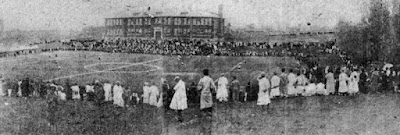
Below is an excerpt from chapter 17 (original Korean at https://dprktoday.com/novel/6443). The chapter begins with the boys watching a soccer match in Pyongyang between rival schools Kwangsŏng and Sungdŏk. KIS uses the match to teach his friends about the value of collectivity over individuality; he observes that "Clearly, in terms of individual skills, Sungdŏk was better than Kwangsŏng. However, the Sungdŏk players had grown arrogant after scoring one goal in the first half, and they lost their lead to Kwangsŏng players while busy showing off their individual skills."

A soccer match in colonial Pyongyang, July 1925
(src: 마니아타임즈)

After the match the boys walk toward the river, passing by the rich American part of town (양촌). Passing a big mansion on the hillside, they see some American kids about their age playing with their pet dog in the yard, tossing cookies into the air for it to catch. 

“Do those children feel right, giving their dog sweets that even people can’t eat?” the Great Leader spoke as if to himself.

“Do you think it’s just sweets? Look how fat that dog is. I heard they feed him two chunks of meat every day,” [his friend] In-sam replied.

“What’s with giving dogs such good food? Meat that nobody else can eat,” said Yoon Byŏng-yi.

The Great Leader thought on it deeply. Here the Korean people, who are the true owners of this country, are naked and starving, and yet these barbarians from an island country are playing the role of masters of the country, and Americans from across the sea are making themselves at home in the midst of the most beautiful part of Pyongyang, the most beautiful city in Korea, living in luxury as if they own the place. What the hell happened to this world? How happy would we be if we chased away all those people and lived in harmony, just us Koreans?

American mission residences on Namsan Hill, circa 1921.
(Src: americanpyongyang.com

This prompts KIS to remember what his father told him about Americans once, back in Manchuria. It was right after they had a visitor from Pyongyang. After the man departed, Kim's father said to him: 

“At one time, that guy wanted to be a pastor and got really into religion; now at last he’s found the true righteous path. He once thought Americans were good people and had great delusions about them, but now those delusions are shattered. Religion is like opium (종교라는것은 아편과 같아서), once you go crazy for it, you can't come to your senses and even if you hear that fermented bean paste is made from beans, you question it (팥으로 메주를 쑨다고 해도 곧이듣게 된단 말이다). That's why the Americans sent missionaries in first to spread religion and thus swallow up our fat country. They use religion as bait and capture the spirits of the Korean people - then they can lead them like an ox by the nose-ring (코투레에 꿰가지구) to do whatever they want.”

Wanting to know more, the young KIS asks, 

KIS' father Kim Hyŏng Jik
(Src: 한국민족문화대백과사전)

“Father, are the Americans as bad as the Japanese?”

“They’re exactly the same kind of bandits. From the first day America came into existence, they’ve feasted on the blood and bones of others until their bellies grew thick. Every clod of American soil is infused with the red blood of innocent Indians, and on top of that bloody soil they make merry.”

“Father, what’s an Indian?”

“Before North America was discovered by Christopher Columbus in 1492, indigenous people already lived there. Because their faces appear reddish, they are also called Red People (홍인종), but they are known as Indians. From the first day the Yankees (양키놈들) set foot on American soil, they began a merciless slaughter in order to steal their land and treasure. The Yankee jackals even initiated human-hunts to wipe out the Indians. They committed the gross atrocity of taking their scalps (머리가죽을 벗겨내는 만행), awarding 100 pounds sterling for a man’s scalp, half  as much for a woman’s or child’s scalp."

“Wow, they’re really vicious.”

“They encouraged the Indian hunts, deliberately planning their complete annihilation. One bastard named Harrison killed an Indian chieftain who had bravely resisted the Yankees, then took the scalp and made it into a belt for sharpening razors (면도칼을 가는 혁띠), giving them out as souvenirs." 

“Do they just let someone like that live in America?”

“Not only did they let him live, he eventually became president. Basically the US was a nest of jackals where they judged a person’s ‘contribution’ to the nation by how many Indians he killed and how terrible his atrocities were.”

“There are lots of black people in America too, right?”

“Indeed there are.”

“If the Indians were the natives, then how did all the blacks come to be there?”

“There are about 100 million people now living in America, but the majority are Yankees who came from Europe, and about 10 million are black. These blacks are descended from Africans who were captured (붙들려온) by European merchants in the 17th and 18th centuries. These European merchants dragged them to America and sold them for money. The Yankee bastards who had a foothold in North America took them and whipped them like oxen or horses, cultivating the wilderness (황무지를 개척했지). The vast farms in the southern United States today are built on the blood and sweat of black slaves.”

“In America, black people are treated worse than dogs, right?”

“That’s correct. Blacks have no rights whatsoever there. You know they aren’t even allowed to enter parks or restaurants where white people go? They’re just made to work like oxen or horses.” Father took a deep breath and went on. “In the short 150 years of its history, the path America has tread has been nothing but murdering people and extracting their blood, bones, and fat, and stealing other people’s territory.

“It should not be forgotten that these American jackals with their taste for robbery have long been eyeing the lands of the East, of Asia, and have set their sights on our country. It is important to understand clearly that Americans are not only as cruel as the Japanese, but also as insidious and sneaky (음흉하고도 교활하다) as the Japanese.

"The Japanese may be thieves, but they are exposed to the world as thieves; the Americans pretend to be good people while committing their thievery. In other words, the way of robbing is just different, but in essence, they are exactly the same.”

The Pyongyang Christian  mission’s school for boys, photo circa 1910.  (Src: americanpyongyang.com)


“Are the Americans in Pyongyang like that?”

“Just the same. In Pyongyang there are American-built churches, schools, hospitals and whatnot. But all those pastors and missionaries are really military spies. They pretend to do charity work to pull the wool over Koreans’ eyes, all the while they’re really scouting out opportunities to devour our country. They walk around drawing maps and taking pictures, just waiting for the right time to invade our country. But some foolish people still see Americans as “good” (선량한) - isn't it pathetic? This is especially true of religious people. They don't know that Americans are jackals disguised in sheep skin.”

Father paused a moment before continuing, “In a way, it’s like two thieves have entered our little land of Korea. But so many of those engaged in the so-called independence movement cannot see it, and keep up their high hopes for the US thinking that they will help Korean independence – it’s so frustrating. But we can’t lose hope. That guest who just visited us, he also believed in Americans like heaven at first. However, after meeting and talking with me several times, his eyes have been opened."

This conversation gives a good introduction to the North Korean orthodox conceptions of religion, race and territory. In particular, there is no apparent argument here for multicultural society even as something that should be aspired to; rather there is a strong ideal of individual races as legitimate "owners" of their respective ancestral territories, living separate but peaceful lives until they are taken over or captured. 

Kim Hyong Jik's description of the black experience in the US was probably fairly accurate to the time when this conversation supposedly took place, circa 1924. The bounty hunting of Native Americans, sadly, is also true, although the timeline is a bit anachronistic. The part about "Harrison" probably refers to William Henry Harrison and Tecumseh – there are some legends that Harrison killed Tecumseh personally and took strips of his skin as souvenirs. That conflict occurred long after the colonial bounty hunting era, however, and one wonders what inspired the author to select that particular example out of all the Indian-killing US Presidents (I mean, Andrew Jackson is right there on the $20).

Harder to believe is Kim Hyong Jik's description of American missionaries as jackals and military spies, since he himself had worked as a protestant missionary and his wife Kang Ban Suk came from a devout protestant family. 

This probably does not seem very surprising to most readers - North Korea's reputation for erasing its Christian heritage is well-documented and often portrayed as just another typical case of communist-regime-hates-religion. But the story gets a bit more complicated in tales of colonial Korea, where Christian institutions played such a prominent role in aiding the Korean independence movement and resisting the Japanese. In South Korea today the association between Christianity, America, and colonial resistance is not too confusing, since the US was Japan's eventual enemy in WWII. But for North Korea, Japan and the US are both portrayed equally as eternal bad guys. Hence the above passage works hard to establish that even though American missionaries may have seemed to oppose Japan, they were and are no friends of Korea.