Showing posts with label technology. Show all posts

Tuesday, October 17, 2023

The Red Flash (2002): North Korean scientists discover a thing in Antarctica

 "The Red Flash" (붉은 섬광) is a science fiction story by Ri Kŭm Chŏl that appeared in Chosŏn Munhak in September 2002.

I was originally drawn to this story after skimming over it quickly and catching phrases like "Antarctica," "Graham Land Research Station," "unexplained phenomenon," "Ph.D. in molecular chemistry," plus a lot of talk about penguins and molecules. Having just recently rewatched John Carpenter's The Thing, I briefly fantasized about discovering a North Korean rendition of the cult classic, which sent me down a spiral of hopeful speculation. What sort of unique test would North Koreans come up with for detecting who is the Thing? How would the Thing manage to infiltrate a group of North Koreans, who are famously always practicing mutual surveillance? How might the Thing be transformed for the better after absorbing Juche thought from their brains?

But sadly, it was not to be. In fact the bulk of the story takes place not in Antarctica but in a South Pacific port and aboard a docked cruise ship. It is less sci-fi horror and more procedural detective story with sci-fi elements. 

The two main characters are a pair of investigators named Helen and Jasmine who are clearly romantically entangled, which got me excited again for a few paragraphs as I wondered if I had stumbled upon the first openly lesbian protagonists in North Korean fiction – until I realized that, against all odds, the character named Jasmine [쟈스민] is an extremely heteronormative man. More on their relationship in the notes below. But first:

The Plot

Late one night on the small South Pacific island nation of Asir, a sudden explosion rips through the commercial port, setting off a fire that spreads rapidly. As the flames approach a huge stockpile of fuel oil barrels with “USA” stenciled on their sides, witnesses observe a US military helicopter appear to drop several black spherical objects. But rather than being extinguished, the flames burn even higher. Just as the fire is about to hit the fuel barrels, a strange reddish light flashes in the sky over the dock. Then, mysteriously, the raging inferno dies down to nothing in seconds.

The next morning, two investigators are on the scene: "Female Prosecutor Helen" of the Asir Prosecutor's Office and "Inspector Jasmine" from the Metropolitan Police Department. 

Their attention quickly turns to the Penguin, a fancy passenger cruise ship docked in the port on its return from an Antarctic excursion. They already have one clue – the quick-acting port authorities have dragged the port area and recovered a metal tube from the seabed near the Penguin [they did this overnight, I guess?]. They speculate that it may be the remnant of a projectile weapon. 

A cruise ship in Antarctica
(src: AdventureSmith Explorations) 
Checking the Penguin's manifest, the investigators become suspicious of three passengers the ship picked up in Antarctica. These are no bourgeois luxury cruise patrons, but North Korean scientists catching a ride home after a stint at Graham Land Research Base in Antarctica. They are all experts in molecular chemistry, and their research involves finding ways to repair the hole in the ozone layer. 

Reviewing surveillance camera footage of the panicked passengers milling on the deck during the incident, they spot one of the North Koreans acting suspiciously calm as he speaks into a mobile phone just moments before the red flash.  Helen goes aboard and meets with the captain, who produces the man, Dr. Kim Hak Sŏng, for her to interview.

Dr. Kim is an extremely handsome 30-something man with Ph.D. in molecular chemical engineering who readily answers Helen's questions. He suggests to her that those black spheres from the US military helicopter, which everyone else thinks helped to extinguish the fire, were actually intended to push it toward the oil barrels. 

This actually puts even more suspicion on him, because the science-loving Helen knows that "if the fire was guided, it would mean Substance M was present to increase oxygen molecules in the air," and his team's research project is known to involve "Substance M." But, Dr. Kim points out, "Substance M is also produced at US research bases."  He also points out that the US military helicopter could not have arrived on-scene so quickly if it had not somehow anticipated the fire.

He urges her to think carefully before jumping to conclusions, and cryptically claims that the US military stands most to gain from the port fire, even though its own oil barrels were endangered. His reasoning:  "Because the US military placed its strategic materials in a civilian port, if they were to explode, your authorities would be held responsible. Then, not only would you have to pay enormous damage compensation, but you would no longer be able to make such strong demands for the US forces to withdraw... So, the US military will continue to sit on this island of Asir like it owns the place, while receiving full payment for value of the exploded fuel."

From the Penguin's captain, Helen learns that somebody had reported "thieves breaking into the luggage hold" during the conflagration. She gathers all the passengers who have large trunks in the hold, weighs each trunk, and compares the results against the weights recorded at boarding. She finds only one disparity - the North Koreans'  trunk is 4.8 kg lighter than when it came aboard at Graham Land.

Graham Land Research Station, Antarctica
Src: istockphoto

Meanwhile, Jasmine has processed the video footage of Dr. Kim's phone call using a lip-reading algorithm and managed to isolate a few phrases: "… Port fire... oil container explosion... using the research product… flames…" All the other detectives think this is pretty incriminating, but Helen points out that he could also be saying, "extinguish the flames by using the research product." The other investigators laughingly suggest that this "young female prosecutor" must have fallen in love with the Korean scientist, who they have all noticed is extremely handsome.

They obtain a few more clues from the surveillance video: Just after the red flash, they can hear a brief sputtering from the ship's engine (which had been hastily started in an attempt to back away from the flames); and at the same time, some of the passengers standing on the deck appear to briefly gasp for breath. Meanwhile, Jasmine has confirmed that the black spheres from the helicopter did in fact contain Substance M.

It's enough to raise suspicions, but for proof they will need access to the US military port. Here Jasmine heroically steps up, calling in a favor from a US military counterintelligence officer with a gambling addiction who owes him $8,000 - the exact price of a base entry pass. This substantially raises his profile in Helen's eyes.

Just as the Penguin is readying to depart, Helen meets Dr. Kim on deck and informs him that they've solved the case. To his surprise, she shows him her classified report. They have found irrefutable proof that the US military was responsible for the port fire: "In the wake of growing anti-American sentiment on a global scale and increasingly calls for American troops to withdraw from Asir, the US military carried out a planned conspiracy. ... The plot was to rationalize the US military's presence in Asir by bringing oil containers into Asir port and exploding them, passing the blame to the local authorities."

Further, her clever sleuthing has concluded that the red flash was caused by the North Koreans deploying their research product to extinguish the fire. Their research involved developing a projectile-delivered flash that [several paragraphs of molecular chemistry talk here] essentially reshapes the oxygen molecules so that they are less flammable. The crucial clues were the 4.8 kg missing from their trunk (the weight of the device), as well as the ship's engine sputtering and the people on deck briefly gasping for air, which are side effects of the phenomenon.

She only has one question: why did they try to hide their altruistic deed, which saved untold lives? Dr. Kim answers humbly: “I did not want to make the research public. You see, it hasn't been shown in my home country yet. However, after getting my emergency report about the fire in Asir Port, our country unhesitatingly instructed us to deploy it. Their concern was for the lives and property of Asir’s people.”

Helen is awed by his patriotism and sense of mission. Before his eyes, she sets fire to her notebook, destroying the record of her findings. “Please forgive me," she says. "When your research product is reproduced and released to the world, I will write this report again. Until then, know that the Asir people will never forget your benevolence.”

Asir

The main port of Fiji in the South Pacific
The fictional setting of Asir [아씨르] is described as a small island nation in the South Pacific on which the US military maintains an unwelcome presence. This could be intended as a stand-in for one of several real-life US security dependencies such as Palau, the Marshall Islands, the FSM, etc. It is not, however, an incorporated US territory like Guam or American Samoa.

This makes for some confusion about  Helen's and Jasmine's identities and loyalties. As civilian port officials seemingly independent of (and at odds with) the US military, they are presumably locals. And yet their names, and Helen's long blonde hair, do not fit with any Pacific islanders I know of. Jasmine used to be a man's name in France, so I guess it's possible they are French descendants somewhere in French Polynesia; but then I don't see how the US military could have a port there.

Helen and Jasmine

Helen's femininity is firmly established early and reemphasized often. She is referred to throughout as "처녀", which can mean either "virgin" or "young, unmarried woman" (as in most East Asian languages, these two things are linguistically indistinguishable in Korean). When her job title is mentioned, she is always "young woman prosecutor" (처녀검사) and never just "prosecutor." She is beautiful and passionate, but strives to maintain appropriate professional distance around both male colleagues and male suspects, however handsome they may be.

Jasmine, on the other hand, is identified as an "inspector" [경부] with the Asir Metropolitan Police. Since Korean pronouns are not necessarily gendered, I held on for some time to the hope that Jasmine might be female, even after he was described several times as "manly" [사나이다운], but eventually I accepted that he must be a man. He flagrantly flirts with Helen, despite her pleas to keep things professional. Her rebukes just make him all the more determined to "shake this beauty's heart with his wisdom and ability as a police officer, as well as his manly temperament and perseverance" [사나이다운 기질과 인내력]. He sees the port fire investigation as his chance to impress her.

When Jasmine suggests that they work together on the investigation, Helen readily agrees but says that they should split up to approach the case from different angles: "When it comes to hunting wild animals, it’s more effective to stab them in two places at once rather than twice in the same place.” She also cites "Eastern scripture" [동방의 성구] which teaches that one must “Look at the beginning and the end at the same time."

Jasmine seizes upon this opportunity for some cringeworthy dialogue: 

   “Helen, if our two lines of investigation intersect at one point, do you suppose that intersection will become our romance (love)?” [그것이 우리들의 로맨스 (사랑) 로 되지 않을가요?]
   “Please don’t look at me that way, it isn't proper.” 
   A coy smile twitched across Jasmine’s lips.
   “I have a feeling that intersection point will be the intersection of our two fates, which have run parallel until now. How about it?"
   "Well. Will our investigations intersect? But I also look forward to that.” 
   In an instant, Jasmine's broad, flat face brightened like a floodlight.

After he heroically steps in to help solve the case at significant financial cost to himself, Helen "looked at Jasmine with fresh eyes" and seems more amenable to his romantic hopes, although we do not see this come to fruition. The story closes with Jasmine comforting a misty-eyed Helen on the dock, after she has finished waving farewell to handsome Dr. Kim as he and his ship recede into the horizon. It's clear who she would rather be with, if she had her 'druthers.

Shipping Delays

Our heroes are under tremendous pressure to solve the case quickly; in particular, they are told they must not detain the Penguin past its scheduled 2pm departure.

The reason is financial; the longer they detain the ship, the more expenses will be incurred by shipping delays  - expenses that must be borne by the port of Asir. Capitalism is indeed a ruthless taskmaster.

For a vacation cruise ship returning from an unpopulated continent, the Penguin carries a surprising amount of time-sensitive commercial cargo and high-pressure corporate shark types. As Helen is interviewing the captain on the deck, several passengers come up and remind the captain how much money a delay would cost them. One says he has a contract with something called "Voltaire" [maybe a magazine?] to do an interview about Antarctic tourism, and asks if the captain will take responsibility [i.e., compensate him] if the contract gets cancelled. Another says, “My shareholders [주권들] are racing against time. We can’t delay here.” The captain gloomily turns to Helen: “You see, miss, to me, time is money. We will lose $800,000 every day our return is delayed.”

These appeals are, of course, intended to illustrate the heartlessness of global capitalism in the face of human tragedy. Standing up to this pressure, Helen asks the captain to consider the cost in lives and property lost in the fire. Even though she is a non-Korean, Helen here takes on the voice of the righteous socialist warrior that is normally exclusive to North Korean characters.

Tech Overkill

The author takes advantage of the story's "sci-fi" categorization to insert some needlessly high-tech gadgetry. Although nothing in the essential plot requires it to be set very far into the future, it seems that it must be so, because the detectives use some tools that make no sense otherwise. 

Remember tricorders?
For instance, Jasmine brings up the port fire surveillance video on a "small portable computer" [자그마한 휴대용콤퓨터], which at the time of publication in 2002 would have seemed quite futuristic. When Helen weighs the luggage in the hold, she does so using a "portable mass sensor" [휴대용질량측정기] which she simply places on top of each trunk. If I recall my high school physics correctly, the difference between mass and weight only becomes relevant as distance from the planet's center varies – and since the luggage is at sea level the entire time, it is unclear why she would need to measure the trunks' mass and not just weigh them on a plain old scale. If such a gadget were readily available, it would save time, I guess.

Bonus Link

Congratulations on reaching the bottom of this post. Since I lured you in by false pretenses (like the American jackal that I am), please enjoy this clip from a classic cinematic masterpiece as compensation:

https://www.youtube.com/watch?v=ebMgBIy6mTo


Saturday, June 18, 2022

Kwangmyongsong-30 (2016): North Koreans Fight Americans in Outer Space

"The Signal that Flew from Kwangmyongsong-30" (《광명성-30》호에서 날아온 전파) is a science fiction story by Shin Sŭng Gu (신승구) that appeared in Chosŏn Munhak in August 2016.

I stumbled across this story as I was searching for references to radiation [방사능,방사선,방사성] in North Korean literature for a forthcoming paper; more on that soon maybe.


This story has everything you typically ask for in a space drama: explosions, flying debris, solar flares, high-stakes meticulous telemetry calculations, a race against the clock, unscrupulous asteroid miners, dizzying space walks, an improbably young and beautiful astrophysicist, a brilliant mission control team scrambling ad-hoc solutions to life-or-death problems... and, of course, antimatter.

But I get ahead of myself. First, let us examine:

The Plot

Satellite Research Institute Director Jang Hyŏk is busily managing the final stages of his institute's biggest project to date - a massive solar array in outer Earth orbit that will collect energy from the sun's rays and beam it back to the surface via laser. This achievement is made possible by the satellite Kwangmyŏngsŏng-30, the culmination of decades of satellites launched by the North Korean space program.

They switch on the big screen, where an astronaut is floating in space, putting the final touches on the array. It’s Director Jang Hyŏk’s son, Yŏng Jun, freshly graduated from Astrophysics University and up on his first space mission.

As his son floats dizzyingly above the earth, he reports on the final repairs, and the two speculate that the enemy will "go apoplectic" [까무라치고말것입니다] when they hear of the array's completion tomorrow. Grinning, they terminate the connection.

Director JH is counting on Yŏng Jun for more than just the space array; he hopes his unmarried son will soon find a nice young daughter-in-law to come live with them [JH's anticipation of this is full-on creepy].

Just as he is thinking these thoughts, a gorgeous vision of womanhood enters his office. She seems familiar, and he immediately guesses she must be a reporter, or perhaps an actress; she shakes her head.

“I’ve come for a job.”
“A job? This is a space satellite research center.”
“I’m aware.”
“That is, one must have manly qualities to work here. Bold, gutsy…”
“That’s why I’ve come.”
She dug into her bag and presented her assignment papers; his eyes widened. “Graduated with top marks from the doctoral program of Astrophysics University? That’s fantastic, for one so young!”

After she leaves, an unnamed senior technician [기사장] speaks up: He was Comrade Ran Hee's graduate advisor, and knew her to be a passionate researcher, always in the library. Twice she’d won gold medals in international exibitions. JH sees how her expertise could complement their work; but still he worries that this "delicate greenhouse flower of a girl" [온실의 꽃과 같이 연약한 처녀] may not be tough enough for this stressful job. 

Director JH continues coordinating power grid issues late into the night. Just after 4 am, they receive a disturbing report from their space observation lab: A chunk of unknown material has flown off Asteroid 233, a 500-m diameter object between Mars and Jupiter. Measuring 50 m diameter, the chunk appears to be headed for Earth. 

North Korean satellite launch control 
center (Src: BBC)
JH is initially unconcerned; at that size it should burn up in the atmosphere – unless it is made up of solid nickel or iron, but those are rare. But the spacelab manager is suspicious; the trajectory is odd, as if the asteroid was aimed straight at their solar array. JH bangs away at his computer a bit and brings up the space view on the big screen. There: that bright red speck is the chunk from Asteroid 233. 

The sub-asteroid is unmistakably headed straight at Kwangmyongsong-30. Spacelab Manager recalls that yesterday’s imagery from the high-powered telescope on the space station had shown what looked like an explosion on A233, where the enemy had planted its flag. Our people on the space station had inquired and been told that they were extracting minerals. Now it seems likely that they had blown off a chunk to fire at Kwangmyongsong-30.

"What sneaky bastards. To calculate precisely all the variables – the asteroid’s position, the earth’s revolution and rotation, the speed of the projectile – they must have used a supercomputer [고성능초대형콤퓨터] to aim so precisely at Kwangmyongsong-30 and get the timing just right. If we do nothing, in hours it will blast our solar power station to smithereens."

Spacelab Manager spots another cause for concern; if it is composed of nickel and doesn’t burn up in the atmosphere, the asteroid is on course to strike North Korean territory. The estimated impact would be apocalyptic for the country. “The bastards are trying to kill two birds with one stone [일거량득],” Director JH observes.

Spacelab Manager suddenly brightens, remembering that they positioned defensive attack rockets around the array for just such a scenario. But JH says no; even if they blow it up, the fragments will continue on the same path. Even a small fragment could shatter the array they’ve worked so hard to build.

“But sir, what about Comrade Yŏng Jun?” Spacelab Manager seems about to cry.

People gather around, filled with determination to save the director’s son; but Jang stubbornly ignores their suggestions. Via satellite link, Yong Jun too rejects the team's offers to send a shuttle  [우주왕복선] to save him: “Thanks for your concern. But my fate lies with Kwangmyongsong-30. Do not fear.” 

Some time later, the unnamed tech who was Ran Hee's graduate advisor shows up, looking sweaty and out of breath. JH scolds him for being truant in their darkest hour, but Unnamed Tech just grins and says he was finishing up a project at the university with Ran Hee. He says they've found a way to save Comrade YJ and the space station.

At an emergency strategy meeting, they announce their audacious plan to "turn this asteroid into a tool to strike back against the enemy.”

Ran Hee elaborates: “I propose we use solar sails [태양돛] to change the meteorite’s path and avoid a collision. [...] A solar sail is a thin, filmy sail about 50 m wide and 0.075 mm thick; it can guide an object in the desired direction by using the power of sunlight. If such a sail could be attached to the asteroid, we could then use the angle of the sail to change its path.”

Src: nasa.gov
The room erupts in animated chatter; Unnamed Tech raps for attention. “It’s a simple problem. The force from sunlight is subtle, but in the weightlessness of space there is no resistance. The sail could move as fast as 200 km/s, and so catch up with this asteroid that is doing about 30 km/s.”

JH looks at the pair wonderingly. Is this what they’d been up to at the university this morning? Have they already built some sort of sail assembly? Suddenly he remembers where he’s seen her before: she was his son’s teammate at the international inventor’s competition, where they won gold! The photo is in his album at home. And his son had spoken fondly of "a doctoral student at the university." Could they be more than just colleagues?

   The First Team Leader spoke up: “Researcher Ran Hee’s idea is a good one. But… how do we get the sail to the asteroid’s position? Solid rockets [고체로케트] won’t work…”
   “That’s why we’re going to use the antimatter thruster [반물질추진기],” Ran Hee quietly replied. 
   The room erupted in agitated murmuring; as rocket scientists, they all knew that antimatter reacted violently when put in contact with regular matter, producing energy 1000 times greater than nuclear fusion. But where to find it? It existed when the universe was formed 13.7 billion years ago, but now there was no trace of it anywhere. 
The antimatter canister
from Angels & Demons
   You could hear a pindrop, as everyone hung on her next words: "That's right. The vehicle to transport the solar sail should be an antimatter craft, not a solid fuel rocket. It is a known fact that antimatter forms in clouds during thunderstorms. The problem is that the substance disappears almost immediately. But working with Comrade Yong Jun, I’ve developed a device to recover that antimatter. In fact, we have built an antimatter powered craft. I will fly this craft into space.”
   More disbelieving murmurs. “That delicate girl, flying up into space?” “But there are no female astronauts…” “But you’re supposed to have three months’ training before you can go up.”

    Jang Hyok’s voice cut through the noise. “No way. Absolutely not!”

   “Why – because I’m a woman? But if this is going to work, I have to be at Yong Jun’s side.”
   “Why is that?”


Unable to answer, she blushes and looks down. Coming to her rescue, Unnamed Tech explains that YJ and RH have always worked best together; "like a pair of meshed gears... they need to engage together to work." Reluctantly, Director JH approves the plan.

At sunrise, the antimatter craft launches with RH aboard. Moving at tremendous speed, it breaches the atmosphere in the blink of an eye and then begins a complicated rotation maneuver meant to unfurl the sail. Watching from mission control, JH tenses, knowing that solar sail deployment requires a meticulous calculation of the subtle correlation between the sail area and the vehicle’s rotational speed. 

After several rotations, it becomes clear that the sail is not unfurling properly. RH struggles at the controls, growing more frantic. Then a masculine voice cuts through her panic: “Ran Hee, listen to me. You have to adjust your rotation period to 3 seconds. Remember that this sail has a much larger area!” It's YJ, transmitting from Kwangmyongsong-30.
 
Everyone holds their breath. 3 seconds is a terribly fast rotation speed; can this mere slip of a girl withstand the centrifugal forces?

She does. The ship spins like a top, the sail unfurls magnificently, and she shoots off toward K30. There, YJ comes aboard and joins her at the controls, and they take off again, headed straight for the sub-asteroid. Closer and closer it comes, but they don't slow down. Finally, at the last possible moment, the craft executes a neat 180 degree turn and bites into the asteroid’s rear.

Clad in spacesuits, YJ and RH step out onto the asteroid. Despite the ferocious speed at which the rock is traveling, they can stand on it without any difficulty, because there is no atmosphere in the vacuum of space. 

Now they just need to install the solar sail. But instead, the pair seem preoccupied with setting up some instruments on the rocky surface. What the hell are they playing around with? 

   Jang Hyŏk screamed in frustration. “Get that sail set up. The asteroid’s nearing the power station.” 
   “Shouldn’t we check its composition though?”
   What? Check the asteroid's composition? When we're almost out of time... looking for evidence of the enemy’s scheme... The balls on these kids! [아, 얼마나 담이 큰 젊은이들인가?]
  Soon after, Yong Jun stood up. “This asteroid is a chunk of iron and nickel broken off from A233. It appears that the enemy laid explosive charges to blast it off. They wanted to obliterate Kwangmyongsong-30 and our space power station. And then, our country…”
   Jang Hyok shook with fury. “You old cowards, are you scared of our strong socialist nation? Surely not.”
   On the wall, the clock ticked mercilessly on toward disaster. Only 5 minutes from impact! And still the seconds ticked by. Finally the pair stood up from their labor.
   “Now to adjust the sail’s angle. What should it be?”
   “Do you have to ask? You know what our people want.”
   “Understood. We’ll send this rock back to A233, to crush it into oblivion. How’s that?”
   Jang Hyok and the technician shouted in unison. “That’s it! Even against this enemy who blocks us at every move, we’ve got to be smart about how we settle the score. Got it?”
   “Roger that!”

With the angle set, YJ and RH return to their ship and head back to K30. The asteroid slowly turns, narrowly avoiding hitting the solar panel, and heads back toward A233. In short order, that hive of enemy scheming will be shattered.

Soon after, YJ and RH come on the speaker together to report that the space power station is now fully operational. Their signal comes from Kwangmyongsong-30! 

Ah, how many trials and sacrifices led to this moment? How hard was the road? Hello world, can you hear it? The glorious shout of the victors who stand at the very pinnacle as a scientific and technological great power [과학기술강국]!

JH gives the triumphant order to switch on the power station. Instantly, the giant power transmission towers buzz and the grid comes alive, sending power out to every corner of the country.

Cosmos

There's a fair amount of geeky space science in this story; Neil DeGrasse Tyson groupies should take note.  Kwangmyongsong-30's mission is described in detail:
30% of solar energy gets blocked by the atmosphere and clouds, never reaching the earth’s surface… That is the advantage of going to space. Now many countries are trying to develop space power stations, but none has achieved the transmission system [송전체계] our country has. The transmission system that we developed is not a microwave-converted electromagnetic wave, but a laser light transmission cable [레이자빛수송관], and there is no need for noisy construction on the ground for a reception site.
In this way, the story deftly takes the country's expensive Kwangmyongsong missile program and makes it seem as if at some point in the future this will lead to a bottomless source of renewable energy that will benefit the whole country. The orbiting solar power plant described in the story resembles one that China has recently announced plans to build.

The story also alludes to North Korean astronauts working alongside non-Koreans at a "Space Station" [우주정류소] housing the high-powered telescope [대형우주망원경] that initially detects the explosion on A233; it is unclear if this is referring to the International Space Station or some fictional future endeavor.
 
Elsewhere, the topic of solar flares and radiation comes up:

Setting up a huge solar array in space was tremendously difficult. The greatest danger was the flares; these had become highly active recently on the solar surface, and they caused unpredictable magnetic phenomena. No matter how well protected, the astronauts were always absorbing radiation. Still, someone had to go; but who to send? After much deliberation, [Director Jang Hyuk] decided to send his own son, who had just graduated from Astrophysics University. 

Later, when First Team Leader discovers that the asteroid is on course to hit North Korea, he explains the  magnitude of the threat by using a classic astronomy geek reference:

“Consider past history. In the early 20th century an asteroid 50 m in diameter struck in an eastern European forest. The fires and windstorms from the impact destroyed hundreds of sq km of forest, and all plant and animal life within 60 km was wiped out. The strong blast from impact was felt 700 km away, and airwaves were even detected by atmospheric pressure gauges thousands of km away in England. The smoke and fumes flew high in the sky, spreading dust pollution across all of Europe making the sky dark as night. The impact force from that 50 m object was equivalent to 10 megatons of TNT [뜨로찔].”

Despite the reference to "Eastern Europe," this passage is clearly referring to the Tunguska event which struck central Siberia in 1908. 

The science behind asteroid composition, solar sails, and antimatter is all described with a level of detail that could have been lifted from Scientific American or Cosmos. The gravity issues of landing and standing on a 50m asteroid are glossed over, but I prefer to think of that as an homage to the tradition of 20th century space operas. If this author is not a Trekkie, I'll eat my hat.

In Space, Everyone Is Equal

Most of the time, reading North Korean fictional depictions of technological advances can be pretty sad, especially the CNC stuff. It's clear that those stories come from the fantasies of people who are accustomed to struggling with ancient Soviet hand-me-down tech and pirated software patches that never work as they should. Everything is a little too shiny and perfect.

But here, the narrative has moved so far into the future that it has escaped the stratosphere of prosaic technological expectations. Let's face it, most space sci-fi doesn't stand up under any real scientific scrutiny. We're always thinking That would never work as planned and That would've definitely broken down by now and Gravity doesn't work that way. Most of us learn to turn off our brains so we can enjoy the story. 

On balance, this story does a pretty good job of working within the realm of the scientifically plausible. Obviously the antimatter part is pretty pseudoscience-y; but if we're going to bust them for that, we'd have to throw out half of Star Trek. The descriptions of the solar power station and the physics of unfurling the solar sail struck me as fairly believable and cleverly woven into the story.

The political rhetoric is subtle, almost invisible. The idea of the sun's power coming to their aid would definitely appeal to the lyrical sensibilities of well-read North Koreans, tying into the imagery of Kim Il Sung as "the eternal Sun" watching over his people from the cosmos. The author seems to hint at this at one point but never quite comes out and says it directly. I blinked for a moment when I read that the astronauts needed to "check the asteroid's composition" [성분을 확인해보아야 할] since "songbun checks" are so often encountered in a very different context in research about North Korea.

"The Enemy"

The title of this post implies that America is the bad guy in this story. But reading back over it, I belatedly realized that the author has done something very clever - not once does he actually mention America by name. The characters only refer to "the enemies" [적들] or "the bastards" [놈들]. The context [and the entire history of NK literature] leads the reader to assume that this refers to America, but the author has taken pains not to say so explicitly. And the ending, with the astronauts striking back at the asteroid mining operation on A233 rather than an Earthbound location, seems designed to leave "the enemy"'s homeland ambiguous. 

My reaction when I realized this

We can only speculate on why this might be. Other NK fiction has certainly never shied away from naming America as the enemy, and in the context of space conflict as we currently imagine it, who else could it be? 

But this story takes place in the fairly distant future; considering that it took NK about 20 years to get to Kwangmyongsong-4, we can project that  Kwangmyongsong-30 might roll onto the launchpad sometime around 2150. At that point, if we stretch our imaginations enough, "the enemy" could be almost anyone - China, Russia, Japan, South Korea, Botswana... even aliens! I've decided it's almost definitely aliens.

I truly enjoyed reading this story. I even slow-clapped when the antimatter thing came up. And when I realized that they were going to get control of the asteroid, I was on the edge of my seat waiting to see where they would send it. Four stars.

Sunday, May 1, 2022

"Dignity" (2017): WikiLeaks Joins the Socialist Revolution

"Dignity" (존엄) is a science fiction story by Ŏm Ho Sam that appeared in the September 2017 issue of Chongnyon Munhak

Ŏm has rapidly become my new favorite North Korean writer, stealing the place in my heart previously held by the late Chŏng Ki Jong. Ŏm also wrote "An Ordinary Day," summarized previously, as well as a 2004 story titled 부쉬소동 which I would dearly love to get my hands on (it apparently involves Middle Eastern mafia kidnapping President George W. Bush and installing a fake Bush in his place, using extensive plastic surgery). 

I cannot find any biographical details about this author, but judging from the subject matter and publication venue, I would guess that s/he is a computer science grad student or junior faculty affiliated with a major university. The story specifically mentions Pyongyang University of Science and Technology (PUST), open source software, and the LINUX operating system, and makes blatant allusions to WikiLeaks.

Like "An Ordinary Day," this story is categorized as "Science Fiction" (과학환상소설) and revolves around the Koryo System, apparently a proprietary creation of the author's. This is a transformative new socioeconomic order created by North Korean scientists in the near future, in which money is replaced by supercomputers that coordinate all production and distribution based on each individual's "intellectual labor and contribution to society." In this story, we get a closer look at the scientific minds behind this system's creation, as well as the shadowy globalist forces trying to destroy it in utero. Along the way we get intriguing glimpses of educated North Koreans' perceptions about roles and functioning of the global internet, hacking, the ICC, cyber security, big data analysis, virtual reality, and open source software development.

The Plot

The story opens onto a secret meeting of the 10 global titans of industry who form a shadowy global mega-conglomerate called "B.D" (yes, apparently North Koreans have picked up their southern brethren's bad habit of dropping the final periods from acronyms). A massive global financial crisis looms, but these 10 "kings" are more concerned about the recent development by North Korea of the Koryo System, which threatens to destroy the very foundation of the world they control by eliminating money altogether. After some acrimonious infighting among the Metals King, the Finance King, the Medical King, and the Oil King, eventually the IT King (Mark Zuckerburg?) speaks up and promises to come up with a solution before their next meeting.

A PUST classroom on October 2019.
Src: PUST Facebook page
Next we meet our main protagonist - Lewis, a young European coder who attended PUST for graduate school, fell in love with the Koryo System, and decided to stay in North Korea to help develop it at the Koryo Research Institute. One of his PUST lecturers is the Institute's director (소장) and offered him an internship (실습생). Despite being the only foreigner, he finds the state-of-the-art research facility to be a welcoming and stimulating work environment. 

One morning, he is reviewing a list of people and institutions that have downloaded the "detailed but user-friendly instruction manual" that he wrote for the Koryo system, when he spots a familiar name: Johanne Melbourne, his childhood friend! Not only that, but when he reaches out to Melbourne, he is amazed to discover that his old friend is actually "Angel" (천사), the ringleader of a notorious hacking group that exposes scandals and corruption around the world.

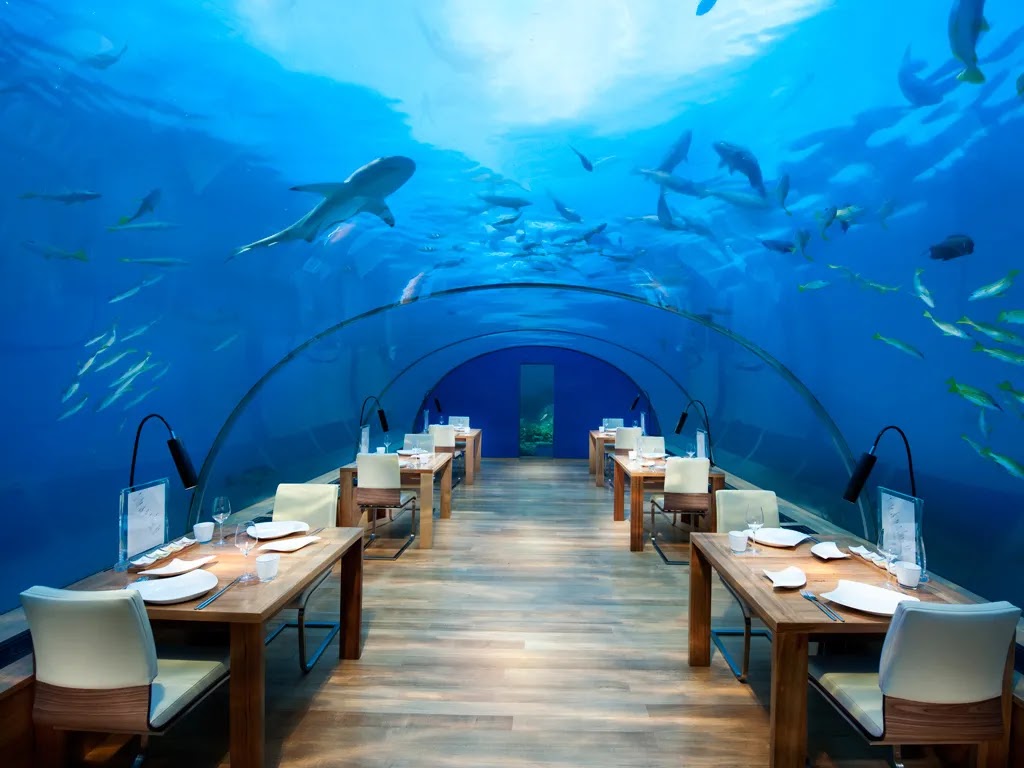
Via video chat, the two old friends catch each other up on their lives. Lewis gushes about his work on the Koryo System. Melbourne seems interested but nervous, and he asks if they can meet someplace private. Lewis proposes meeting that evening at "The Mermaid," an upscale underwater restaurant (수중식당) that has adopted the Koryo System. The reader is initially left wondering how such a meeting is possible, until several pages later it is revealed that The Mermaid has a cutting-edge virtual reality environment where patrons from all over the world can "meet" and dine together either virtually or in person. 

"Underwater restaurants" appear in at least two
Ŏm Ho Sam stories
Over dinner, Lewis explains the virtues of Koryo to a skeptical Melbourne, who shrewdly asks, "Is North Korea trying to use the Koryo System to take over global wealth?" Still, he keeps an open mind; he has always hated global capitalism, which is why he chose to become a hacker. Lewis tells him, "You may think that your hacking activities are righteous, but I would rather do something more proud and meaningful. Instead of just helping people as we do now, I think we should try to bring about a fundamental change in the lives and consciousness of all people... Why don't you put your brilliant brain to work on developing the Koryo system?"" Johanne says he'll think about it, and they promise to meet again next Sunday. But it was not to be...

Meanwhile, Koryo Institute Director Kim Ju Sŏng and Cyber Security Chief Myong Jun have been monitoring  Lewis' unconventional foreign contact. Myong Jun is concerned this may pose a security threat, but Director Kim proclaims his confidence that these foreign hackers are no match for Myong Jun's skill, adding:

"Isn't there a proverb that says you can't ferment beans if you're afraid of maggots [구데기 무서워 장 못 담글가=can’t succeed if afraid of failure ]? Don't jump to conclusions. Not long ago, Comrade Lewis came up with the idea of introducing a biological computer (생물콤퓨터) into the lab's security system. Very interesting stuff. It seems that if we confront a few challenges, our security system will develop more proactive security measures rather than passive ones.”

Their trust pays off when Lewis makes an innovative proposal to make the Koryo system code open-sourced; that way "not only will we expand usership, but also the program will be developed to a higher standard." Security Chief Myong Jun is worried that this may allow users with "impure intent" to "spread viruses or steal our secret materials"; but the youthful economic team director backs Lewis up: “After all, Windows dominated the computer world for so many years in the bygone IT era; but in the end wasn’t it quickly overtaken by Linux?” They decide to proceed with the proposal.

Meanwhile, the ten "kings" of B.D meet again, more desperate than ever to crush Koryo before it takes over the world. They've found out that the notorious hacker "Angel" is the nephew of a global charity fund manager, so they decide to blackmail them into assisting with their scheme. The IT King unveils his dastardly four-point plan:

1) To delay implementation of the Koryo system, secretly gain the cooperation of international hacker groups; have them hack into the database of the Koryo Research Institute and disrupt its operations.
2) Invest in Koryo to gain their trust, gain a majority stake and monopolize their name and profits. To this end, all B.D members must invest heavily.
3) If 1 and 2 fail, get the international hackers to bring down the whole system; if 2 succeeds, monopolize the system and ultimately transform it to serve our 'globalization' plans.
4) If 1, 2, & 3 all fail, spread a rumor through international charity foundations that the Koryo Research Institute and its supporters are causing a global catastrophe, and foment large-scale protests and condemnation.

Soon after, Koryo Director Kim gets a perplexing email from a certain “Globalization Corp,” congratulating them on the global success of the Koryo system and offering to donate some "cutting-edge technology." They kindly offer to send "some of our best experts" to assist and add that the system will have to be slowed down temporarily for installation and testing.

Director Kim is immediately suspicious; it seems “Globalization Corp” was launched just a few days ago, and yet it is offering state-of-the-art equipment on an enormous scale. Clearly, some dark game is afoot...

He promptly has his cyber security people to look into the organization; but all they can find out is that it is backed by some very big players. Then, Lewis recalls that Melbourne shared some files with him at their meeting, which he hasn't had time to read until now; the data reveals that Globalization Corp is a shell company [유령단체] "formed by the secret ultra-monopolist group B.D, to conceal their true identity." "Angel" had been able to hack into their recent meeting and learn their secret plan.

The deputy director suggests completely rejecting cooperation with Globalization Corp; but Lewis suggests that they refuse the equipment, but allow the specialist technicians to come anyway. Everyone is aghast at this plan except for Myong Jun, who sees the wisdom: 

   “I’m with Lewis, we can turn this to our advantage (화를 복으로 전환). If we can turn their technicians to our side, then those who tried to wield money to use them will eventually end up digging their graves with their own hands.”
   “Brilliant thinking, comrades. Right, let’s enlighten those engineers who’ve been used by that gang. It’d be unforgivably shameful to let the world’s intellectual creators of wealth continue to be driven by money. And we need to tighten up our database security anyway.”
   “Got it. I’ll double - no, triple - the encryption and firewall [암호와 방어벽]."

Lewis texts Melbourne as soon as the meeting ends. But the only response is an encrypted message:

  Lewis, sorry I can’t keep our appointment. I’m being threatened by the most vicious human scum. Beware of the "Globalization Corp" that is seeking to collaborate with you. They’re a shell company of the secretive B.D conglomerate. Don’t try to find me anymore. Just forgive me for being unable to live as you do. Your friend, Johanne Melbourne.

Later that same evening, the global news networks break some explosive news: the world-famous hacker “Angel” has been unmasked as Johanne Melbourne, and he is to be tried at the International Criminal Court!

Lewis is horrified for his friend. He immediately goes to see Director Kim and Security Chief Myong Jun, who have already heard the news. Myong Jun comforts Lewis: “Don’t worry so much. Since ‘Angel’ and his hacker group were sent to court, various people have argued for leniency, pointing out the humanitarian and righteous aspects of their activities.” 

Lewis blames himself for knowingly meeting a notorious hacker and potentially exposing them to impure elements; but Myong Jun says he has kept an eye on things, and there’s zero evidence that Melbourne's group ever tried to harm their system: "It’s clear that from the beginning, Melbourne was convinced of Koryo's superiority and just wanted to study it.”

Grinning, Myong Jun explains that they did as Lewis proposed and made Koryo open-sourced. Consequently, the world's best computer programmers have flocked in, further refining the code, and their virus and data leakage problems have vanished. “Now that all those hackers, who practiced their craft out of boredom, have became participants, they instinctively act to mutually police each other and catch any unhealthy behaviors... Everyone wants to be respected for their talents. You have to trust and respect people. When that respect is based not on power or money but on genuine love, people come together, and society, the economy, science and technology all develop at an astounding pace. That’s the core ideal of our Koryo system.”

Soon after, the Institute gets a surprising visit from an international charity organization seeking to learn more about their system. Leading this delegation is none other than Melbourne's uncle, Bill Melbourne. On the last day of their stay, Bill seeks out Lewis and personally apologizes for “nearly getting mixed up in the machinations of those who seek to destroy the globally acclaimed Koryo system.” He explains what happened in the days leading to Angel's unmasking. 

The night after their meeting at the Mermaid, Melbourne confronted his uncle with an astonishing declaration: "Uncle, people can never achieve dignity through faith and money. My comrades and I have decided to devote our lives to spreading the Koryo System, which loves humanity and values human dignity and ability. Be proud of me. I know my parents in the afterworld will be."

Bill was happy for him; but the next day, his nephew disappeared. He continues:

   "The next morning,  I got a call from one of our charity's big-time donors: 'Did you know your nephew is a world-famous hacker? ... He’s caused untold damage to the IT industry, and we have him in custody. We were going to expose him, but out of consideration for his talents and your reputation, we have relented. If he cooperates, both of you can preserve your good names. But you have to convince him.'
   "I consented; no matter how reckless, he was my only nephew after all. 
   "But when he came home, his attitude shocked me: ‘Those bastards, they wanted me to break into the Koryo system while I was online with Lewis, to disrupt it and plant distrust among the users. I’d rather die than do such a despicable thing.’
   "Discovering the nefarious plot of these so-called ‘philanthropists,’ I gave up on cooperating; then they threatened me. ‘Either convince your nephew or release a statement in your name denouncing Korea. Do it, or your reputation and your nephew’s life are both over.’ 
    "I ended up agreeing to participate in a forum denouncing Koryo as a threat to the world. But when Johanne heard this, he denounced me: ‘A charitable organization is supposed to help people do good, so why are you trying to condemn Joseon for developing the Koryo system? Are you opposed to helping people free themselves from money and live with dignity? Why? Because of the cash these corporations throw at you? Because of your position?'”

Johanne Melbourne convinced his uncle that Koryo is a righteous cause worth fighting for, then turned himself in to stand trial at the ICC. Bill realized that his nephew was doing this “for all humanity, not just himself and his family name” and felt shamed at his own selfishness in comparison.

Bill met with the chairman of his charity organization, explained everything, and offered to resign. But instead of being dismissed, he was promoted to head the organization's delegation to North Korea. He says his entire delegation has been completely blown away by the Koryo system, and they promise to work together for its success. 

ICC in session
The story concludes with Melbourne's ICC trial, which garners global attention. The first day, he and his associates plead guilty. The members of B.D and others targeted by their past hacking demand the harshest punishment. This backfires on B.D, however, as over the course of the trial their various machinations against Koryo are exposed. Furthermore, representatives of various charities and NGOs testify on Melbourne's behalf, calling for leniency. Others demand that the hacked materials presented as evidence be released to the media.

At this point, fearing their dirty deeds are about to be exposed, B.D shuts up. 

The court finds the defendants guilty, but gives them a light sentence of 3 years of suspended license [자격정지], "in consideration of their lofty goals, transparency of spending, role in stopping B.D’s conspiracy, and voluntary confession." Meanwhile, the court gives a stern warning to B.D for "attempting to obstruct human development."

Secret Gang of Evil Global Industrialists


The best parts of this story are the brief interludes where we eavesdrop on the ten "kings" of the B.D organization as they plot to destroy the Koryo System. The story opens on a meeting in their swanky secret lair on a nameless Pacific island, featuring a heavy oval table with a world map engraved on it (the story does not specify that this lair is inside a hollowed-out volcano, but one assumes):

  The Oil King was first to speak. “You all seem tense. There’s no need to be so surprised. Isn’t this the world we control?”
  The Finance King laughed bitterly at these words, thinking: Hah, wonder how much crude oil is left... Don't you know that your days are numbered, you crazy old man? 
  The Oil King tried again: “Don’t worry. I can always freeze myself and come back to life to look after your grandchildren, hahaha. Ah yes, Persson, won't you buy my company's hibernation technology? As a collaboration, of course.”
  The Medical King ignored him, lost in his own thoughts. The currency’s going to be wastepaper soon anyway. It's horrifying. But that old man thinks that the famous paintings and antiques he’s raked up will save him. It's absurd. Hello, even if the fraudsters from your A.H corporation bring you out of hibernation, you'll probably at best be an "Ancient Human" for evolutionary biologists to study.
   The Oil King had tried to relieve the dark atmosphere with his outburst, but his optimistic words only deepened the uneasiness that had been floating around.
   Even when the anti-Wall Street protests broke out in the early 21st century, these ten had just laughed and sent the president, military, police, and other such salaried workers deal with it, while they hung out with beauties on tropical beaches.
  But now, the world structure was changing in ways that jeopardized their “leadership” status, ignoring their authority and threatening to overthrow them. They were not threatened by the passive workers' strikes and anti-Wall Street demonstrators with their placards and shouting. Nor even by the structural transformation brought by the violence of financial crises and wars that certain monopolistic capitalists had devised. It was a social transformation, based on the advancement of human consciousness and intelligence. At the forefront of this was the Koryo System program, recently developed by the Koryo Research Institute, now rapidly spreading via the internet…
  The Finance King turned to the IT King, who had been silent. “What gives? You haven't said a word until now. The truth is, you know better than any of us about this ‘Koryo System,’ our greatest problem. This system is a ‘monster’ created by your IT industry.”
  Everyone expected the IT King to have a stinging comeback; but after a moody silence, he spoke: “Gentlemen, I won’t deny that the Koryo system is a product of IT. However, I ask you to bear in mind that the IT industry is entering a new era. I'll discuss my ideas and strategy for coping with this situation at our next meeting.”

That next meeting, at the midpoint of the story, is where the IT King unveils the aforementioned 4-point plan. The members agree to it; but after everything falls apart and they are humiliatingly exposed at the ICC, they hold a final emergency meeting:

They were all shocked that the IT King showed up. “Hmmph, he’s got some nerve,” sniffed the Metals King. The room erupted in outrage: “How dare you drag ‘Angel’ into our business? In trying to cut off one wart, we grew a new one [혹을 떼려다가 혹을 붙인 ].”

“Thanks to you, we’re all completely disgraced.”

Facing this uproar, the IT King remained unphased. “... If you want blame me, go ahead. Anyway, we all agreed by consensus, didn't we?”

His calm words seemed to quiet them for a moment, but then a commotion arose again.

“A consensus, you say - but wasn’t the whole thing your plan?”

“That’s right. I warned you it was dangerous, too, the Oil King chimed in support of the Financial King. 

Disgusted, the Medical King put in: “I don’t recall you saying that.”

“What? How dare you challenge me, you little baby chick.”

“If I’m a baby chick, then you’re an old cow, am I right?”

Such was their "high-minded” style of argument. But gradually the gentlemen were reduced to merely grappling at and punching each other. The gentlemanly face and dignity they had maintained thus far disappeared, revealing the beastly ugliness of biting and clawing.

They’ve finally shown their true colors. What a sight! I'll never come to a place like this again, the IT King laughed bitterly as he departed. He had always prided himself as a scientist who contributed to the development of science and technology and as a man of enormous wealth. But now he was ashamed of himself for dealing with such disgusting humans.


These are objectively the most entertaining parts of the story; evil characters are always more fun than good ones, and the incompetent evil are better still. You can't help but wonder how North Korean readers feel when they have to return to the cloying moral sanctimony of Lewis and his comrades, who take up 90% of the story.

Wikileaks to the Rescue

I considered including a photo 
of Julian Assange here but
 decided against it, so here's
a wallaby instead

The character Johanne Melbourne runs a global hacker group that is clearly modeled after WikiLeaks. He and Lewis have been friends since they were children, growing up in an unnamed northern European country. Melbourne's uncle is "the manager of the northern Europe division of a famous international charity organization" [유명한 국제자선기구의 북유럽지부책임자] and raised him after his parents died, while Lewis' father is a former diplomat [외교관] who recently moved with his sister to New Zealand. Weirdly, it is repeatedly implied that this put them on very different socioeconomic tiers [한사람은 평범한 외교관의 자식이였고 다른 한 사람은 자선가의 자식이였다], with Melbourne's family being more elite, and that their friendship was remarkable for overcoming class barriers. 

Lewis recalls how the young Melbourne was "said to be a computer genius from a young age," "a quiet kid who did nothing but study." His hacking work seems driven by a strong sense of socialist morality, as he tells his uncle: "I have always believed that it is right to take the unearned wealth of the rich and distribute it to the poor and unhappy, and that exposing and punishing falsehood and evil is the only way to find the truth."

Initially unaware of his old friend's new hobby, Lewis emails Melbourne after he spots his name on a list of foreigners who downloaded the Koryo System manual. Immediately a startling reply comes back, not from Melbourne, but from a user identified as "Angel":

   Lewis suddenly became very nervous about the security of his data. "Angel" was the name of the notorious hacker behind a famous website for leaking confidential information.

“Angel” and his colleagues hacked (해킹) into systems to collect detailed data on scandals (추문), misbehavior (비행), speculation (투기), and tax evasion (탈세행위) by big business tycoons and politicians. They then released the original texts alongside analyses of the legal and moral implications.

Lewis was about to terminate his connection with “Angel,” but then he thought there could be no harm in confirming his identity. He sent another e-mail: “...Now that we’re communicating, let’s do a video chat (동영상면담).”

There was no response for a while; perhaps the guy had been spooked. Just as Lewis was about to break the connection (접속을 중지), his interlocutor appeared on his quantum computer screen. Lewis couldn’t believe his eyes; “Angel” was none other than his old pal Melbourne. He promptly switched on his own camera, exclaiming, “Why Melbourne, I can’t believe you’re –  Well anyway, it’s good to see you.”

“Likewise. Pardon my rudeness earlier. If my true identity became known, it would cause a bit of trouble.

After Melbourne turns himself in, his trial at the ICC reveals that actually quite a lot of people around the world support his group's activities exposing the rich and powerful. Meanwhile his hacking group, won over to the side of righteousness, helps improve Koryo's open source system code and keep it secure from "bad elements." 

The author reveals a clear admiration for hackers and a perception of them as Robin Hood figures with an unerring sense of justice who only wish to work for the betterment of humankind, which naturally means they will eventually ally with North Korea in the fight against global capitalism. The associations drawn between open source code development and socialist ideology are also interesting to observe here.

The Mermaid Underwater Restaurant

This author seems quite taken with the "underwater restaurant" concept; his previous story "An Ordinary Day" mentioned that one had been installed at Okryugwan. The Mermaid is not only underwater, but has a virtual reality option:

    Melbourne already knew the location of the Mermaid underwater restaurant. He had looked it up on the internet. People said that the restaurant's dishes were numerous and of high quality, and it had a unique operating method that piqued Melbourne’s interest.

   The Mermaid was a restaurant that implemented the Koryo system. Not only were the number and quality of dishes the best, but they also using cutting-edge science and technology to create a virtual reality environment, so that even if the diners were physically located far away, they felt as if they were right there having a conversation and eating at one table. More importantly, the futuristic restaurant operated not using currency or credit cards, but by data on the contributions to human welfare development of patrons who were Koryo system members, based on analyses of their intelligence and intellectual works provided by the Koryo Research Institute.

   People who visited The Mermaid became determined to make their own contributions to the development of human society. A big conglomerate called Zeno once tried to buy the “Mermaid” at a huge price, as it irked them; but they were denied. Then they tried to get rid of it, but that backfired. One reporter criticized the conglomerate: “... You must wake up from the delusion of buying the Mermaid with money, and it would be wiser to increase your charitable donation instead. And rather than struggling to eliminate this restaurant, it would be better for you to quietly check out the Mermaid and try its service.”

Src: Eater Chicago

When the two old friends meet, they can feel the warmth of their greeting via the VR feedback. Lewis pays, since Melbourne is not yet registered on the Koryo System and thus has no credit. Lewis selects a rare and expensive wine, which Melbourne recognizes:

“Mmm, exquisite. You know, even the wealthy only drink this wine on special occasions.”

“It’s no surprise. In the past, if an ordinary worker came up with a creative idea, the business owner’s profit would multiply several dozen or even hundreds of times, while the creator would timidly accept a few pennies as reward. However, in today's highly developed knowledge industry, that is no longer acceptable. Once everyone receives sufficient compensation for their intelligent labor, inevitably the production and quality will increase while prices decrease.”

“Yes, but…”

“You don’t believe me? Everyone gets evaluated and treated according to his abilities and creation. Today, when production is unmanned and intelligent creations are increasing, anyone, even a worker, can receive high treatment if he/she has high intelligence."

Lewis continues to evangelize about Koryo over dinner. Melbourne is skeptical at first, but cannot deny being impressed by the swanky results. 

Links:

This academic article by Seo Dong-su of Shinhan University published in the The Journal of Korean Fiction Research in 2020 has some good analysis of recent trends in NK science fiction, including the above story. Seo also identifies clear parallels between Johanne Melbourne and Julian Assange.

North Korea's preference for LINUX systems is well-known; its homegrown Red Star OS is built on a LINUX shell. For a pretty good English overview check out this Reuters article. Much more detailed content on Red Star and various other aspects of computing in North Korea can be found at https://nkinternet.wordpress.com.


Thursday, February 10, 2022

"An Ordinary Day" (2009): Unfrozen Caveman Economist Tours Future Pyongyang

"An Ordinary Day" (평범한 날에) is a science fiction short story (과학환상소설) by Ŏm Ho Sam that was published in Chosŏn Munhak in Oct 2009.

"Commissions for Utopia," North Korean
architectural drawings displayed at the Venice
Architecture Biennale in 2014 (Src: Wired)
OMG you guys, this story... If you've ever seen the movie Idiocracy, it's like that, except that instead of an average guy unfrozen in the distant future to find himself the smartest person in a land of idiots, it's the story of a genius economist unfrozen in the not-so-distant future to find himself the dumbest person in a land of geniuses.

The story says a lot about North Koreans' ideal conception of technological society and the author's own understanding of technological innovations, whether they be common (e-mail, password security), cutting-edge (stem cell medicine, quantum computing, smartcars, robotics, dietary optimization), or theoretical (cryogenics). 

The Plot

Renowned North Korean economist Dr. Nam Man Woo is attending an economics conference in Switzerland when he suffers a near-fatal accident in the Swiss Alps. He is flown back to Pyongyang on life support and saved by North Korea's finest doctors, but his liver was destroyed, so they decide to cryogenically freeze* him until they can regrow it [*Note: the text uses the term "동면시키다", most literal translation is "put into hybernation" but perhaps this is a N Korean euphemism for a medically-induced coma].

Six years later, his liver has been regrown using stem cells [만능세포기술], and his other injuries are all healed. The only problem is, he will awaken to a dramatically changed world - ironically the result of an economic structure that he himself theorized about. In the past six years, North Korea has implemented the Koryo System, in which currency is abolished and instead super-computers regulate the distribution of all goods and services according to "how much each individual's intelligence contributes to society" (화페가 아니라 매 인간의 지능이 사회에 기여하는 정도). This incentive structure motivates citizens to maximize both the social contribution of their labor, and their own intelligence level. All citizens attend biannual intensive education sessions to keep up with the constant technological innovations, so anyone who missed six years would be hopelessly far behind.

His recovery is overseen by Director Moon Sŭng Joo, the head of the International Center for Life Preservation, and Dr. Moon Jŏng Soon, an engineer/historian who is also Director Moon's daughter. They decide that the best treatment plan to minimize the psychological stress of his re-adjustment will be to give him an automated tour of the new improved Pyongyang, the instant he wakes up, without any explanation.


So when Nam wakes up in a hospital bed, his sole companion is a robot who helps him get up and dress. Although the robot speaks Korean, Nam assumes he's still in Switzerland, until he steps out on the balcony and recognizes the green flowering hills of Moranbong Park. A driverless car shows up and whisks him off down a ramp and into the city. The car cruises past various futuristic Pyongyang sights before dropping him off at the "Four Seasons Restaurant."

He immediately turns to leave, thinking he has no money to pay for a meal; but then a receptionist-robot stops him, saying “Dr. Nam, please proceed down the corridor to your left. Your physician, Director Moon Sŭng Joo, has ordered a special service for you.” He proceeds down the hall, eager to meet this Director Moon, but the private dining room is empty. 

A screen on the table lights up, showing a menu and inviting him to order whatever he wants. But as soon as he makes his selection, the menu disappears and a recommended diet advisory appears: “Based on your health condition, we recommend you try the pine nut porridge and carp stew.” In fact, a health sensor (신체검사기) had scanned his physical condition in the hallway; but Nam, not knowing this, assumes that such instructions were passed on by his physician. 

He hopes someone will show up soon so he can express his gratitude; but instead of human servers, an automated cart wheels itself in and begins placing dishes on the table. Geez, it’s hard to find a human being around here, he thinks.

After his meal, the Moons finally show up and introduce themselves, explaining to Nam about his coma and everything that has happened in the past six years. He feels awed and ashamed of his sudden intellectual deficit, but they vow together to catch him up in record time using sleep hypnosis therapy. The story concludes with Nam reuniting with his wife and setting off on a superconductor bullet train [초전도자기부상식렬차] for an all-expenses-paid vacation at Majŏn Beach.

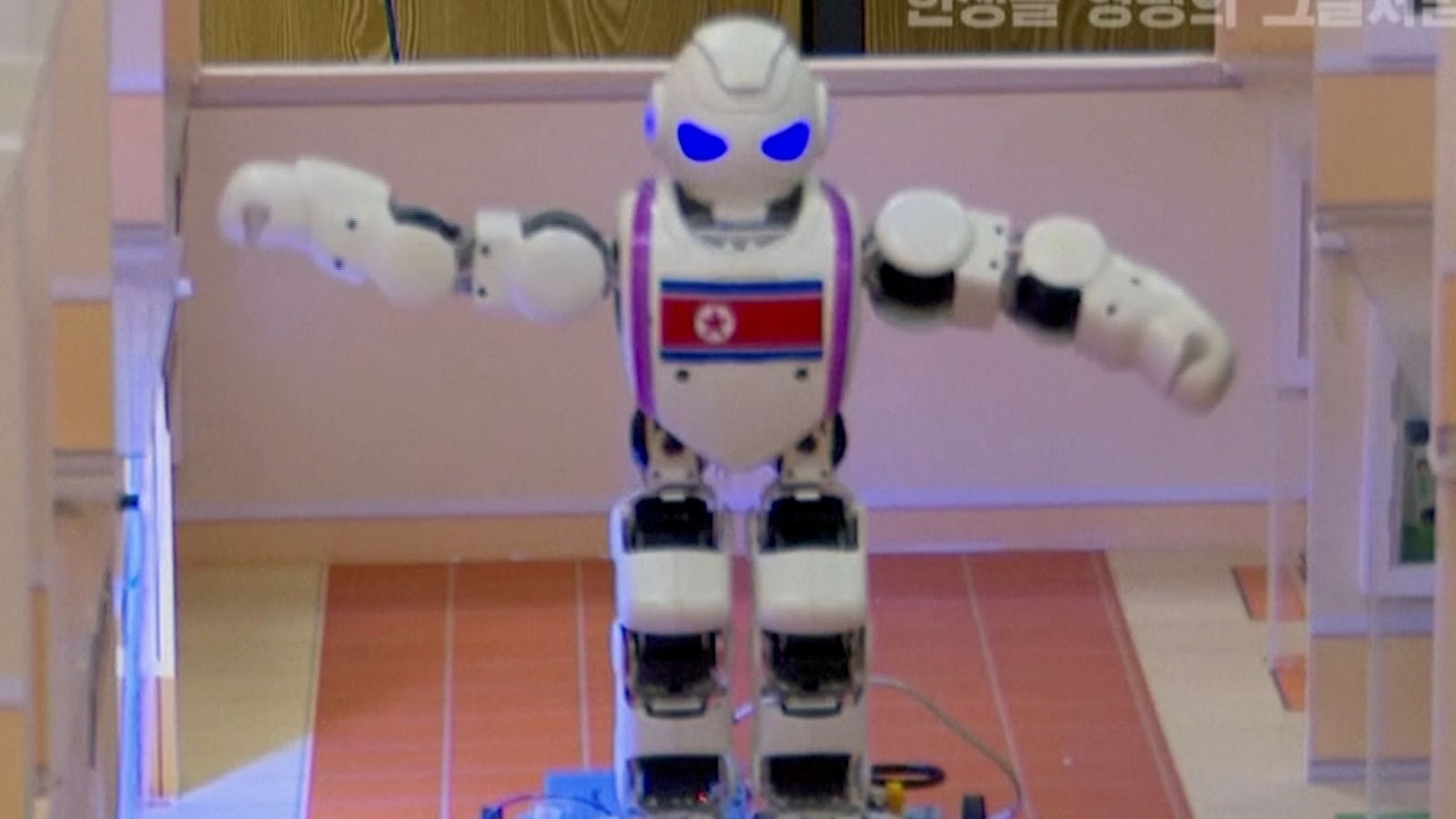
Src: "North Korea using robots to teach children
English and 'enhance intelligence'
," Sky News,
3 Nov 2021
Future Shock

Ŏm's utopian vision of the future is a world in which human interaction is minimal. All services are provided by robots; specifically, 1950s robots with lots of lights flashing meaninglessly on their consoles and hidden probes that scan you without your knowledge or consent. Nam is driven from the hospital to the restaurant, greeted, seated, and served without ever encountering a human being. He is confused and hurt by this, thinking people must be avoiding him, but eventually it is explained that "In the new intelligence era, humans only contribute mental labor, and all secondary services are done by robots."

In this future, North Korean engineers have developed a kind of super-advanced "light-based quantum computer" (빛량자콤퓨터), and these are used for all manner of tasks, from scanning a coma patient's dreams (not cool!) to sending e-mails (adorably rendered in North Korean as 전자우편). These computers are protected by DNA-coded security software which apparently can detect gender but not a lot else, as hinted by the following excerpt, in which Director Moon walks in on his daughter using his office computer:

  “Hmm, doesn’t look like the sort of thing historians usually look at. Impressive that you cracked the password."

  Pleased by this uncommon praise from her father, Jŏng-soon quickly corrected his misapprehension. “There’s nothing impressive about it. The security program’s genetic scan [유전자조사] recognized that my gender was different, so it didn’t let me access any data. But then I told it I was your daughter, and it kindly gave me a password.”

  Director Moon chuckled. “'The ax you trust stabs you in the foot' (믿는 도끼에 발등을 찍힌다), indeed. I'm getting forgetful, so I arranged a backup where the computer can give me a new password, and it ends up letting you in? This is a serious problem.”

   “You’re the serious problem, Dad. Living in this age of information sharing, and you still use antiquated things like password management programs.”

   “I’m older than you, that’s true; but there are certain materials and personal data that should not be shared. For instance, I know of a certain special relationship between you and a certain Kim Ho Yŏng of the Department of Education faculty, though I haven’t let on.”

In my institution, we have to take an online seminar on the do's and don'ts of cyber-security every year, and this exchange reminded me of one of the "don't" videos. 

Perhaps most intriguing is the daughter's accusation that her father is behind-the-times for continuing to use something as "antiquated" as password protection in the "age of information sharing" [정보공유의 시대에 살면서도 아직도 구태의연하게 암호관리프로그람을 사용하고]. Bear in mind that this conversation is taking place at the nation's premier biological research center, concerning a computer that apparently contains not only groundbreaking cryogenic research but also the director's complete genome. Yet the interaction is entirely light-hearted, like a scene out of Father Knows Best, and there are no real consequences or follow-ups.

A Real Cashless Society

The underlying premise behind Pyongyang's rapid technological leap is that North Korea has successfully implemented the “Koryo System,” a new economic model originally theorized by Dr. Nam, in which money is abolished and goods and services are dispensed according to each individual’s “intellectual contribution to society.” This system is explained in the story by way of Dr. Nam’s coma dreams, which Dr. Moon eavesdrops on via her father’s quantum computer (for the purpose of, er, research):

   Exiting the conference hall, Nam was pelted with questions from reporters: “Is it really possible to establish a new concept of currency and a new global economic structure?” “You predicted a new intelligent society, but can you give more concrete details?”

   Nam Man-woo smiled as he sat down to take questions in the briefing hall.

   “Asking for your forbearance, I will briefly explain. 

   “First, let me tell you my views on currency and the establishment of a new global economic system. As you all know, the man-made currency system in use today has caused the fate of humans to be controlled by extreme individualists. However, in the information era, procurement, research, production, and sales are realized through the Internet, accelerating the establishment of a new global economic system.

   “Finally, I will talk about the representation of an intelligent society. In the information age, the share of intelligent labor is increasing. But on the other hand, excessive information has led to a problem of unnecessary research and production. The intelligent society of the future will be one in which a highly refined and planned society overcomes these challenges, a society in which - as I just explained - material rewards and production are carried out according to the degree of contribution of each human being to society. Thank you, that is all.”

   (Loud applause from the reporters.)

This Koryo system seems to be a proprietary invention of this particular author; he refers to it in at least one other story, as the means by which future North Korea finally conquers the wicked forces of global capitalism and re-emerges atop a money-free new world order. As dream-Nam explains, the expansion of the “internet” has in theory enabled the global economy to be reordered according to individual intellectual contributions – and not only real contributions, but potential future contributions, calculated by super-advanced but apparently incorruptible computers. 

In this system, freed from the need to accumulate monetary savings, people are motivated instead to educate themselves, build their intellects, and maximize their social contribution through inventions and other “intellectual labor.” The result is a hyper-intelligent society with no room for laggards; thus the Drs. Moon spend much of their time worrying about how even a former genius like Dr. Nam can catch up after six years asleep.

You may laugh, but this is virtually identical to an explanation Captain Jean-Luc Picard gives to a 21st century human about the 24th century world economy in the film First Contact. I look forward to the intellectual property rights lawsuit between these two creators who don't believe in monetary compensation for mental labor.

First Contact, Paramount Pictures, 1996 Src: Imgur

In the story, it is vaguely hinted that evil global capitalists engineered Dr. Nam’s “accident” because they felt threatened by his theory. This conflict is never concretely fleshed out or resolved in this story, however. It is more fully explored in another story of Ŏm’s, 존엄, which I hope to post here in the future.

Links: SciFi in North Korea

For a deeper dive into the early days of North Korean science fiction, check out Dafna Zur's article "Let's Go to the Moon: Science Fiction in the North Korean Children's Magazine Adong Munhak, 1956–1965"

For Korean readers, there is a 2018 book by Seo Dong-soo of Sangji University, 북한 과학환상문학과 유토피아 , which analyzes over 100 North Korean works of science fiction published from the 1950s to the present.

North Korean robot soccer exhibit, Oct 2019
src: arirangmeari.com
In searching for images of North Korean robots, I came across this fascinating old RFA article by defector Kim Ju-won about North Korea's big robotics push in the 1980s. According to Kim, in the 1980s North Korea pushed for an expanded robotics program, inspired by East Germany. Jang Song Taek was put in charge, and engineers were promised party membership if they could produce a working robot - but they had to supply all the funding themselves. This culminated in a robotics exhibition with all the major university and industrial engineering programs in Pyongyang in January 1990. Afterward, a special private exhibition was planned for the leaders, and the author was selected to demo his team's robot. To his disappointment, however, the event was cancelled at the last minute out of "safety concerns" - allegedly, Kim Jong Il got cold feet when he realized that "nobody could predict what intelligent robots might suddenly do, so it was too dangerous to have the Great Leader around them." Sounds like somebody watched Robocop one too many times.

The images of futuristic Pyongyang above were taken from a Wired article on a 2014 Italian art exhibition that showcased futuristic designs by a North Korean architect. The entire article is worth a read.