Showing posts with label death. Show all posts

Friday, January 31, 2020

2009 (2014): Introducing North Korean Readers to President Obama

2009 is the penultimate novel of the “Immortal Leadership” series, which chronicles the life of Kim Jong Il. It was co-authored by Song Sang Won and Kim Yong Hwan, published in 2014, and recently made fully available online at North Korea’s uriminzokkiri.com website.
As suggested by the title, the novel covers the events of the year 2009 – particularly the April Kwangmyŏngsŏng-2 satellite launch (also covered in the story Sky, Land and Sea) and KJI's brief summit meeting with former President Clinton. 

This post will summarize Chapter 4, which dedicated readers may find online in the original Korean here. This chapter is fascinating both for the biographical details it gives about US President Obama and for introducing one of the most truly sinister POV characters I’ve yet encountered in North Korean fiction.

Chapter 4 Summary

The chapter begins with a biographical sketch of “America’s 44th president and the first black man elected to that office” (see below). It particularly notes that his anti-war rhetoric has gained him popular support from poor Americans weary of endless wars.

On the eve of his election, Obama’s maternal grandmother "Marylin Damhum" (매럴린 담험) passes away from cancer, and Obama suspends his campaign activities to attend her funeral in Hawaii. A CIA operative named Conan seizes the opportunity and flies to Hawaii for a private word with the man he anticipates will be the next president.

Conan is your prototypical deep state operative, an old government hand who has “hung around like a fixed asset” through successive administrations. He’s hated Korea ever since his father died in the Korean War, but he’s learned to respect North Koreans after watching them outfox every American president since Truman. Now dying of tuberculosis, he is determined to see that the new administration takes a hard line. He’s disturbed by Obama’s peacenik rhetoric and feels the need to nip it in the bud, before America loses its position at the top of the unipolar world order (일극세계).

President Obama scattering his grandmother's ashes
in Hawaii. Src: DailyMail
After the funeral Conan and Obama have a long walk on the beach talking. Playing on Obama’s vanity, Conan calls him “Mr. President” and acts as if the election is already won. Conan gives the candidate a long-winded account of how past presidents have failed to rein in North Korea, at times growing so animated that spittle flies from his mouth. In the process, the reader gets a nice overview of the North Korean evaluation of post-war global events. Conan makes frequent references to how America has “invited God’s punishment” by failing to use its nuclear weapons to seize global supremacy. Obama is surprised at the calumny Conan levels against the current Bush administration, which he still purports to serve. 

   “Conan, aren’t you criticizing yourself?”
   At the unexpected interruption, Conan realized he had said too much.
   “My apologies, Mr. President, my intent was to criticize historical presidential policy. I suppose that includes the current administration and myself as well.”
   “Go on.”
   “With every new administration, the CIA and intelligence corps have hoped for a more hard-line uncompromising policy. We’ve advised this again and again. But they always went their own way.” 
    Conan began to lose heart. How could they entrust the country to this political newcomer lacking all knowledge and experience, who was a black man and a Democrat to boot? It was a tragedy, but he’d come to Hawaii to try to fix it.

Eventually the two men seem to reach an understanding. “God will not forsake us,” Obama assures him before they part. The next day is the election, and Obama wins as expected. A few days after the election Conan’s dead body is discovered on a Hawaiian beach, dead from apparent shock. But his work will be carried on by his son (Conan II) in a later chapter…
President Obama in Hawaii


Obama biographical details

The first several pages of this chapter are taken up by a biographical sketch of President Obama. The text notes his parents’ divorce, his brief education in Indonesia, his subsequent upbringing by his white grandparents in Hawaii, his work supporting low-income families in Chicago and his status as the first black editor of the Harvard Law Review, before going on to describe his entry into politics. 

   During his time as an Illinois senator, he caught the attention of the media and society with his witty speeches. This was at a time when the US was fighting successive wars in the Balkans, Iraq and Afghanistan. Domestically, there was high unemployment and inflation due to the severe economic downturn and financial crisis, and the poor were having a harder time than ever. It was precisely this suffering and anti-war fervor that Obama was able to skillfully manipulate through his speeches, evoking public sympathy by presenting himself as an anti-war champion.
   He also gained popularity among blacks and Americans opposed to racism by speaking out about racism and vividly expressing his own experiences as a black man.

The text notes somewhat misleadingly that Obama was the only black senator in the US Senate (he was the only black senator at the time, but not ever). It states that he defeated “Hillary” in the primaries and secured the 218 delegates needed for the Democratic nomination. The chapter then includes a segment of Obama’s famous 2004 Democratic Convention speech, with one interesting mistake:

   "There is no free America, no conservative America, only America (자유로운 미국, 보수적인 미국이 따로 있는것이아니라). There is no black America, white America, or Asian America, only America. There are patriots who oppose the Iraq war. On the other hand, there are patriots that support the Iraq war. We are all citizens who swear allegiance to the Stars and Stripes and defend the United States.” (direct translation)

Explaining that this speech is what made Obama “instantly famous,” the text adds:

  By transcending race and ideology, Obama’s speech rang deeply in the hearts of Americans who had been divided over the Iraq war. In his clear and convincing words, there was a passionate call for a return to the founding spirit of the US.

Concerned about this anti-war stance, the deep-state spook Conan studies Obama’s biography and identifies weaknesses and character flaws that he believes he can exploit.

   He found helpful “Barack and Michelle: Portrait of American Family” by Christopher Anderson, a writer famous for his coverage of Princess Diana’s death. According to the book, after completing his first year at Harvard University Law School, in 1989 Obama went to receive training at the famous Chicago law firm Sidley Austin, where he met Michelle for the first time. 
   A graduate of Princeton and Harvard, Michelle was reluctant to guide a first-year student. But Obama fell in love with Michelle at first sight and pursued her despite her haughty attitude. Michelle eventually gave in. After four years of marriage, Obama became an Illinois senator, but in his wife’s eyes he was a useless husband. When he came home he threw his socks and underwear anywhere and filled the room with cigarette smoke, even burning a huge hole in the rug.
   He was always going around in a plain suit jacket and jeans boasting about “changing the world,” but to Michelle he was a “lazy idiot” (게으른 바보). She told him politics was a waste of time and he should instead work at a big law firm and make lots of money. Obama would joke to friends that “My wife’s nagging is killing me.”
   Conan delighted inwardly. Obama would no doubt show the same habits in his politics. Hypocrisy and two-facedness, two essential facets of any US president.

Nuclear History

This chapter contains some excellent insights into North Korea’s perception of American attitudes toward nuclear weapons, through the thoughts of the malevolent Conan:

   Fate had made the US first to obtain nuclear weapons, which were like the fire of Zeus. Nukes were power, and power was everything. It was this power that had allowed Truman to defeat Japan and raised the US above all the world.
    With nuclear weapons, there was nothing the US could not do. But still it had not done all it should. It failed to secure a nuclear monopoly. It shared nukes with other countries. It betrayed the gods (or God) and paid the price. Other powers emerged, and America’s unipolar might was eroded.
   In the world of power, nukes could make anyone a superpower.
   In July 1945 Truman appeared at the Potsdam Conference to discuss the end of WWII and the post-war order, confident that the world was at America’s feet. Then the USSR had been able to match the US because it, too, developed nukes.
   The UK, once known as a great empire with colonies all over the place where the sun never set, lost its empire status in WWII but luckily escaped from becoming another middle-power because it, too, had a successful nuclear test in 1952.
   When France had its successful nuclear test in 1960, President de Gaulle shouted “Hooray for France! (프랑스 만세!) France is a greater and prouder nation as of this morning!”
   Experts believed that the reason China achieved equal power status with the USSR and détente with its erstwhile foe the US was because it had conducted a successful nuclear test in October 1964.
   Nukes were the reason why India had reached a nuclear accord with the US; why Pakistan, which had leaned one-sidedly toward China, was now embraced by both China and the US; and why Israel was able to brazenly take on the whole Arab world of 3 hundred million people. All was made possible by nuclear weapons.
   Conan felt himself heating up again. “Mr. President, when God gave us these weapons they were not intended for display or storage. They were meant to be used. But our past presidents have failed to follow God’s wishes.” 
    He returned to Truman. Truman should have used nukes in Korea in 1950. If he had, not only Korea but also its allies China and the Soviet Union would have been reduced to rubble, and the US would be rid of its two greatest foes. France and the UK might be potential rivals, but at present they are our allies. India and Pakistan may have nukes but they would not dare challenge the US. Israel gets its nukes from us, so they shouldn’t be a problem.
    Conan continued. “There were plenty of chances to use nukes in Korea even after the war. The US started deploying tactical nukes to Korea in the mid-50s, and by the mid-70s we had over a thousand over there. Beginning in the 1960s there was the Pueblo incident, the EC-121 incident, the Panmunjom incident – God kept giving us opportunities, but we just let them pass….”

The above passage is intriguing not just for its geopolitical outlook but for the way that this outlook is revealed through a truly nefarious POV character. In previous entries I have noted that North Korean-style socialist realism seems incapable of producing an unreliable narrator, but perhaps I spoke too soon.

The sinister Conan implies that Truman was too soft-hearted to use nuclear weapons in Korea. One can’t help but wonder how much North Koreans are aware of the conflict between General MacArthur and Truman over just that issue. Do they think well of Truman for overriding MacArthur’s wishes?  If “bad guy" Conan disparages past American presidents for being weak, are North Korean readers supposed to feel the opposite, that they had some virtue in restraint?

Saturday, May 19, 2018

"The Crow that Passed by" (2017): A nice children's poem about the Trump White House

"The Crow that Passed by" (떠나간 까마귀) is a poem by Ri Wan Gi that appeared in the literary magazine Adong Munhak (Children's Literature) in November of 2017.  It is interesting in that it mentions Trump by name and also references his "Make America Great" slogan (강대한 미국을 만들기). Actually, the phrase could more accurately be translated as "Make a Powerful America" but I think they were aiming for the former. This is my first attempt at translating poetry, and I found it unexpectedly difficult, so apologies for the somewhat stilted language.

Many thanks to @FahySandra for finding this poem in a South Korean archive and sending it to me and @NKResearcher for providing the missing stanzas.

The Crow that Passed by
떠나간 까마귀
Ri Wan Gi

Hearing the delicious rumor 
That at the White House there were some tasty corpses
The crow flew from far away.
Settling on the White House roof
He muttered, "The rumors were true,
The corpse smell is ripe."
He flitted back and forth
"Aha, it’s coming from that window."
The crow settled on a nearby branch. 

Within the room, Trump
was making a rambling speech
to his sycophantic aides:
"To make America great,
We must annihilate Korea through war."

"Eh? War?"
The crow, well over a hundred years old,
Witness to numerous battlefields, 
pricked his ears.

"Mr President! All those bastards
Who opposed your war drive have departed."
At the flunky's words
The man called Mr President screeched even louder
"All those shitheads who resigned from the White House,
One by one - they're all maniacs."

The crow nodded his head,
"Seems there were quite a few 'maniacs' there."

One person stepped forward from the side
And spoke up,
"But Mr President, Congress
Is griping that a war with well-armed Korea
Would bring nuclear catastrophe to American soil.
What a bunch of idiots."

The President trembled with rage
"To make America great,
We must wage war
Against those crazy nonsense-spewing bastards."

At Trumps’ bawling, like the chime of a broken gong,
The crow grimaced
"Ow my ears, such a racket!
Crying war, war…
For real, this president is crazy for war."

Right then the plump fellow 
Jumped up, not wanting to be overlooked.
"Mr President! Korea has tested
H-bomb equipped ICBMs
With complete success
Threatening destruction before the UN General Assembly
How can we patch this up?
Even congressmen are holding anti-Trump rallies;
Such a pain in the butt."

Frothing at the mouth, the President stamped about,
"So those bastards 
Don’t want to make America great!
It’s all the busywork of lunatics."

Meanwhile huge crowds
assembled in the streets
Calling down with Trump, who drives sane men mad;
Screaming: Drag forth lunatic Trump, that walking corpse,
Who has plunged America into crisis and danger
The protest column plunged wildly forward
Toward the White House

Suddenly the crow
Who'd been salivating over the corpse smell
Took offense at the racket
"Pfooey, messing with such a rotten corpse, even I'd go nuts
Much as I do enjoy corpses
The stench of such a demented corpse
It's utterly loathsome
Gack, ptooey!

And so he spread his wings
And flew away
From the house of the crazy old lunatic

Tuesday, December 19, 2017

"Silver Lining" (전화위복): Floods and Self-Sacrifice in Rajin-Sŏnbong

"Silver Lining" (Chŏnhwa Uibok) is a short story by Ri Myŏng that appeared in Chosŏn Munhak in January 2017.

The story opens on heavy flooding in the northeast around Rajin-Sŏnbong (aka Rasŏn). Meanwhile, Kim Jong Un is in his office reading reports of the Rasŏn citizens' heroic efforts to save city's famous statues and mosaic of the leaders Kim Il Sung and Kim Jong Il.

Kim&Kim mosaic in N Hamgyong
Src: Yonhap
Flashback to the previous day, when a citizen brigade is frantically stacking sandbags around the large mosaic of the leaders in the town square to protect it before the levee breaks. Captain Ŏm Tae Sŏn of the local fisheries division is overseeing the work when he spots a familiar female face half-hidden under a hood. It's Song Hwa, a girl from his neighborhood who is like a daughter to him. Knowing the area is not safe, he gruffly orders her back home to her family. Song Hwa protests that as a neighborhood resident it's her duty to help, and anyway she already got permission. She starts to show him her permit.

Just then, the thing they had most been dreading happens: the levee breaks. A huge wall of water rushes down the street toward them, sweeping debris with it. The crew standing around the mosaic takes up positions to shove branches and roots out of the way. Suddenly an enormous tree trunk sweeps toward them; just as it is about to collide with Captain Ŏm, Song Hwa steps in front of him. In an instant, the young woman is pulled under the tree trunk and swept away in the surging waters.

"Comrade Yu Song Hwa sacrificed herself while serving as a Youth Brigade team member. Comrade Ŏm Tae Sŏn has taken responsibility, confessing that his momentary hesitation was to blame for her death. He is a man over 50 with great strength who has made many contributions." Kim Jong Un reads the report solemnly to himself, pondering the grief of those who lost their homes or loved ones, and empathizing strongly with Captain Ŏm. If it would ease their pain in any way, he would gladly burn his body to a crisp (한몸을 깡그리 불태워도).

Just then, in walks Armed Forces Minister Pak Hyŏn Sŏk [probably a pseudonym for Pak Yŏng Sik], bowing apologetically.
Inchŏn landing reenactment, September 15, 2015.
Src: Yonhap

   "Comrade Supreme Commander, even after the North-South High-Level Joint Declaration, the southern authorities are darkening the path for inter-Korean relations. This September 12th, US imperialist ships of the invasion force (미제침략군함선) plan to conduct a joint exercise with south Korean armed forces on the pretext of 'reenacting the Inchŏn landing,' in fact a military excercise aimed at us. Here I have prepared a supplemental strategy document."
   "Thanks. I'll give it a look."
   Pak turns to leave, then hesitates and looks back. "Supreme Commander, it's late."
He glances at the clock on his desk. Somehow the hour hand has already passed 2. "On one side, the enemy threatens us with their nuclear cudgel. On the other, we are fighting a deadly battle against water. Somehow, I don't think I can sleep."
Urging the leader to take care of himself, Pak submits a supplemental proposal for flood relief and retreats.

KJU speaking before the KWP Central Military
Commission, August 21, 2015
Src: Yonhap
The next day, Pak listens as Kim Jong Ŭn delivers a speech before the KWP Central Military Commission. Kim leads with an analysis of the "August Crisis" (8월사변), North Korea's term for a series of incidents that occurred in August 2015. Interspersed with Kim's narration, Pak revisits his memory of the crisis:
   "Just as the 'Eulji Freedom Guardian' joint military exercises were culminating, there was a landmine explosion along the DMZ, strange suspicious cannon fire from the North,  36 rounds of artillery fired on North Korean territory,  the restart of psych-warfare broadcasts across the DMZ, a US aircraft carrier moving toward the Korean peninsula,  and suspicious movement of various strategic nuclear assets; with all this happening, the arrogance of the southern puppet warmongers (남조선괴뢰호전광들) was at its peak. At a time when the US was going crazy trying to destroy North Korea's socialist system, the KPA Supreme Command issued an emergency protocol that shook the whole world. The KPA Joint Chiefs' ultimatum: cease all propaganda broadcasts and other psychological warfare from the South, or we will conduct a forceful military strike."
   [Pak remembering] The whole world had its eyes turned to the Korean peninsula. How would the South respond to the North's demands? Acquiesce, and have peace. Stay silent, and have war!
   The US and the South were seeking to tear down and usurp the socialist system that we have chosen and defended with our lives. War was inevitable and it would break out on right here in Northeast Asia!
   It had been America's century-old ambition to seize the Korean peninsula as a stepping-stone to achieving hegemony over all of the Asia-Pacific. Now they were goading their puppets into starting a war on the peninsula. Now at last they had the opportunity to realize their long-held ambitions. According to the analysis of the world's Korea experts, war was fast approaching.
As the speech continues, Pak flashes back to that time. Late on the night of the ultimatum, Pak came to inform Kim Jong Un that there had been no response yet to their demands; the propaganda broadcasts continued, and in a few hours the North would have to make good on their threat.
   "Reports from the South indicated that people residing near the DMZ were fleeing, youths were avoiding military conscription, increasing numbers were applying to emigrate overseas, foreign diplomats were pulling out of Seoul, the National Assembly was in uproar. This showed the [South Korean] people had lost faith in their society and fallen into despair, the government has lost the faith of the people, and the social fabric was in shreds."...
   If the nuclear fanatics were to touch one inch of our sacred land, sea or air territory, we were prepared to launch a victorious fusillade upon the South. We must match aggression with aggression, nukes with even stronger nukes; the stronger we are the more we can assure peace in the region and the world...
    But thanks to the great general's nerves and resourcefulness, backed up by the mighty Paekdu Revolutionary Army, a solution was reached. Instead of a fiery resolution, there would be high-level peace talks between North and South!
   Pivoting from a "forceful military strike" to peace talks! The American imperialists were left utterly dumbfounded by these unprecedentedly brilliant tactics.
Pak comes alert as Kim's speech turns to the subject of the flooding in Rason. Kim announces that as the damage is far worse than expected, the KPA will be deployed to aid in construction. Pak listens with interest; this proposal is part of the report he had submitted.
   Suddenly Pak recalled a memory from the hard post-war years, when the Great Leader [Kim Il Sung] angrily scolded some workers who were ignoring the suffering of the people: "Are you not the flesh and blood of these people? How is it that women with babes on their backs are planting rice? If we live for the people, how can we accept that? On the plains of Manchuria during the anti-Japanese struggle we fell a dozen times, and got back up again, to fight for the people. Now that liberation has come, how can we allow them to suffer like this?"
   And on the heels of that came a memory of the General [Kim Jong Il] boarding that train on the last day of his life: "Why do you doctors always try to stop me? Don't I know my own illness better than anyone else? I have to keep going, the people are waiting for me! My illness is nothing compared to their troubles, so don't try to stop me."
Continuing his speech, Kim Jong Un announces that the flood recovery effort will be completed by the time of the Party's 70th Anniversary day. The assembled officials are astonished; putting flood relief above national defense? And finishing it all in just one month? Kim explains "By the power that led us to triumph in the Five-Day War [apparently another name for the August 2015 crisis], we will triumph in this 30-day battle and restore everything to its original state."

---

Pak Hyŏn Sŏk, who has taken command of the housing construction effort, is overseeing the loading of a freight train with supplies headed for the flood zone. He scolds soldiers for packing too many creature comforts such as bedding and snacks, saying "Do you think we're going camping? Load the tools first!"

Flood damage relief work in Rasŏn shown on Chosŏn
Central TV, August 2015. Src: FRA
Upon arrival, Pak leads a rally for the relief team; he orders singing and dancing around the construction area to get the workers' blood pumping. A series of construction "battles" unfold using the principles of "socialist competition." The cement team churns out a 10-li field full of cement blocks in record time. The marines beat expectations by completing their assigned wall-building in just three days. This launches a competition between military units.

When Pak asks how the marines completed their walls so quickly, the team leader cryptically remarks, "When it comes to beating time, the secret is three-dimensional warfare [립체전]." He explains that this is a new tactic of labor developed by one of the marines, a young man famous for his ability to sleep standing up.

Pak promptly arranges a meeting with this super-worker, whose name is Ŏm Ju Ho. Something about the marine's boyish face seems familiar, and then his snaggletoothed grin jogs Pak's memory: he last saw Ŏm on pigpen cleaning duty aboard a submarine chaser patrolling the West Sea. Ŏm confirms that he had been given pigpen duty as a punishment for being late. Pak had sought out Ŏm after hearing he installed a new long-range sonar system that performed well in recent tests, but was surprised to find the young marine performing such a humble duty.

The next day, as the marines were filing out for a storm warning, Pak encountered a commotion at the front gate of the base.
   Surrounded by a crowd of children, a single marine stood with a woman clinging to his uniform, pleading about something. Thinking there must be a military-civilian relations problem, Pak went over to investigate. Seeing the stars on Pak's lapel, the woman sheepishly released the soldier and bowed deeply. The marine gave a crisp salute and ran off to join his regiment. Gazing after him regretfully, the woman muttered, "That comrade soldier... he saved my child's life. My child, who was on the edge of death."
   Through the woman's rambling account, Pak soon learned the whole story. The previous Sunday her daughter had fallen from a cliff while out collecting vegetables. An unknown marine had carried her all the way to the hospital and even donated his own blood to save her, then disappeared without a trace. Wanting to thank him, the woman had brought some children who witnessed the accident with her to the base so they could identify him.
   After calming the woman and sending her on her way, the unit commander clarified Pak's suspicions. "Last Sunday was the day I put Ŏm Ju Ho on communications duty, and also tasked him with delivering some magazines and books. But he took three hours to do it."
  "And the reason he was so slow?"
  "He said he had taken a shortcut through the woods and gotten lost."
  "So that's when he saved the child. And got punished for it..."
Pak sensed back then that Ŏm had extraordinary character, and now he finds him once again distinguishing himself in the flood relief effort. He asks Ŏm about the rumors that he sleeps standing up, and Ŏm explains that it is a habit from boyhood when he used to help his dad on his fishing boat. Pak asks to hear more about his father, and Ŏm replies that he is a ship captain in the local fisheries division. OMG, his father is none other than Ŏm Tae Sŏn!

Pak informs Ŏm that his father's heroic acts during the recent flooding have caught the attention of the supreme commander himself. A shocked Ŏm recounts how, when he stopped by his family home after being deployed to the region on flood relief duty, his father scolded him for leaving his post at the front.
"Listening to the radio lately, seems like the Yankee bastards are trying to mess with us again. Doing the Inchŏn landing and whatnot, just like the 50s. Right in front of your noses. And yet even you leave your post to come here! Just hearing that the army was coming here had me crying all night. At a time like this, with those jackals breathing down our necks, how can they worry about my humble home? Where else in the world can you find a leader like ours?"
Pak Hyŏn Sŏk felt deeply moved by the patriotism of this old worker who cared more about defending the front line than recovering his lost home. But at the same time, he agreed that the enemy could easily strike at such a vulnerable time.
   The US imperialists' invasion activities were growing ever more egregious. It wasn't just the Inchŏn reenactment in mid-September. Next month the nuclear-powered aircraft carrier "Ronald Reagan," loaded with dozens of fighter jets and accompanied by cruisers and destroyers, would sail into Pusan. And the south Korean puppet warmongers, nattering about "maritime security," had moved its missiles to sites on five islands in the West Sea including Yŏnpyŏngdo and Baekryŏngdo.
   The southwestern border had indeed become a time bomb [시한탄] where full-scale war could erupt at the slightest provocation. Pak Hyŏn Sŏk felt the ticking of that time bomb every hour of every day. For that reason, he felt that selfless and multi-talented soldiers like Ŏm Ju Ho were needed most desperately at the front.
---

The Kim Jong Il Youth Hero Medal
KJU's days have been filled with preparations for the KWP anniversary and reports on the flood relief work, but somewhere he found time to award the Kim Jong Il Youth Hero Medal posthumously to Yun Song Hwa, the young woman swept away in the flood.

Kim Jong Un and Pak Hyŏn Sŏk chat together in the car as they roll through the streets of the capital, past the construction site of Future Scientists Street [미래과학자거리]. Their conversation turns to the relief effort.

   "How are the soldiers getting on, living in such an unfamiliar area?" He [KJU] was always putting the soldiers first.
   Bak Hyŏn Sŏk swallowed his emotion and spoke lightly. "They faced some hardships at first, but now thanks to your gracious consideration they are getting special rations. Our energized soldiers are leading the charge [돌격전] night and day. Almost every day, the local residents try to bring gifts that our soldiers won't accept, causing some arguments."
   "It's a battle of love [사랑싸움] between soldiers and civilians. We must take this opportunity to show the noble ethos of our troops. Well then, how are the flood victims getting on?"
   "They're still living in tents, but their situation has stabilized. Food and daily necessities are being delivered regularly. When I visited, the shipments of fish and beef you sent had just arrived by boat and train."
    "Just a little while ago I read a letter from a little girl in Changsŏng county. She said she was going to take all her birthday gifts - notebook, pencils, and erasers - and send them to the people of Rasŏn. Right now the whole of our Party and society is devoted body and soul to the people of Rasŏn. Such is the virtue of our beautiful and gracious society."
   "Indeed, I hear some people are even jealous of the flood victims, with their nice new homes."
The Ma'ansan blanket factory
Src: dprktoday
They eventually arrive at a collection center where they inspect the goods prepared for shipment to the flood zone: plasma TVs, warm cotton duvets, "Ma'ansan" blankets, clothing and undergarments, glass tableware sets, and other household supplies.

KJU inspects them all and issues instructions to Pak: Make the duvets thicker, ensure the highest quality, send everything without delay. "But make it clear that these are aid materials, not gifts. If we call them gifts, people are likely to cherish them like family heirlooms and not really use them."

KJU and Pak then go for a walk along the Taedonggang for some fresh air. KJU brings up the Ŏm family and reflects on the selflessness exhibited by the old ship captain. "Through this recent flood, we have seen our people's true colors... Even in their distress, the people of Rasŏn thought first of protecting the images of the leaders. Despite losing their houses and all their possessions, their instinct was to protect the leaders [수령님들]. This is not just a matter of virtue. Even as they were flailing in the water, they understood that their fate and the fate of the leaders was one and the same."

KJU pauses, gazing up at a high-rise apartment building. From one brightly lit window comes the sound of a piano and a child's voice singing:
Grasping his loving hand
I can't lose the moment
Holding his cheery smile close in my heart
I dream of good fortune.
Our greatest gift
Our Leader is here
Our Leader who makes ten million wishes bloom
Inspired by this sign of the people's pure faith, KJU reflects on the Leaders who "wore down the soles of their shoes" [신발창이 닳도록] working to give the people a better life.

---

Pyongyang Central Tree Nursery
Src: Yonhap
Pak attends a tree-planting in front of the nearly completed housing for Rasŏn flood victims. He has brought a variety of fruit and vegetable seedlings from Pyongyang's Central Tree Nursery and Seed Farm [중앙양묘장과 채종농장].

Pak turns to Ju Ho, who is busily digging root beds, and asks him what kind of fruit tree he would like in front of his future home. Ju Ho replies that he has always been partial to the white apricot [백살구] because there was one in the yard of his childhood home. The white apricot is strongly associated with Hweryŏng, the hometown of "Mother of Revolution" Kim Jŏng Suk [KJI's mother].

The next day, Pak gets a visit from Captain Ŏm Tae Sŏn. Having heard so much about the man, he greets him warmly and praises his heroism during the flood.

But Ŏm is clearly feeling uncomfortable; he blurts out "I've committed an unforgivable crime!" He then confesses that one of his crew had been caught wrecking his own house, hoping to claim flood damage and get a new one built for him.

Pak is aghast at this show of bad citizenship, especially after all the selfless deeds he has witnessed. Indeed, he thinks, "just one loach can muddy a clear stream" [종개 한마리 맑은 강을 흐린다더니].

Hoping to make amends, Captain Ŏm begs Pak to let the troops accept a boatload of fish, but Pak points out that such a serious crime must be properly prosecuted.

Just then Pak's phone rings with amazing news: the Supreme Commander himself is on his way over to the construction site! In short order, KJU's motorcade arrives on the scene. Everyone is thunderstruck, none more so than Pak, who knows too well how packed the leader's schedule is with the KWP Anniversary imminent; yet here he is in the remote north of the country.

Without taking a moment's rest, KJU proceeds to ascend a high promontory from which he can survey the entire construction scene. In just ten days, the scene of nature's destruction has been transformed into a "fairyland" [선경마을] of orderly construction. KJU makes a little speech praising the achievements of the last 10 days and urging them to take care in construction "as if you were building your own homes." He particularly emphasizes making sure the electricity and plumbing work.

Suddenly Ŏm Tae Sŏn pushes through to the front of the crowd. "Leader!" he cries. "How can you be so kind to us, we who have only put more burdens on your shoulders?"

Pak introduces Ŏm, and KJU makes another speech reassuring everyone that a visit to the suffering people is well worth his time. He then turns to Ŏm and asks what happy coincidence brought the fishing boat captain to the work site that day. Ŏm stands frozen, unable to speak of the terrible act that his crewman committed. Pak Hyŏn Sŏk takes pity on him and begins to tell the sordid tale.

KJU  listens quietly to the tale, then everyone holds their breath as they await his judgement. But the young leader is magnanimous: "On the contrary, I see this man's destructive act as a sign of the man's faith in the Party. He could not have done such a thing unless he trusted in the Party like a mother. For people with such faith, we should move heaven and earth to do whatever they ask. Let's give this man a new home too, without discrimination."

Captain Ŏm is overwhelmed by the leader's generosity and vows to work till his boat is overflowing with fish every single day. KJU replies that it is people like the captain who make the nation great.

Notes and Links:

Satellite imagery shows Rasŏn port before and after the
flood. Src: RFA
Late-summer flooding seems to be an annual event in North Korea, but the flooding described in this story, which  hit the Rajin-Sŏnbong area in August 2015, was especially severe. A general summary of the damage in English from Reuters can be read here.

North Korean news footage from September 2015 promoting the military's role in the Rasŏn flood relief effort can still be viewed on Youtube.

This article from the South Korean media talks about the flood relief effort and how it interfered with plans for the KWP 70th Anniversary.

An RFA story (with audio) on the flood relief speed campaign can be read here.

South Korean news coverage of the "August Crisis" of 2015 and KJU's 48-hour ultimatum can be seen here. North Korean news coverage of the KWP Central Military Commission deliberations from that time can be seen here.

Militarized Flood Relief

A striking thing about this story is the frequent use of military language in reference to non-military tasks. In his speech on flood relief KJU talks about "going to war against nature's tyranny" [자연의 횡포]. He issues the order for flood relief in the name of Supreme Commander and orders the KPA Command to take charge of the flood relief headquarters. He explicitly connects flood relief effort with his earlier triumph in the August 2015 crisis, calling the recovery effort a "30-day war." Pak describes this order as the first "shots fired [포성] in the war for flood damage recovery [큰물피해복구전쟁]" and notes that soldiers from all over the country are departing their posts to head for the "point of combat" [공격지점], that is, the flood area. The marines are said to be "leading the charge" [돌격전을 벌린다] in rebuilding homes. The construction effort is praised as an "attack without gunfire" [포성없는 공격전] and a "war of love" [사랑의 전쟁]. To speed things up, KJU decrees that building materials be shipped using the "wartime transport system" [전시수송체계].

Military themes have been strong in North Korean fiction since Kim Jong Il inaugurated the military-first [sŏngun] policy in the 1990s. But the newer stories of the KJU era seem to take things one step further: even non-military tasks are elevated using military language. By leading a large-scale military construction operation and issuing commands in his capacity as Supreme Commander, KJU appears to burnish his image as an experienced military leader, without having to actually go to war.

An important key word in this story is "civil-military relations" [군민관계]. KJU inquires about how the soldiers are getting along with the locals, and the story features several anecdotes illustrating the extraordinary love and gratitude the locals feel for the soldiers. Various defector-run media outlets in South Korea have been claiming for years that the KPA is engaged in forced looting of civilian property, and as this story reveals, civil-military relations clearly remain a concern.


Speed Battle Agitprop

This story features many colorful phrases and slogans that seem to be rote features of speed-construction propaganda. Some that I found interesting include:

reaching astronomical figures 전문학적수자에 달하다
line-of-fire agitation 화선선동
unprecedented in the history of construction 지금까지 건설력사에는 례가 없다
with the speed of a lit fuse 화약에 불달린 기세로!
supersonic speed 초음속
100 days shrinks to one, a year shrinks to 10 days. 백날을 하루, 1년을 열흘로 압축

Quality Control Issues

As the above suggests, North Korean speed battles in construction have always tended to emphasize speed over quality. As a result, citizens are often less than enthusiastic about moving into some of the new state housing complexes despite their sparkly exteriors. For instance, Daily NK has some good reporting on the heating problems at the new Future Scientists Street complex. Tellingly, in KJU's speech at the construction site he specifically instructs the soldiers to make sure that the electricity and plumbing work properly and that there is an abundant supply of firewood at each new home before they move on.

KJU's magnanimity in forgiving the fisherman who destroyed his own home to get a new one can be understood in this context. North Korea is not really worried about a spate of literal home-wreckers lining up for new homes, because the reality is that most people are now justifiably wary of hastily constructed new housing.

Friday, November 3, 2017

"Him in December" (12월의 그이) - Kim Jong Un buries his father

"Him in December" (12 wŏl ŭi kŭi) is a short story by Hwang Yong Nam that appeared in the collection A Promise of Fire (Bul ŭi yaksok) in 2013. The story follows the young successor Kim Jong Un through the mourning period following his father's death in December 2011.

Kim Jong Il's body lies in state.
Src: Daily Mail
The story is noteworthy for its depiction of South Korean political, academic, media and online discourse as well as its specific mention of many South Korean political and societal leaders. One can get a sense of where various individuals stand in the North’s favor at this particular point in time: liberal ex-presidents are up, the Hyundai chairman is down, Reverend Moon Ik-hwan is still fondly remembered.

To the North Korean reader, it relays with outrage how foreign media have suggested that their tears are “staged.” It also suggests that many, many South Koreans were quite desperate to pay their respects but were blocked by the government.

The Plot

The story opens on the day after Kim Jong Il’s death was announced; KJU stands before the casket officiating. He stands like a rock for two hours as wave after wave of sobbing citizens come forth to pay their respects. KJU alone cannot indulge in the luxury of tears; he has to be strong for the people.

In the midst of his grieving, KJU is shown attending to a hundred different details related to the funeral plans, various high-level delegations and other minutiae. He realizes for the first time just how hard his father worked and how many details he attended to every single day with great respect and care for the people. 

He encounters the all-female Persimmon and Wildflower Brigades, who declare that “our powder is dry” and ask for orders. They are furious at the South Korean president Lee Myongbak for his statement issuing condolences “to the people of North Korea” and not to the government.

Female soldiers mourn Kim Jong Il's death.
Src: The Telegraph
KJU wants to initiate an open-border policy to allow South Korean mourners to come and pay their respects, but his generals worry that the ROK government will take advantage of any opening to launch an invasion, even in this time of national mourning.

KJU then takes a drive through the snowy streets of Pyongyang, mapping out the route of the funeral procession. The story meticulously mentions each of the iconic sights of Pyongyang that they drive past: the 4.25 Cultural Palace and Kim Il Sung Square, Okryu Bridge and the KWP Founding Memorial Tower, the greenhouses that grow the Kimjongilia flowers. 

----

On a cold wintery evening, Kim Dae-jung's widow Lee Hui-ho is gazing out at the sunset. Despite her advanced age of almost ninety, from the moment she heard the news she had been determined to pay a condolence visit to the North. If only her husband were alive, he would surely accompany her.

Lee Hui-ho with her husband Kim Dae-jung at his
inauguration in 1998.
Src: Kim Dae-Jung Peace Center
Hearing of her request to make a condolence visit to the North, Representative Pak Su-won of the Democratic Party has come to visit.

Together they reflect on better times, after the 6.15 Declaration, when media executives traveled North to beg forgiveness for their bad behavior, cultural exchanges took place several times a year, tourists could freely visit Mt. Kŭmgang, and pretty northern cheerleaders came down to Pusan and set young men's hearts aflutter. But alas, now the "Big 3" media were up to their old tricks, idiots were talking about war rationing, and they had just lost the one man who fought for peace - Kim Jong Il.
"It's not just me. Former Minister Lim Dong-hun, President Roh Mu-hyŏn's widow Kwŏn Yang-suk, and many others want to go. I'll do what I can. But looking at the current government attitude, we can't hope for much."
Since word had come down that the North was willing to accept condolence visits from any representative of any group or party in the South, the government had been frantic to come up with some excuse to block their visit. First they demanded that some family be left behind to ensure their return, and then they made noises about posting spies with the delegation. Next they started quibbling about scheduling and procedures.

Finally, this morning a call came from the Ministry of Unification, telling Lee to prepare to leave but offering all sorts of ridiculous instructions – bring plenty of food and clothing, don't bow your head, etc. 

That afternoon, her son Kim Hong Il returns from his visit to the Ministry of Unification in a bad mood. "Those no-good politicians. They're refusing to let Representative Pak come with us." He explains that they have categorically rejected all applications by actively serving government representatives and civic groups, as well as President Roh Mu-hyŏn's widow and the family of the late Reverend Moon Ik-hwan. Around Seoul National University students are putting up wall posters faster than officials can tear them down, demanding to be allowed North.

KWP Central Committee Member Kim Ki Nam
greets Lee Hui-ho at her husband Kim Dae-jung's
funeral in 2009.
Src: Hangyoreh
Unbelievably, it appears that Hyundai Chairman Hyŏn Jŏng-un may attend. Lee is outraged that Hyŏn gets to go when Roh's widow and Moon's family are denied, since those two worked so hard for unification. She recalls Reverend Moon's words when he was sentenced to prison for traveling North: "It seems like people can go North for business, but not for unification."

They speculate that the reason Roh's widow was denied is because North Korea only sent a condolence telegram when Roh died, not a full delegation like they sent for Kim Dae-jung. This kind of pettiness is typical of Unification Minister Yu Wu-ik and the transactional attitude of the president. "He may have started as a businessman, but he's our president now," Hong Il complains. "He can't just pursue profit, he's supposed to represent the people's spirit (minshim)."

Observing his mother's agitation, Hong Il has been holding back on the really bad news, which he finally reveals: They are only allowed two days and one night for their trip north. They'll leave tomorrow, and return the next day, before the funeral. Why? Because that's exactly how long the North Korean delegation stayed for Kim Dae-jung's memorial.

"This is really too much," Widow Lee mutters, disgusted.

---

As Lee Hui-ho's delegation travels north along the unification road to Pyongyang, she reflects on how much has changed. Has it only been a decade?

Kim Dae-jung and Kim Jong Il in the Baekhwawŏn
Reception Hall, June 2000
Src: Tongil News
She warmly greets Secretary Chŏng Sŏn Il and is surprised by the familiar face of her driver from the 2000 visit, who has been appointed to chauffeur her again. Amazed by the warm welcome, she remembers how the MoU busybodies had fretted and warned her about the likely broken-down facilities and bad infrastructure she would find in the economically depressed North. Why, it is quite the opposite!
   "We've prepared the same suite you stayed in last time, at the Baekhwawŏn Reception Hall."
   Lee Hui-ho is startled by the words. Why, Baekhwawŏn is reserved for visits by heads of state! To think they went to such lengths for their shabby entourage.
   "It's on the Dear Leader Kim Jong Un's orders. He said you are to have the same room in the same condition as when you and President Kim visited... And he's the one who thought to arrange the same driver for you. He said to spare no effort to make you feel at home."
Kim Jong Un in a tank,
January 2009
Src: Yonhap
    Lee Hui-ho felt like she was dreaming. In the South, from the moment they first saw Deputy Chairman Kim Jong Un on the TV - his manner, his gait and his broad smile - why, everyone said he was like Kim Il Sung reborn! Since he was shown driving a tank at a military base on New Year's 2009, he had been portrayed as merely a professional soldier. And he was linked to the punishment of Yŏnpyŏngdo. And when he launched the Gwangmyŏngsŏng 2 rocket, and they said he was prepared for war, they all thought him terribly intimidating.
   A young, vigorous and decisive leader. That's how they thought of him in the South. Who knew he could be so thoughtful, so considerate?
That evening, Lee Hui-ho and entourage pay their respects to Kim Jong Il's body. There's a lot of crying and apologizing on behalf of South Korea for being so insensitive.
Lee Hui-ho, widow of former South Korean President Kim Dae-jung,
pays her respects to Kim Jong Il's casket.
Src: Joongang
The next day, with great regret, Lee's delegation says goodbye and returns South. The next day, they watch on TV as the funeral procession wends through the streets of Pyongyang, gasping as the hearse is swarmed by grieving people. "How could anyone look at that river of tears and say it is all just 'acting,' or 'forced'?" Lee wonders.

Back in North Korea, the funeral draws to a close. Gazing at the assembled top officials and military officers, Kim Jong Un makes an impassioned speech which includes the line, "We can forgive many things. But we can never forgive the crime of disrespecting our people's tears."

Seasonal Imagery

This story is chock full of winter metaphors. The Lee Myong Bak administration is described as a "cold frost" that froze over the warm wind of the 6.15 Inter-Korean Summit. The South Korean scenes are repeatedly described as cold and desolate, with great dark clouds threatening snow. Lee Hui-ho constantly refers to the current political deadlock in seasonal terms, saying "When will this cold snap end?" and "I think this winter will be very cold indeed." 

The North Korean delegation that went south for Kim Dae-jung's funeral is described as "a breath of warm spring air blowing on the frosted ground of the South." It is explained that Kim Dae-jung's nickname was "Honeysuckle" because he was to be "the weed that triumphed over winter." "Winter" of course refers to the period of Lee Myŏng-bak's presidency, when North-South relations were at their nadir.

North Korea's Condolence Delegation

This story contains an interesting reinterpretation of the August 2009 delegation of North Korean officials to Seoul to offer condolences upon the death of the late South Korean President Kim Dae Jung. This section begins at the visitation, as KJU talks with Central Committee Secretary Han Su Nam.
  "Secretary Han Su Nam!" His voice thundered out. "When was it we sent that condolence delegation south?”
  “Two years ago, in August.”
  “Only two years, then."
  It was two years ago, in August, that all North-South cooperation stopped. The Lee Myong-bak administration’s insane confrontation policy, known as the “lost decade," reached a fever-pitch with the Mt. Kumgang tourist incident. As the whole world was going crazy over our nuclear program, the cretins collaborated with foreign forces, and their bad behavior worsened. The warming mood that followed the 6.15  agreement had completely frozen over.
  After our editorial harshly condemned the traitor administration’s so-called “pragmatic government” as anti-Korean and anti-unification, North-South relations had deteriorated to a state even worse than before the 6.15 agreement. And then Kim Dae-jung passed away.
   The condolence delegation to Seoul, sent in the name of the General, was like a breath of warm spring air blowing on the frosted-over ground of the South at the height of confrontation. When the Central Committee Secretary Han Su Nam stepped out on the tarmac at Incheon airport, the south Koreans lowered their heads in awe at the great magnanimity and brotherly love of the General. The people lined the road all the way from Incheon to Seoul, waving flowers and cheering:  “Thanks to the benevolence and fraternal spirit of NDC Chairman Kim Jong Il, Kim Dae Jung will remain honored in our people’s history forever.” “Even though our land is divided, the blood of our people flows together as one.”
  Meanwhile criticism grew more concentrated against Lee Myung Bak and his policy of confrontation with the Republic. Though he had adamantly resisted, eventually he had no choice but to meet with the delegation. Secretary Han, who had been entrusted with handing over the General's personal letter of condolence, remembered his growing disillusionment as he watched the man flounder. 

Kim Ki Nam (second from left) and other North Korean officials
present flowers at Kim Dae-jung's funeral, August 2009
Src: SinoNK
For reference, here is Hankyoreh's coverage of the 2009 condolence delegation: http://english.hani.co.kr/arti/english_edition/e_northkorea/372535.html 
Note: The delegation actually arrived at Kimpo airport, not Inchŏn. Needless to say, the roads from Inchŏn to Seoul were not lined with people shouting the above slogans.

From the above excerpt, we can assume that "Secretary Han Su Nam" is probably Kim Ki Nam, the Central Committee secretary who joined the 2009 condolence delegation (http://www.nkleadershipwatch.org/kim-ki-nam/).

South Korean key words

At several points this story invokes phrases that hint at how North Korea's writers are in tune with South Korean media terms and key words. The following terms appear in the story:

실용정부 "pragmatic government" - another term for the Lee Myŏng Bak administration; the North Korean text uses this term disparagingly several times.
흡수통일, 급변사태대응책 "Unification by absorption" "Response Strategy for Sudden Emergency" - phrases in vogue whenever North Korean collapse seems imminent
잃어버린 10년 "the lost decade" - refers to the ten years of sunshine policy.
인동초 "Honeysuckle" - apparently this was a nickname of Kim Dae-jung. This seems fairly obscure, but one South Korean blogger wrote this post explaining its meaning.
목포의 눈물 "Tears of Mokpo" - The story describes this as one of Kim Dae-jung's favorite songs. This song is indeed associated with Kim Dae Jung, who considered Mokpo his second hometown.
보안법 National Security Law - The law invoked in South Korea to crack down on pro-North sentiment. Apparently the incident with the incense altars being prohibited by the NSL actually happened.
다음, 네이버 Daum, Naver - listed among the "big 5 internet sites" of South Korea that supposedly posted mourning pages for Kim Jong Il. 
퍼주기 to overfeed, coddle - this is a phrase that was used a lot by South Korean conservatives as the Sunshine Policy was winding down in the late 2000s. In the story, the MoU officials use this phrase to explain their opposition to a condolence visit: "We can't keep coddling them all the time."

Friday, December 2, 2016

"Dokdo": Love, loss and fishing on a disputed islet

The islets of Dokdo
The short story "Dokdo" (독도) appeared in Chosun Munhak in August 2006, right around the time the Dokdo/Takeshima tussle was heating up between South Korea and Japan. I remember this well, as I was living in Japan at the time. The Japanese prefecture that claims the islands of Takeshima as its jurisdiction proclaimed a "Takeshima Day" festival, and South Korean media blew up overnight. South Korea refers to the islands as "Dokdo" and has stationed a garrison there since 1954.

I picked this story because I wanted to see how the Dokdo controversy is depicted in North Korea, which also technically claims sovereignty over the islets (along with all South Korean territory).

This story is told in the story-within-a-story-within-a-story style; a historian, being interviewed in the present day, recounts a story he heard from an old fisherman he interviewed years ago, about events that occurred on Dokdo during the Japanese colonial period. The narrative thus jumps back and forth between the three different times and settings. The fisherman's speech is rendered in a thick Gyeongsang dialect.

The Plot

The historian Hyun Young Ryul had been commissioned by the Kumsung Youth Publishing Company to write an article directed at young people, explaining Dokdo's historical status as Korean territory. Looking over the papers he had been writing, Hyun suddenly felt he wasn't adequately expressing what he wanted to say.

Just then his thoughts are interrupted by a visit from a young publishing representative named Kim Jong Min who has come to interview him.
   "Far from abandoning their ambitions for seizing Dokdo, the Japanese reactionaries have grown more frantic. A clear example is their 2007 decision to use middle and high school texts claiming that Dokdo is Japanese. That's why our publisher has decided to print materials explaining the historical, geographic, and environmental components of the territorial issue so that youth to understand it more clearly. If time permits, I'd like you to discuss it in more detail." 
Hyun proceeds with a lengthy, rather pedantic description of the islands: their geographic features, ecology, mineral resources, distance from Ulleungdo and the mainland, etc. This section seems dedicated to simply educating readers who might not know what exactly Dokdo is.

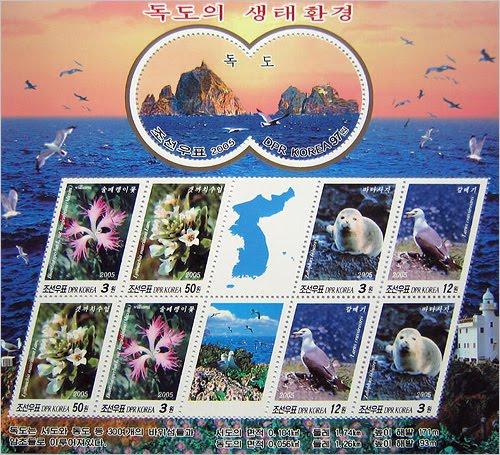
North Korean stamps celebrating Dokdo
(Src: Chosun Ilbo)
As he speaks, Hyun is suddenly reminded of an interview he conducted many years ago with an old fisherman named Hwang Hak Chun who had been born and raised on Ulleungdo.
   "I had a dream last night that a historian from the capital would come to see me," the old man said, fiddling with his cigarette. "But I have no idea how this old illiterate could be of any help."
   "Please, just share anything about life on Ulleungdo. The lifestyle, the scenery, people and incidents you remember, things like that."
   "Ha, what nonsense. History is about great people who defeated foreign enemies, like General Eulji Mundeok and Admiral Ri Sun Shin, not some old guy who lived on some island."
   As he started to turn away, Hyun asked the old man if he had ever chanced to visit Dokdo.
   "Of course. Not just to visit, but I lived there in the summer," he said, lighting a cigarette. "Even when dirt fills my eyes, I'll never forget that place... You could say that I buried my youth, my love, and indeed my whole life on those islets. When I was young, I fell in love for the first time there."
When Hwang was growing up on Ulleungdo, there was a young girl in the house next door named Somnyon. A few years before national liberation, he and Somnyon both lost their fathers on the same day, when the two went sailing together and got swept out to sea. Hwang's household had a strong young worker and was able to make ends meet, but Somnyon's family was having trouble.

Hwang and Somnyon began working together to provide for their families. As they spent more and more time together out on the water, they developed feelings for each other. One flirtatious episode is recounted, involving skinny-dipping and a pair of fishing goggles. The pair eventually decided to marry. However, it was still a struggle to support their combined families. So Hwang decided to set out for Dokdo, where he had heard there was a wealth of abalone, sea urchin and sea cucumber in the surrounding waters.

"Dokdo is our land since ancient times!"
(Src: The Asia-Pacific Journal)

Hwang and Somnyon made many trips to Dokdo over that summer, staying overnight in a stone hut on a narrow gravel spit. It was on Dokdo, as the couple sat outside their hut counting the stars one evening, that Somnyon revealed she was pregnant.

As Somnyon's pregnancy progressed, Hwang tried to talk her out of exerting herself so much, but she insisted on accompanying him on one more fishing trip to Dokdo.

When they arrived, they found a fishing boat was already there. It was Hwang's buddy Myongduk. The fishermen called out happily to each other, and agreed to fish separate areas. Hwang deposited Somnyon at the campsite where she could prepare to cook their dinner. Hwang then spent the afternoon fishing alone, and was just about to turn toward the island for supper when suddenly, gunshots sounded.

Paddling frantically toward his campsite, he spotted a strange motorboat floating between the two islands. At the campsite, he found the abandoned pot still boiling. Somnyon was collapsed on the ground a little ways away, with a wound on her leg gushing blood.
   "You bastards! How could you shoot a living person?" Hwang raised his fists and screamed. The Japs, who had been busily loading a seal into their boat, turned and gaped at him.
   One fellow who seemed to understand some Korean came to the front of the boat and called out, "Oh, was someone injured? That's not our fault. You folks get mixed in with the seals, and it's hard to tell you apart. Koreans and seals are so much alike."
   "What? You thieving bastards, you think Koreans are the same as seals?"
   He had heard that the oenom had been making huge profits from seal hunting on Dokdo, but this was his first run-in with them. It was bad enough that they came creeping over to another country's islands like a thieving street cat, but to actually hurt people?  These were not simply thieves, they were bandits and beasts! Hwang thought: Oh, if only I had a gun, I would rain fire on their heads until I felt better...
   "You bastards, what gives you the right to come to someone else's island, hunt seals and shoot people?"
    At Hwang's relentless scolding, the Japs stopped what they were doing and came crowding to the front of their boat. The one who spoke Korean put on a bold front for his buddies: "This is Japan's land, Takeshima. Don't you know that?"
   "Don't talk nonsense. Dokdo has been Korean land for generations. Since when did it become yours?"
   "And what is Korea? There is no more Korea, so how could it be a Korean island?" The Japanese laughed. "Guy doesn't even have a country, and he says this is his country's island..."
Myongduk had also come paddling over at the sound of the gunshot. When he saw that Somnyon had been shot, the irascible fisherman flew into a rage and paddled over to the Japanese vessel, shouting obscenities. The Japanese fired several warning shots to keep him away, but when he started beating their boat with an oar one of them lowered his gun defensively, and accidentally shot him in the head.

Seeing his friend slump motionless in the boat, Hwang momentarily forgot his wife and rushed over to help. The Japanese took advantage of the confusion to beat a hasty retreat. Hwang turned to Myongduk's young companion and told him to make haste back to Ulleungdo to get medical care. After seeing his wounded friend off, he returned to his wife.

Her face was pale from loss of blood, but the more immediate problem was that the shock had sent her into labor. Hwang knew she would not survive long without help, but the nearest midwife was on Ulleungdo. Desperate, he began trying to load his wife onto the boat, but she just moaned and shook her head.
"If I'm going to die, I want to die here on Dokdo. This is where we fell in love, and I feel at peace here."
Somnyon finally gave birth, and then passed out from pain and blood loss. Hwang shook her awake, pleading with her to live, but it was no use. With her dying breath, she asked Hwang to take care of their baby, and bury the placenta on Dokdo.

Hwang accommodated his wife's dying wish, burying the placenta under the rocky shoal near their cottage, and marking the spot with a large rock. He then set off for Ulleungdo, with his newborn son squalling for milk and his dead wife lying motionless beside him. Upon arrival, he learned that his buddy Myongduk succumbed to his wounds en route as well.

Hearing that Japanese poachers had killed two people, the Ulleungdo islanders marched to the township offices to demand justice, but the (Japanese) township officials replied that since they had let the assailants go there was no way to find them and charge them. However, noting that none of them had obtained permits to fish on Dokdo, they charged Hwang and Myongduk's young assistant with trespassing and put them both in jail.

After languishing in jail for a month, Hwang returned to find that his baby had survived in his mother's care, although they had had to beg for help feeding him. Soon after that, he got his draft notice from the Japanese military. Hwang knew that without his support his entire family and Somnyon's surviving family would starve. With no other choice, he left to seek his fortune on the mainland, promising his mother he would send for them as soon as he could.

Hwang traveled north as far as Chongjin, where he found work as a day laborer. He sent word back to Ulleungdo with an acquaintance, and his mother brought the family to join him. Somehow, they survived to the end of the war.

   [Hwang recalls to Professor Hyun]: That August, the anti-Japanese struggle was victorious, the Japs were crushed and we were liberated. I remember it like yesterday, sweeping through the streets with my buddies, cheering "long live!" for General Kim Il Sung at the top of my lungs. The first spring after liberation, General Kim Il Sung visited Chongjin and held a huge celebration for the international worker's holiday on May 1st, declaring that the workers were now the owners of the country. I joined the march on that first May Day, waving the red flag proudly, and felt it was truly wonderful to be alive.
   To think that this poor fisherman, a draft dodger without a country, could become one of the owners of the new nation...  At that moment I realized that in order to live like human beings, people need a country of their own, led by a great General who serves the people as if they were heaven.
   Through all that, I never forgot Ulleungdo and Dokdo. I longed to spread my wings on my native island, free from the treacherous oenom. I kept thinking I would go back soon, but I waited too long and then the American bastards blocked us off at the 38th parallel. I wonder if I will ever get to go home again, and see Somnyon's grave...
At this point Hwang broke off telling his story, as there was a knock on the door. In walked a tall young soldier in a neat navy uniform. Hwang revealed that this was none other than his son, Tae Seok, now all grown up. He had been granted leave to visit home as a reward for his stellar performance in training.
"Professor, listen to this old man's words. Tae Seok, you sit and listen too. We say that Ulleungdo and Dokdo belong to our country, but that isn't just because it's written so in books and on maps. It's our land because our Korean placenta is buried there, and our sweat and our tears and dreams permeate the land."
Back in the present day, continuing his story to the young interviewer, Professor Hyun confesses that he recently met Hwang's son Tae Seok again, at a naval base on the East coast. The young soldier had grown to become a distinguished-looking naval commander.
    "Father passed away several years ago at 80, having never again seen his hometown on Ulleungdo. Even after you left, he kept on reminding me, 'You are a son of Dokdo. Your placenta is still buried there, under that large rock I left as a marker. He made me swear that I would protect it, not just as my duty but to preserve my parents' honor."
   His eyes scanning the distant horizon, Tae Seok continued: "Nowadays the Japanese reactionaries are acting completely ridiculous - declaring "Takeshima Day," printing distorted textbooks, claiming Dokdo in their 2005 Defense White Paper, and whatnot. They've even mobilized their warships and jets to make practice landing drills. They've made illegal intrusions in the area around Dokdo: 45 times in 1993, 63 in 1994, 85 in 1995, and 58 times in just 9 months from January to September 1999. It gets worse every year.... We soldiers will never forgive those who infringe on our national sovereignty."
Long after the interviewer leaves, Professor Hyun sits at his window contemplating that old fisherman's tale. The story ends as he takes up his pen and begins to write.

Territory as destiny

The story cleverly connects the Dokdo issue with the history of the Korean nation and the threat of becoming "a people without a country" (망국노) Several times in his story the old fisherman associates his sorrows with the fact that he had "lost his country." The Japanese who mock him after shooting his wife make a point of reminding him that he has no country, and therefore no claim, to the islets.

In concluding his remarks to his interviewer, Professor Hyun warns,
If we allow even a slight infringement of our country's sovereignty, the country will be taken away piece by piece and we will become a people without a country, penniless, aimless and scattered. Dokdo may be just a few rocky islets, but it is not small. It is a precious land imbued with our people's honor and infused with our forefathers' blood.
Interestingly, not once does the story mention the fact that the islands are currently occupied by the South Korean military. Clearly there are no North Koreans there, as the old fisherman bemoans being unable to visit either Dokdo or his ancestral home on Ulleungdo. And the Japanese clearly do not hold the islands, as they are supposedly planning an invasion. But the reader is left unaware of the current defensive fortifications on the islets, and the fact that they have become a major tourist destination for patriotic South Koreans.

Indeed, the reader is left with the strong impression that the islands are somehow being defended by the North Korean military. For instance, the old fisherman's parting words to Professor Hyun are:
"Don't worry, Professor. As long as we have General Kim Jong Il's revolutionary Songun leadership and our invincible Korean People's Army, Dokdo will remain our land. This is not just me talking; it is backed up by our soldiers, who don't know how to make empty threats."
Legal background for Dokdo

As this story seems primarily aimed at educating North Koreans about the details of the conflict, the narrator takes several long asides to reflect on the details. At the outset, we find the historian Hyun Young Ryul alone in his office, contemplating historical patterns:
  Taking advantage of the "Unyang Incident" that they had fabricated, the Japanese Imperialists threatened the feudal government of Joseon (리조봉건정부) and forced them into the Kanghwa Treaty. Then, by Article 5 of the Eulsa Treaty, they seized control of Korea. Even after their regime collapsed and they were chased out, at every opportunity they plotted to reinvade. Looking over the long list of such incidents, one can uncover a clear historical pattern.
  The recent moves by the Japanese imperialists to talk of our land of Dokdo, in the seas southeast of Ulleungdo, as "common territory" reflect a continuation of this pattern that cannot be overlooked.
  The Dokdo problem has continued for over 100 years, but never before have our people been so united and gutsy in responding to it.
   What has awakened our people so abruptly? In this era when we guard our independence like our lives, it is imperative that we view the Dokdo matter as not merely a territorial issue but as a serious political issue.
Later, in the midst of Hyun's story about the fisherman, his interviewer interrupts:
   "Professor! Lately these Japanese reactionaries have been going on about the Shimane Prefecture Edict 40, saying it 'proves' the legal basis of their right to Dokdo. Could you explain that in more detail?"
   Hyun Young Ryul replied without a moment's hesitation: "Edict 40 was concocted in February 1905 by the Shimane prefectural government to establish Takeshima - that is, Dokdo - as part of their prefecture. This tricky document is not worth even discussing. More importantly, we should be asking ourselves what the Dokdo issue signifies, and what its wider implications are.
   "Of course, the Japanese imperialists' designs toward Korea have always been the same, but we can assess that the Dokdo issue only really began around 1905. A Japanese whaler from Shimane named Nakai Yosaburo had been illegally hunting seals in the surrounding waters since 1903, making huge profits every year. By incorporating Dokdo into Shimane Prefecture he hoped to gain a monopoly on seal hunting. The Japanese government, which was just waiting for the chance to acquire Korea, approved Nagai's lease petition in January 1905 and determined that Dokdo, as "unclaimed land," could be incorporated into Japanese territory. Accordingly, on February 22 of that year Shimane Prefecture concocted Edict 40 and unilaterally incorporated Dokdo as its territory.
   "But was Dokdo really 'unclaimed land'? Already 1500 years have passed since the land of Usan (including Ulleungdo and Dokdo) was absorbed into the Shilla kingdom in 512 AD, as is recorded in the History of the Three Kingdoms (삼국사기). According to the basic principles of international law, a state can only claim a territory as 'unclaimed land' if its people were the first to inhabit it. By that principle, our country had already claimed ownership of Ulleungdo and Dokdo 1500 years ago.
   "Furthermore, the feudal Chosun government reaffirmed its possession of Dokdo in accordance with modern international law in October 1900 when King Kojong issued Edict 41, proclaiming Dokdo and Ulleungdo as part of Kangwon Prefecture."
This description matches pretty closely with South Korea's arguments supporting its own claim. One slight difference is that the North Koreans seem to more readily acknowledge the role played by King Kojong and the fading Chosun Dynasty. As a "feudal" government, it is regarded by the DPRK as illegitimate, and thus any legal documents they may have signed can be freely acknowledged and condemned without risk of contradiction.

Explaining Dokdo's value

Early on, Hyun explains to his interviewer that the area around Dokdo is rich in natural resources, not only fisheries but liquefied natural gas, "the oil of the sea." Later, after telling the fisherman's tale, Hyun elaborates on why he believes Japan covets the islands so much:
"There is no historical or legal grounds to doubt our country's claim to Dokdo. Yet the Japanese imperialists continue to make trouble about it. It is vital for us to understand the source of their ambitions.
   "Japan's desire for Dokdo stems from two root causes. The first is economic; they want to monopolize the rich natural resources in the waters and seabed around Dokdo, while using the islets as a base to redraw the ocean territory and push their exclusive economic zone closer to our country.
   "The second is their military aspirations. During the Russo-Japanese war they used it as a refueling base to defeat the czarist Russian fleet, and in the same way they intend to use it again when they invade the north and re-take Korea. In other words, the Japanese militarists want to use Dokdo as a military beachhead (군사적교두보) to re-invade Korea, on the way to finally achieving their old dream of conquering all of Asia."

Hyun then proceeds with a lengthy historical explanation of the "Greater East Asian Co-Prosperity Sphere" (대동아 공영권), Japan's ambitious plan for regional domination which he believes it has never truly abandoned.


Historical references

I was mildly surprised to see casual references to Eulji Mundeok and Yi Sun Shin in the story. I had been led to understand that North Koreans typically don't learn much about historical people or incidents unless members of the Kim family are directly involved. For instance, I recently discovered that one of my North Korean students was unaware of the story of Perry's Black Ships, although he knew all about the General Sherman.

North Korean geographic terms and labels

This story filled me in on all the various terms for Japanese, including the following:
일제   Japanese imperialists
일본반동들    Japanese reactionaries
일본군국주의자    Japanese militarists
왜놈   oenom, ethnic slur for Japanese

In addition, I learned these unfamiliar terms:
리조봉건정부  Feudal government of Choseon (i.e. the Choseon Dynasty)
짜리 로시야   Czarist Russia