Showing posts with label religion. Show all posts

Wednesday, December 29, 2021

Thousand-Ri Road of Learning (1971): Revolutionary tween Kim Il Sung learns about American racism

The Thousand-Ri Road of Learning [배움의 천리길] is a novel by Kang Hyo-soon that was published by 사로청출판사 in 1971 and reprinted by 금성청년출판사 in 2013. This novel came out at an important turning point in North Korea's cultural development: Kim Jong Il had taken charge of the Propaganda and Agitation Department (of which the Korean Writers' Union is a part), but had not yet risen to successor status, and was heavily invested in transforming the arts & literary bureaucracies to serve his father's developing cult of personality. It is not a part of the "Imperishable History" series, but only because the series had not begun yet - the first official series book, 1932, would come out a year later.
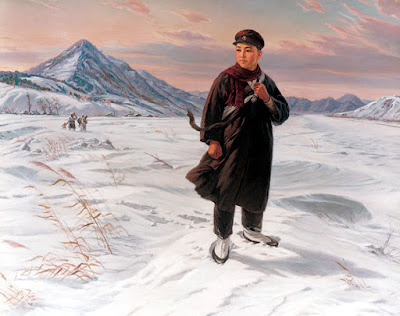
Kim Il Sung as a tween on the 1000-ri Road of Learning
(Src: uriminzokkiri)

This novel depicts Kim Il Sung as a young boy. It tells of his stay with his father in Badaogou [팔도구] in Manchuria, his fabled journey of one thousand ri (400 km) to Pyongyang, his schoolboy days, and his later journey back across the Yalu River. This legendary journey is something all North Korean schoolchildren learn about, and select members of the Youth League recreate the voyage every year - reading this novel as they trek along. The story has been retold in several subsequent novels, but this novel was the first attempt. It thus represents an important formative stage in establishing the hagiographic tropes and style of all subsequent leader representation novels.

Youth League members recreating KIS' 1000-ri journey
(Src: Uriminzokkiri)
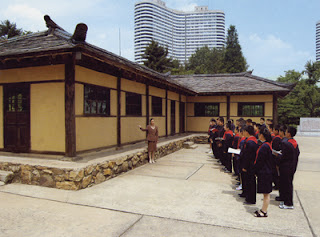
Young Pioneers visiting the Changdok school historic site.
(Src: Uriminzokkiri)

After graduating from a four-year elementary school in Paldoku, at age 12 KIS was sent to stay with with his mother’s family in Chilgol while attending Changdok Middle School. In the novel, while at Changdok the young leader organizes a secret study group comprised of his eager, if rather clueless, classmates, and begins developing his revolutionary ideology while observing people’s lives in the poorer parts of colonial Pyongyang. Eventually, he gets word that his father was arrested again by the Japanese. Entrusting his secret reading club to his friends, he again crosses the Yalu River, firmly vowing not to return until Korea is liberated.

The author, Kang Hyo-soon, is a children's book writer by trade, and his style lends a more playful tone to the boys' antics. While his friends tear around and compete together over normal boy things, KIS always takes on a teacher role, guiding them to see the realities of poverty and inequality in their occupied country. Though only about age 12 in the novel, he is referred to throughout as "The Great Leader" [대원수님].  This presents the author with a unique problem when he is talking with his young friends, who presumably don't know yet that he will one day be the GL, and wouldn't call him Il-sung either since he didn't come up with that name until about 1931. As far as I can tell, the author solves this conundrum by never letting any of them address KIS either by his name or any title. Mostly they talk amongst themselves, and then KIS chimes in to point out where their thoughts have gone astray.

Below is an excerpt from chapter 17 in which the boys watch a soccer match in Pyongyang between rival schools Kwangsŏng and Sungdŏk. KIS uses the match to teach his friends about the value of collectivity over individuality; he observes that "Clearly, in terms of individual skills, Sungdŏk was better than Kwangsŏng. However, the Sungdŏk players had grown arrogant after scoring one goal in the first half, and they lost their lead to Kwangsŏng players while busy showing off their individual skills."
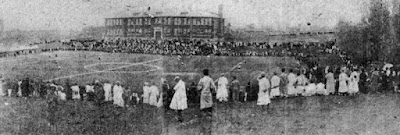
A soccer match in colonial Pyongyang, July 1925
(src: 마니아타임즈)

After the match the boys walk toward the river, passing by the rich American part of town (양촌). Passing a big mansion on the hillside, they see some American kids about their age playing with their pet dog in the yard, tossing cookies into the air for it to catch. 

    “Do those children feel right, giving their dog sweets that even people can’t eat?” the Great Leader spoke as if to himself.
    “Do you think it’s just sweets? Look how fat that dog is. I heard they feed him two chunks of meat every day,” [his friend] In-sam replied.
    “What’s with giving dogs such good food? Meat that nobody else can eat,” said Yoon Byŏng-yi.
    The Great Leader thought on it deeply. Here the Korean people, who are the true owners of this country, are naked and starving, and yet these barbarians from an island country are playing the role of masters of the country, and Americans from across the sea make themselves at home in the midst of the most beautiful part of Pyongyang, the most beautiful city in Korea, living in luxury as if they own the place. What the hell happened to this world? How happy would we be if we chased away all those people and lived in harmony, just us Koreans?
American mission residences on Namsan Hill, circa 1921.
(Src: americanpyongyang.com

This prompts KIS to remember what his father told him about Americans once, back in Manchuria. It was right after they had a visitor from Pyongyang. After the man departed, Kim's father said to him: 

    “At one time, that guy wanted to be a pastor and got really into religion; now at last he’s found the true righteous path. He once thought Americans were good people and had great delusions about them, but now those delusions are shattered. Religion is like opium, once you go crazy for it, you can't come to your senses, and you start to question even whether bean paste is made from beans [팥으로 메주를 쑨다고 해도 곧이듣게 된다]. That's why the Americans sent missionaries in first to spread religion and thus swallow up our fat country. They use religion as bait and capture the spirits of the Korean people - then they can lead them like an ox by the nose-ring [코투레에 꿰가지구] to do whatever they want.”
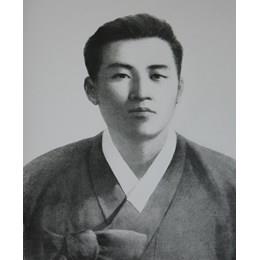
KIS' father Kim Hyŏng Jik 
(Src: 한국민족문화대백과사전)
Wanting to know more, the young KIS asks,

   “Father, are the Americans as bad as the Japanese?”     
   “They’re exactly the same kind of bandits. From the first day America came into existence, they’ve feasted on the blood and bones of others until their bellies grew thick. Every clod of American soil is infused with the red blood of innocent Indians, and on top of that bloody soil they make merry.”
    “Father, what’s an Indian?” 
    “Before North America was discovered by Christopher Columbus in 1492, indigenous people already lived there. Because their faces appear reddish, they are also called Red People (홍인종), but they are known as Indians. From the first day the Yankees (양키놈들) set foot on American soil, they began a merciless slaughter in order to steal their land and treasure. The Yankee jackals even initiated human-hunts to wipe out the Indians. They committed the gross atrocity of taking their scalps (머리가죽을 벗겨내는 만행), awarding 100 pounds sterling for a man’s scalp, half  as much for a woman’s or child’s scalp."
    “Wow, they’re really vicious.”
    “They encouraged the Indian hunts, deliberately planning their complete annihilation. One bastard named Harrison killed an Indian chieftain who had bravely resisted the Yankees, then took the scalp and made it into a belt for sharpening razors (면도칼을 가는 혁띠), giving them out as souvenirs." 
    “Do they just let someone like that live in America?”
    “Not only did they let him live, he eventually became president. Basically the US was a nest of jackals where they judged a person’s ‘contribution’ to the nation by how many Indians he killed and how terrible his atrocities were.”
    “There are lots of black people in America too, right?”
    “Indeed there are.”
    “If the Indians were the natives, then how did all the blacks come to be there?”
    “There are about 100 million people now living in America, but the majority are Yankees who came from Europe, and about 10 million are black. These blacks are descended from Africans who were captured [붙들려온] by European merchants in the 17th and 18th centuries. These European merchants dragged them to America and sold them for money. The Yankee bastards who had a foothold in North America took them and whipped them like oxen or horses, cultivating the wilderness [황무지]. The vast farms in the southern United States today are built on the blood and sweat of black slaves.”
    “In America, black people are treated worse than dogs, right?”
    “That’s correct. Blacks have no rights whatsoever there. You know they aren’t even allowed to enter parks or restaurants where white people go? They’re just made to work like oxen or horses.” Father took a deep breath and went on. “In the short 150 years of its history, the path America has tread has been nothing but murdering people and extracting their blood, bones, and fat, and stealing other people’s territory.
    “It should not be forgotten that these American jackals with their taste for robbery have long been eyeing the lands of the East, of Asia, and have set their sights on our country. It is important to understand clearly that Americans are not only as cruel as the Japanese, but also as insidious and sneaky as the Japanese.
    "The Japanese may be thieves, but they are exposed to the world as thieves; the Americans pretend to be good people while committing their thievery. In other words, the way of robbing is just different, but in essence, they are exactly the same.”
    "Are the Americans in Pyongyang like that?" 
    "Just the same. In Pyongyang there are American-built churches, schools, hospitals and whatnot. But all those pastors and missionaries are really military spies. They pretend to do charity work to pull the wool over Koreans’ eyes, all the while they’re really scouting out opportunities to devour our country. They walk around drawing maps and taking pictures, just waiting for the right time to invade our country. But some foolish people still see Americans as “good” [선량한] - isn't it pathetic? This is especially true of religious people. They don't know that Americans are jackals disguised in sheep skin."
    Father paused a moment before continuing, "In a way, it’s like two thieves have entered our little land of Korea. But so many of those engaged in the so-called independence movement cannot see it, and keep up their high hopes for the US thinking that they will help Korean independence – it’s so frustrating. But we can’t lose hope. That guest who just visited us, he also believed in Americans like heaven at first. However, after meeting and talking with me several times, his eyes have been opened."
 
  
Pyongyang Christian  mission’s school for boys, c.1910
(Src: americanpyongyang.com)

This conversation gives a good introduction to the North Korean orthodox conceptions of religion, race, and territory. In particular, there is no apparent argument here for multicultural society even as something to be aspired to; rather there is a strong ideal of individual races as legitimate "owners" of their respective ancestral territories, living separate but peaceful lives. 

Kim Hyong Jik's description of the African American experience was probably fairly accurate to the time when this conversation supposedly took place, circa 1924. The bounty hunting of Native Americans, sadly, is also true, although the timeline is a bit anachronistic. The part about "Harrison" probably refers to William Henry Harrison and Tecumseh – there are some legends that Harrison killed Tecumseh personally and took strips of his skin as souvenirs. That conflict occurred long after the colonial bounty hunting era, however.

Harder to believe is Kim Hyong Jik's denunciation of religion as "opium" and of American missionaries as jackals and military spies, since he himself worked as a protestant missionary and his wife Kang Ban Suk came from a devout protestant family. 

This will not surprise most external readers - North Korea's reputation for erasing its Christian heritage is well-documented and often portrayed as just a typical case of communist hostility to religion. But the story gets a bit more complicated in tales of colonial Korea, where Christian institutions played such a prominent role in aiding the Korean independence movement and resisting the Japanese. In South Korea today the association between Christianity, America, and colonial resistance is not too confusing, since the US was Japan's eventual enemy in WWII. But for North Korea, Japan and the US are both portrayed equally as eternal bad guys. Hence passages like the above work extra hard to establish that even though American missionaries may have seemed to oppose Japan's takeover, they were and are no friends of Korea.

Wednesday, September 2, 2020

Eternal Life (1997): Kim Il Sung and Jimmy Carter on a boat

This entry continues my summary of select chapters from the important Imperishable History series novel Eternal Life (previous entries here and here). This novel was published in 1997 and co-authored by Paek Po Hŭm (who later contributed the short story "Green Land" to the first anthology of stories about Kim Jong Un) and Song Sang Wŏn. It covers the events of the last seven months of KIS' life, including his 1994 summit meeting with former US President Jimmy Carter.

Jimmy Carter and Kim Il Sung in 1994

In Chapter 18, the Carter delegation is treated to a surprise boat ride on the Taedonggang River through the city. President Carter and KIS continue their negotiations and reach an astounding level of agreement.

Chapter Summary

The world waits with bated breath for news of the summit. After the first summit meeting, CNN had broken the news that KIS had agreed to hold off on expelling the inspectors in exchange for the promise of a light water reactor, and now everyone is waiting for the US response. 

    The press remained silent, seemingly giving the Americans time to think. Meanwhile, a ferocious debate was playing out across board tables and conference calls as the pro-dialogue moderates, led by Clinton, debated the hardliners, led by Senate Republican leader and future presidential candidate Bob Dole. The debate between the two sides generally boiled down to three main points: 1) Whether it would be better to spend $80 billion and just go to war with NK, or spend a tiny fraction of that to provide a LWR; 2) If they did provide the LWR, how to contain the backlash from their ally “South Korea” at being completely excluded; 3) How to deal with the loss of face from to acceding to Pyongyang’s pledge, which implied concessions from the US.
   The debate raged on into the early morning hours.

Just past 5am, Jimmy Carter gets Washington’s response: they're willing to withdraw the UN sanctions resolution and hold a third round of talks to discuss the LWR. But in return, Korea must make important “concessions.”

That morning, Carter's delegation headed out prepared to play hardball, but they were surprised when the driver took them to the river instead of the conference hall. They found KIS waiting on the dock alongside his luxury river cruiser, the Moranbong. “Mr. Carter, why don’t we take a pleasure cruise to the West Sea. Along the way, we can say what we need to say.”

Taedong River view with Juche Tower and 
May 1 stadium

So they all take a leisurely cruise through the city; KIS plays tour guide, pointing out famous sights like the Okryugwan restaurant, KIS' childhood home on Mangyongdae hill, and Pyongyang's Arc de Triomphe. A scrum of foreign reporters follows on a separate boat. At one point KIS suggests, “Before we get down to the main discussion, why don’t we give your media something to shoot?” Carter agrees, and they let the other boat pull alongside to take photos.

Then, observing people fishing on the riverbank, KIS asked Mun to slow the boat down. At Carter’s puzzled look, he said:

   “Mr. Carter, do you like to fish?”
   “I do.”
   “Then it seems we have a common interest.” Glancing at the fishers on the riverbank, He continued, “As a fellow fisherman I’m sure you understand, there is nothing more annoying than a passing motorboat kicking up a wake. It wouldn’t do for us to earn their ire while holding our very productive summit.”
    Carter looked at the fishermen again with new eyes, amazed that the president could spare a thought for them despite being at the center of the world’s attention on this historic day… Thinking back on his own time as president, his face reddened in shame, thinking “I was a ruler and an administrator. As president I governed over people, but this president supports his people.”

Finally, after a pointed look from Dr. Creekmore, Carter quits stalling and gets down to business. With great fanfare, he reveals that the administration is willing to open a third round of talks with North Korea on providing a light-water reactor. They also discuss possible paths to reunification and moving troops away from the NLL, before the subject turns to the UN sanctions resolution. 

   [Carter] “I want to pass on the rest of the message from the administration. Premier, the US has decided to withdraw its sanctions resolution against your country at the UN.”
   Carter watched closely for the leader’s response.
   But Premier Kim Il Sung just regarded him silently.
   “This withdrawal,” Carter went on, thinking He had misunderstood, “was communicated to me directly from the White House. They asked me to inform you personally.”
   Premier Kim Il Sung just looked bored, gazing absently out the window. Finally He spoke. “I thank you for passing on this important news. But it’s just a nice change.”
   “What!?”
    “The truth is we’re not afraid of sanctions. We’ve survived under sanctions all this time; we’ve never been without them. We’ve faced sanctions from you, and from Japan, and others. We’ve been under sanctions so long that we don’t really think about them any more.”
   Carter was speechless as Premier Kim Il Sung went on. “In other words, whether you cancel the sanctions or not, we’re fine either way. This confrontation is your fault, not ours. You wouldn’t trust us, so we can’t trust you. You’re always trying to make us poor, but that doesn’t mean we are poor. No matter how much you try to pressure us, we’ll get on just fine. Please pass that along to President Clinton and your colleagues.”

Following this exchange, the subject turns to North-South relations. Carter delivers a message from ROK President Kim Young-sam, expressing willingness to hold an immediate North-South leadership summit to discuss matters of concern, including unification.

KIS swiftly responds in the affirmative. Again Carter is perplexed; he had expected heavy resistance. “Premier, I’m sure you feel a lot of anger toward the South Koreans; are you really willing to meet with them?” KIS replies their nationalist mission must supercede any ill feelings. Carter is overjoyed, but he feels a twinge of misgiving at the thought of a great statesman like KIS facing off against Kim Young-sam, who he considers "a mere political hack" [한갖 정상배에 지나지 않는]. 

The river cruise concludes on a high note with a banquet featuring hot Kŭmchŏngju liquor. KIS delivers a heartfelt speech on Koreans' universal desire for unification and invites Carter to tour the newly discovered tomb of Tangun "on your next visit." 

Foreign perspective

In addition to illustrating KIS' skilled statesmanship and clarifying policy stances, this chapter also takes advantage of the occasion of a foreign visitor to portray North Korea through an experienced world traveler's eyes. The text at times reads like a travelogue highlighting the famous sights of Pyongyang as the Moranbong cruises past them.

As the two leaders chat aboard Kim’s riverboat, the subject turns to the nature of the North Korean people.

   Carter suddenly became contemplative. “I’ve traveled all around the world, but I don’t think I’ve ever seen a leader who serves his people as sincerely, or a people who revere their leader as much as they do here.”
   “Thank you. It’s long been the way of our people to view loyalty and filial duty as virtues... We are a wise and sagacious people. It’s said that the Jews are the world’s most gifted people, but Koreans are actually even more gifted (재간있다). They say the Jews are special because they produced Jesus, who sacrificed himself for them. But it was because of Judas, a Jew, that Jesus was betrayed and nailed to the cross to die. So it seems that the Jews are a gifted people, but prone to betrayal. Our people have wisdom but also value loyalty (신의) as much as life itself.” 

In this passage, we see the North Korean people through Carter's eyes. KIS uses another race, the Jews, as a reference point to point out that Koreans are equally intelligent but superior in loyalty. It is telling that Carter is presented as a reliable witness to the virtues of the Korean people precisely because he has “traveled all around the world” and thus presumably has the global experience to compare Koreans against other races.

Carter's perspective also works to illuminate the contrast of North and South Korea. At one point, KIS presents his stance on reunification:

    “Our policy is to pursue unification as one people, one country, two systems and two governments. In other words, the separate governments of North and South will remain in place, with a common chairperson placed over them. That way we will stop fighting, and there will be no more unfortunate problems between us and the US. How about it? Will you lend your support to peace on the peninsula? Think how that would raise your profile as a master negotiator.”  
    “Great.” Carter felt pleased... “Premier, can I ask you something? ... Right now, the thing that worries South Koreans the most is that your side is insisting on unification without foreign interference, but they worry that if the US military withdraws you will attack them.”
    “As I’m sure you know, we have proposed a troop draw-down to 100,000 on both sides of the peninsula, along with US withdrawal. But the South Koreans don’t talk with you of our intentions.”
   “Really?” Carter looked thoughtful.
   “See here. It’s because you’ve been dealing only with them that these misunderstandings occur. But so far I haven’t complained about this unfair treatment. After all, it’s not Chinese or Japanese you are dealing with, but Koreans of the same blood as us."
   Thinking back, since his arrival, Carter hadn’t heard anyone say one bad word about the South... But what of the other side? Any time South Koreans so much as met an American they went crazy slandering the North. Carter had listened to them of course, but their calumny was so extreme that it was just embarrassing. It was frankly disappointing to see how far they had fallen from the spirit of national solidary compared to the Northerners. 

Here Carter again seems to serve as a reliable worldly witness to the superiority of North Korea. His perspective is a powerful tool because he is motivated to side with the South, yet he can't help but be swayed by the superior Northern manners.

Hidden Forces in US Politics

Toward the end of their ride, Carter discusses the current political dynamics in the US.

   “Our country now has a president with a Senate majority for the first time in many years. This means our current president can consider new approaches that would never have been possible for Bush or Reagan.”
   “That’s good.”
   “But unfortunately, the president faces many political obstacles, both domestic and foreign. Of course, his election victory means that the political forces supporting him are on the rise. Among them are many people who are very sensitive to ecological and technological issues; they are strongly opposed to the spread of nuclear weapons. On the other hand, there are people who feel differently, too many for the president to ignore. Our relations with Europe are more complicated now too, meaning he has to deliberate with them on foreign policy more than in the past. In my view, these and other factors limit his ability to compromise on the Korea issue. But I can give you my personal guarantee that President Clinton is making a good faith effort to ensure that all these issues get resolved fairly.”
   After thinking quietly for a moment, Comrade Kim Il Sung replied solemnly, “I believe you.”
   What He was referring to was not Clinton or his administration, but the deeper forces directing the superpower from behind the scenes, the forces that had no choice but to wave the white flag before our Republic. And His belief was based on faith in the might of our Republic that no force on earth could hold back. 

This passage illustrates a recurrent theme in NK fictional depictions of summit diplomacy. Anyone who meets KIS in person is immediately won over by him; but this presents a problem when the diplomat is a foreign leader with actual power. If KIS' summit diplomacy is such a resounding success, why didn't the whole conflict end after the Carter summit? Here is where mysterious "deeper forces" step in to block further progress. 

It would seem that North Korean fiction writers are big believers in the "deep state."

Links 

Dr Creekmore's book, A Moment of Crisis, tells the story of this summit from the US viewpoint. C-SPAN has video of Creekmore and Carter reminiscing about the trip while promoting the book in 2006. 

Friday, November 1, 2019

Eternal Life (1997): Introducing Billy Graham and Jimmy Carter

Eternal Life is the final novel of the Immortal History series, which chronicles Kim Il Sung's life from his days as a guerrilla fighter through the country's founding, war and reconstruction, and on through his later years.  It was published in 1997 and co-authored by Baek Bo Hŭm (who later contributed the short story "Green Land" to the first anthology of stories about Kim Jong Un) and Song Sang Wŏn.

This novel covers the events of the last seven months of KIS' life, including the decision to withdraw from the Nuclear Non-Proliferation Treaty and his 1994 summit meeting with former US President Jimmy Carter.

Devoted readers of this blog might recall that this same summit was also the subject of the short story "Enchantment" (매혹), covered in one of this blog's earliest entries. That story took the point of view of First Lady Rosalynn Carter. This novel was written earlier, and the summit chapters alternate between the perspectives of KIS and President Carter.

In Chapter 15, we get a window on KIS' thoughts on the eve of the summit, as he sits in his office working and thinking through the night.

Chapter 15 Summary 

KIS recalls what he knows of the 39th president, including his childhood, family background, schooling (noting that he attended "a black primary school" in Georgia and later graduated 33rd in his class from the US Naval Academy), his early military career, his success in expanding the peanut farm he inherited, and his later political career.

The story lingers particularly on Carter's early encounters with nuclear technology as a young naval officer.
   That was when Carter became involved in the construction of K-1, the world’s first nuclear submarine. In the wake of the atomic bombing of Japan in 1945, the majority of America’s youth were basking in a sense of superiority as “citizens of the Great American Empire,” but the young Carter was filled with fear. He understood the horrific tragedy that the bomb represented for humanity.
   Five years later, participating directly in constructing another kind of nuclear weapon – a nuclear submarine – he wasn’t as fearful as he had been, but he felt a residual unease and a sense of emotional objection. Taking a sudden leave, he took his girlfriend Rosalynn (then a college student) and escaped to a resort in the South Pacific. Walking the beach, he tried to forget the 20th century evil that had so preoccupied his mind.
   At that time his views on nuclear weapons were not rooted in any political ideology. His objections stemmed not from politics but from his philosophy of humanism, or more precisely benevolence, which was a product of his Catholic faith.
KIS then recalls that he has heard that Carter is a friend of the Reverend Billy Graham, whom he has met twice before.
   “Billy Graham!” He whispered softly to Himself.
   In His mind’s eye He saw an image of Graham, his heavy build and fierce expression belying a gentle and charitable nature. As a Christian, Graham followed a creed of generosity. He had served as an army chaplain during the Korean War and faced censure for praying for KPA soldiers as well as American soldiers. But he did not waver, saying it was his duty to pray for all.
Reverend Billy Graham meeting Kim Il Sung.
Src: The Washington Post 
The story then delves into a history of McCarthyism in America, explaining how "Red Terror" caused innocent Americans to fall under suspicion. It notes that Graham would have been a target if it were not for his status as a Christian pastor, but that he sympathized with the victims and it was an important formative experience for him.
   Several decades later when Graham visited South Korea, he felt that he was seeing the rebirth of McCarthyism there. The “National Liberation” (주사파) furor strongly reminded him of American McCarthyism. This was a hysterical movement to round up and arrest the followers of Juche ideology. At the sight of so many Korean students, intellectuals, legislators and laborers being arrested, he saw the nightmare of the 1950s resurrected. And he began to wonder what it was about this ideology, this idea, that had the south Korean authorities so fearful and so many young people and citizen laborers (근로민중) risking bullets and violence to follow it.
Graham made his first visit to Pyongyang in March 1992. The story notes that this first mission, occurring just after the collapse of the Soviet bloc and amid expectations that the DPRK would soon follow, had an ulterior motive of observing the state of the country and assessing the likelihood of its collapse.

Dormitory in the American Compound of the Pyongyang
Foreign School, 1939.
Src: Shannon McCune Collection, UW-Madison
The story explains that Graham had a peculiar connection to Pyongyang because his wife Ruth had once lived there. The daughter of Christian missionaries in China, as a teen Ruth had attended the famous Pyongyang Foreign School for girls from 1933-36. The Pyongyang that Ruth had known, in those days before liberation, must have seemed shabby to her eyes. When she heard her husband was going there she had a lot to say about the city, none of it nice. 

But when Graham tours the city, he is impressed by the streets teeming with vitality, the tall new buildings emblazoned with banners reading “Long live our-style socialism!” Thanks to the devastation of the war, there are no buildings older that 30 years. 

With no old buildings anywhere, how is this place supposed to collapse? he thinks.

KIS then recalls his second meeting with Reverend Graham, which occurred just last January amidst preparations for the Three-Step Process meetings with the US. He recalls that "interest in the reverend’s visit was intense" because "Reverend Graham was the most popular and influential person in the US after the president himself."

After delivering the president’s verbal message of good will for the new year and passing a few pleasantries, they sit down to a banquet. KIS expresses to Graham “Since you are both Clinton’s friend and my friend, I hope you will help to make it possible for us to sit down together.” Graham promises to "carry your words with the same weight as the gospel.”

Now, as day breaks on the morning of the summit, KIS thinks hopefully that he can forge a friendship with Carter as he did with Graham.

Forging Friends among Enemies

This novel, the short story "Maehok," and the novel Ryŏksa ui Taeha (excerpted earlier in this blog) represent relatively rare examples of North Korean literature describing interactions between the Leader and foreign dignitaries. I have searched in vain for examples of stories that cover more recent summits, such as Madeleine Albright's 2000 visit, Koizumi Junichiro's 2002 summit, and the later brief rescue missions by ex-Presidents Clinton and Carter. It could be that I simply haven't found them yet, or it could be that these later meetings were simply not important or successful enough to merit literary treatment. As a general rule, North Korean fiction will not cover an event until it is far enough in the past to allow for a settled and resolutely positive interpretation.

In all of these stories, the Leader always blows away his guests with his hospitality and benevolence. The visitors arrive ready for a fight, for prevarications and insults, and are surprised to find a leader who is more honest and forthright than anyone they've ever encountered. Visiting to Pyongyang for the first time, Graham has a revelation:
   He never would have imagined it when he left, but he was completely won over by Comrade Kim Il Sung’s grace, honesty, kindness and benevolent presence. Graham had expected that He would try to conceal the serious problems brought by the collapse of the communist bloc when assessing the state of His country. But it was not like that at all. Comrade Kim Il Sung concealed nothing. He was extremely frank in describing the difficult straits the country was in. He was even more astute than Graham himself in evaluating the problems brought on by socialist malfunction in other countries.
   This was completely unexpected. Listening in astonishment, Graham sensed that this was a man who would always speak the truth no matter who He was talking with; at the same time, he realized that socialist Korea would never collapse as long as such a leader was in charge. It takes a truly strong leader to acknowledge tough circumstances. When Comrade Kim Il Sung said “Korea will fight to uphold socialism no matter what,” Graham was completely convinced.
The chapter ends with KIS looking forward to his upcoming summit with Carter:
   Recalling His days with Graham, He softly whispered to Himself: “Carter said he met with Graham before coming to Pyongyang… The time has come for me to meet him and speak the truth. Maybe I can build a friendship with him too.”
   The Great Leader Kim Il Sung, who had a gift for forging friendships among the enemy, felt confident that His hopes would come true. 
This image of the Leader "making friends among enemies" is clearly the central theme of this chapter and other summit stories. He is shown extensively studying his counterparts before each meeting, learning intimate details of their lives. Graham's and Carter's biographies are picked apart for clues as to why they may be more amenable than other foreigners. Everyone who meets the leader is instantly charmed and becomes a steadfast defender. It is only the implacable, inscrutable, faceless American government that stands in the way of improved relations.

Christian Faith and Juche

A young Billy Graham traveled to Korea to minister to
US troops in 1952. He was not an army chaplain, as this
story suggests, but a civilian.
 Src: Billy Graham Evangelist Organization
The chapter describes both Reverend Graham and President Carter as men of great faith and fairness. It notes that Carter's Christian faith led him to abhor the nuclear weapons that other Americans celebrated, and Graham was censured for praying for KPA during the war. It also notes that Graham's first visit to Pyongyang had an ulterior motive:
Let me see for myself. For 100 years communist ideology has rejected all religious faith; how long will it be until its last bastion collapses?   This was the question he was sent to answer by then-President Bush. But instead of being a government spy, he ended up forging a deep friendship with the Leader. 
On that first tour, Graham visits a Christian church in Pyongyang.
   After praying there, he asked Comrade Kim Il Sung, “What are you doing to guarantee freedom of faith?”
   He replied, “As you saw, we have built a Christian church, even though our construction needs are great.”
   Overjoyed, Graham then asked, “I suppose you’ve noticed the commonalities between Juche thought and the teachings of Christianity?”
   “Similarities?” Comrade Kim Il Sung thought a moment and then said modestly, “Thank you for holding Juche to such a lofty comparison.”
   Graham didn’t press the matter any further. But he privately believed that Juche and Christianity shared the same basic ideal. That ideal was love.
On his second visit, when Graham attends a banquet in his honor, the Leader makes an unexpected gesture.
   “Let us pray,”  Comrade Kim Il Sung said as they took their seats around the banquet table.
   “What?” Graham gaped, as if he could not believe his ears.
   “Isn’t it a Christian custom to pray to God before a meal?”
   Graham was speechless. He, who had affirmed his Christian faith at age 16 and preached to 110 million people in 84 different countries, could hardly forget this basic rule.
   “The food is getting cold,” he said.
   Comrade Kim Il Sung merely waited, not picking up His spoon.
   At last, Graham rose and lifted his glass. “I thought I’d forego that custom tonight. Instead, let us toast the health of the Chairman, who is like heaven to the people of this country.”
   Comrade Kim Il Sung stood, waving His hand. “No, no, I’m not these people’s heaven, I am their servant.”
   “Then I bow my head all the more to you.”
This and earlier stories suggest that, rather unusually for a socialist state, North Korea's propaganda does not treat religion with scorn. Rather, it depicts religion and Christianity in particular as a stepping stone for foreigners on the way to finding the superior ideology of Juche. Carter and Graham's Christianity is described as "a creed of benevolence" that enables them to see past political enmity and embrace common humanity.

In the North Korean interpretation, it is not in spite of but because of their devout Christianity that these men are able to see the truth of Juche, while the godless politicians back home remain stubbornly opposed to it. The text openly acknowledges similarities between Christianity and Juche, but rather than acknowledging that the latter plagiarized the former, it suggests that the former foreshadowed the higher truth of the latter. The passage tying together Graham's Christian faith, his abhorrence of McCarthyism, and his curiosity about Juche ideology is particularly revealing.

Of course, it must be repeated, the official propaganda position is far removed from the actual treatment of people of faith in North Korea.

Friday, November 3, 2017

"Him in December" (12월의 그이) - Kim Jong Un buries his father

"Him in December" (12 wŏl ŭi kŭi) is a short story by Hwang Yong Nam that appeared in the collection A Promise of Fire (Bul ŭi yaksok) in 2013. The story follows the young successor Kim Jong Un through the mourning period following his father's death in December 2011.

Kim Jong Il's body lies in state.
Src: Daily Mail
The story is noteworthy for its depiction of South Korean political, academic, media and online discourse as well as its specific mention of many South Korean political and societal leaders. One can get a sense of where various individuals stand in the North’s favor at this particular point in time: liberal ex-presidents are up, the Hyundai chairman is down, Reverend Moon Ik-hwan is still fondly remembered.

To the North Korean reader, it relays with outrage how foreign media have suggested that their tears are “staged.” It also suggests that many, many South Koreans were quite desperate to pay their respects but were blocked by the government.

The Plot

The story opens on the day after Kim Jong Il’s death was announced; KJU stands before the casket officiating. He stands like a rock for two hours as wave after wave of sobbing citizens come forth to pay their respects. KJU alone cannot indulge in the luxury of tears; he has to be strong for the people.

In the midst of his grieving, KJU is shown attending to a hundred different details related to the funeral plans, various high-level delegations and other minutiae. He realizes for the first time just how hard his father worked and how many details he attended to every single day with great respect and care for the people. 

He encounters the all-female Persimmon and Wildflower Brigades, who declare that “our powder is dry” and ask for orders. They are furious at the South Korean president Lee Myongbak for his statement issuing condolences “to the people of North Korea” and not to the government.

Female soldiers mourn Kim Jong Il's death.
Src: The Telegraph
KJU wants to initiate an open-border policy to allow South Korean mourners to come and pay their respects, but his generals worry that the ROK government will take advantage of any opening to launch an invasion, even in this time of national mourning.

KJU then takes a drive through the snowy streets of Pyongyang, mapping out the route of the funeral procession. The story meticulously mentions each of the iconic sights of Pyongyang that they drive past: the 4.25 Cultural Palace and Kim Il Sung Square, Okryu Bridge and the KWP Founding Memorial Tower, the greenhouses that grow the Kimjongilia flowers. 

----

On a cold wintery evening, Kim Dae-jung's widow Lee Hui-ho is gazing out at the sunset. Despite her advanced age of almost ninety, from the moment she heard the news she had been determined to pay a condolence visit to the North. If only her husband were alive, he would surely accompany her.

Lee Hui-ho with her husband Kim Dae-jung at his
inauguration in 1998.
Src: Kim Dae-Jung Peace Center
Hearing of her request to make a condolence visit to the North, Representative Pak Su-won of the Democratic Party has come to visit.

Together they reflect on better times, after the 6.15 Declaration, when media executives traveled North to beg forgiveness for their bad behavior, cultural exchanges took place several times a year, tourists could freely visit Mt. Kŭmgang, and pretty northern cheerleaders came down to Pusan and set young men's hearts aflutter. But alas, now the "Big 3" media were up to their old tricks, idiots were talking about war rationing, and they had just lost the one man who fought for peace - Kim Jong Il.
"It's not just me. Former Minister Lim Dong-hun, President Roh Mu-hyŏn's widow Kwŏn Yang-suk, and many others want to go. I'll do what I can. But looking at the current government attitude, we can't hope for much."
Since word had come down that the North was willing to accept condolence visits from any representative of any group or party in the South, the government had been frantic to come up with some excuse to block their visit. First they demanded that some family be left behind to ensure their return, and then they made noises about posting spies with the delegation. Next they started quibbling about scheduling and procedures.

Finally, this morning a call came from the Ministry of Unification, telling Lee to prepare to leave but offering all sorts of ridiculous instructions – bring plenty of food and clothing, don't bow your head, etc. 

That afternoon, her son Kim Hong Il returns from his visit to the Ministry of Unification in a bad mood. "Those no-good politicians. They're refusing to let Representative Pak come with us." He explains that they have categorically rejected all applications by actively serving government representatives and civic groups, as well as President Roh Mu-hyŏn's widow and the family of the late Reverend Moon Ik-hwan. Around Seoul National University students are putting up wall posters faster than officials can tear them down, demanding to be allowed North.

KWP Central Committee Member Kim Ki Nam
greets Lee Hui-ho at her husband Kim Dae-jung's
funeral in 2009.
Src: Hangyoreh
Unbelievably, it appears that Hyundai Chairman Hyŏn Jŏng-un may attend. Lee is outraged that Hyŏn gets to go when Roh's widow and Moon's family are denied, since those two worked so hard for unification. She recalls Reverend Moon's words when he was sentenced to prison for traveling North: "It seems like people can go North for business, but not for unification."

They speculate that the reason Roh's widow was denied is because North Korea only sent a condolence telegram when Roh died, not a full delegation like they sent for Kim Dae-jung. This kind of pettiness is typical of Unification Minister Yu Wu-ik and the transactional attitude of the president. "He may have started as a businessman, but he's our president now," Hong Il complains. "He can't just pursue profit, he's supposed to represent the people's spirit (minshim)."

Observing his mother's agitation, Hong Il has been holding back on the really bad news, which he finally reveals: They are only allowed two days and one night for their trip north. They'll leave tomorrow, and return the next day, before the funeral. Why? Because that's exactly how long the North Korean delegation stayed for Kim Dae-jung's memorial.

"This is really too much," Widow Lee mutters, disgusted.

---

As Lee Hui-ho's delegation travels north along the unification road to Pyongyang, she reflects on how much has changed. Has it only been a decade?

Kim Dae-jung and Kim Jong Il in the Baekhwawŏn
Reception Hall, June 2000
Src: Tongil News
She warmly greets Secretary Chŏng Sŏn Il and is surprised by the familiar face of her driver from the 2000 visit, who has been appointed to chauffeur her again. Amazed by the warm welcome, she remembers how the MoU busybodies had fretted and warned her about the likely broken-down facilities and bad infrastructure she would find in the economically depressed North. Why, it is quite the opposite!
   "We've prepared the same suite you stayed in last time, at the Baekhwawŏn Reception Hall."
   Lee Hui-ho is startled by the words. Why, Baekhwawŏn is reserved for visits by heads of state! To think they went to such lengths for their shabby entourage.
   "It's on the Dear Leader Kim Jong Un's orders. He said you are to have the same room in the same condition as when you and President Kim visited... And he's the one who thought to arrange the same driver for you. He said to spare no effort to make you feel at home."
Kim Jong Un in a tank,
January 2009
Src: Yonhap
    Lee Hui-ho felt like she was dreaming. In the South, from the moment they first saw Deputy Chairman Kim Jong Un on the TV - his manner, his gait and his broad smile - why, everyone said he was like Kim Il Sung reborn! Since he was shown driving a tank at a military base on New Year's 2009, he had been portrayed as merely a professional soldier. And he was linked to the punishment of Yŏnpyŏngdo. And when he launched the Gwangmyŏngsŏng 2 rocket, and they said he was prepared for war, they all thought him terribly intimidating.
   A young, vigorous and decisive leader. That's how they thought of him in the South. Who knew he could be so thoughtful, so considerate?
That evening, Lee Hui-ho and entourage pay their respects to Kim Jong Il's body. There's a lot of crying and apologizing on behalf of South Korea for being so insensitive.
Lee Hui-ho, widow of former South Korean President Kim Dae-jung,
pays her respects to Kim Jong Il's casket.
Src: Joongang
The next day, with great regret, Lee's delegation says goodbye and returns South. The next day, they watch on TV as the funeral procession wends through the streets of Pyongyang, gasping as the hearse is swarmed by grieving people. "How could anyone look at that river of tears and say it is all just 'acting,' or 'forced'?" Lee wonders.

Back in North Korea, the funeral draws to a close. Gazing at the assembled top officials and military officers, Kim Jong Un makes an impassioned speech which includes the line, "We can forgive many things. But we can never forgive the crime of disrespecting our people's tears."

Seasonal Imagery

This story is chock full of winter metaphors. The Lee Myong Bak administration is described as a "cold frost" that froze over the warm wind of the 6.15 Inter-Korean Summit. The South Korean scenes are repeatedly described as cold and desolate, with great dark clouds threatening snow. Lee Hui-ho constantly refers to the current political deadlock in seasonal terms, saying "When will this cold snap end?" and "I think this winter will be very cold indeed." 

The North Korean delegation that went south for Kim Dae-jung's funeral is described as "a breath of warm spring air blowing on the frosted ground of the South." It is explained that Kim Dae-jung's nickname was "Honeysuckle" because he was to be "the weed that triumphed over winter." "Winter" of course refers to the period of Lee Myŏng-bak's presidency, when North-South relations were at their nadir.

North Korea's Condolence Delegation

This story contains an interesting reinterpretation of the August 2009 delegation of North Korean officials to Seoul to offer condolences upon the death of the late South Korean President Kim Dae Jung. This section begins at the visitation, as KJU talks with Central Committee Secretary Han Su Nam.
  "Secretary Han Su Nam!" His voice thundered out. "When was it we sent that condolence delegation south?”
  “Two years ago, in August.”
  “Only two years, then."
  It was two years ago, in August, that all North-South cooperation stopped. The Lee Myong-bak administration’s insane confrontation policy, known as the “lost decade," reached a fever-pitch with the Mt. Kumgang tourist incident. As the whole world was going crazy over our nuclear program, the cretins collaborated with foreign forces, and their bad behavior worsened. The warming mood that followed the 6.15  agreement had completely frozen over.
  After our editorial harshly condemned the traitor administration’s so-called “pragmatic government” as anti-Korean and anti-unification, North-South relations had deteriorated to a state even worse than before the 6.15 agreement. And then Kim Dae-jung passed away.
   The condolence delegation to Seoul, sent in the name of the General, was like a breath of warm spring air blowing on the frosted-over ground of the South at the height of confrontation. When the Central Committee Secretary Han Su Nam stepped out on the tarmac at Incheon airport, the south Koreans lowered their heads in awe at the great magnanimity and brotherly love of the General. The people lined the road all the way from Incheon to Seoul, waving flowers and cheering:  “Thanks to the benevolence and fraternal spirit of NDC Chairman Kim Jong Il, Kim Dae Jung will remain honored in our people’s history forever.” “Even though our land is divided, the blood of our people flows together as one.”
  Meanwhile criticism grew more concentrated against Lee Myung Bak and his policy of confrontation with the Republic. Though he had adamantly resisted, eventually he had no choice but to meet with the delegation. Secretary Han, who had been entrusted with handing over the General's personal letter of condolence, remembered his growing disillusionment as he watched the man flounder. 

Kim Ki Nam (second from left) and other North Korean officials
present flowers at Kim Dae-jung's funeral, August 2009
Src: SinoNK
For reference, here is Hankyoreh's coverage of the 2009 condolence delegation: http://english.hani.co.kr/arti/english_edition/e_northkorea/372535.html 
Note: The delegation actually arrived at Kimpo airport, not Inchŏn. Needless to say, the roads from Inchŏn to Seoul were not lined with people shouting the above slogans.

From the above excerpt, we can assume that "Secretary Han Su Nam" is probably Kim Ki Nam, the Central Committee secretary who joined the 2009 condolence delegation (http://www.nkleadershipwatch.org/kim-ki-nam/).

South Korean key words

At several points this story invokes phrases that hint at how North Korea's writers are in tune with South Korean media terms and key words. The following terms appear in the story:

실용정부 "pragmatic government" - another term for the Lee Myŏng Bak administration; the North Korean text uses this term disparagingly several times.
흡수통일, 급변사태대응책 "Unification by absorption" "Response Strategy for Sudden Emergency" - phrases in vogue whenever North Korean collapse seems imminent
잃어버린 10년 "the lost decade" - refers to the ten years of sunshine policy.
인동초 "Honeysuckle" - apparently this was a nickname of Kim Dae-jung. This seems fairly obscure, but one South Korean blogger wrote this post explaining its meaning.
목포의 눈물 "Tears of Mokpo" - The story describes this as one of Kim Dae-jung's favorite songs. This song is indeed associated with Kim Dae Jung, who considered Mokpo his second hometown.
보안법 National Security Law - The law invoked in South Korea to crack down on pro-North sentiment. Apparently the incident with the incense altars being prohibited by the NSL actually happened.
다음, 네이버 Daum, Naver - listed among the "big 5 internet sites" of South Korea that supposedly posted mourning pages for Kim Jong Il. 
퍼주기 to overfeed, coddle - this is a phrase that was used a lot by South Korean conservatives as the Sunshine Policy was winding down in the late 2000s. In the story, the MoU officials use this phrase to explain their opposition to a condolence visit: "We can't keep coddling them all the time."

Tuesday, January 24, 2017

Lim Soon-hee's new book on North Koreans and religion

Dr. Lim gave me a free copy of her latest book, 북한 주민의 종교성 (Religiosity of the North Korean people), which is full of great anecdotes and quotes. This book should be of great interest to those interested in studying the state of religious faith in North Korea or the religious elements of the Kim family cult. Her primary source material comes both from interviews with North Korean defectors living in South Korea and her extensive reading of North Korean literature.

Inside a state-sanctioned North Korean church service.
Src: Donga
The introduction discusses the current state of religious practice in North Korea, the regime’s policy on religion and its evolution over time. It includes some interesting excerpts of interviews with North Koreans, who recount their actual experiences of religious practice in North Korea today.

The second section sets the scope, giving an overview of the three religions under observation (Confucianism, Christianity, and Korean folk beliefs), and identifying the main identifiable components of each that are relevant to North Korea. For instance, as regards Confucianism there are three key observable components: 효 (filial piety), 남존여비 (patriarchy), and 장유유서 (respect for the elderly). As regards Christianity, the important themes are “love” (both brotherly love and God’s love), “eternal life,” “salvation,” and “heaven on earth” - all concepts that have been adapted to the Kim family cult. Folk beliefs incorporate practices like fortune-telling, shamanistic rituals, and talking to spirits - all of which are still actively practiced in North Korea today despite the official prohibition on them.

The third section is where the real meat of the research is - analysis of the religious elements incorporated, intentionally or unintentionally, into various excerpts from North Korean literary works.

For instance, in the section on “folk beliefs” Dr. Lim identifies numerous references to “하늘” (heaven or God) found throughout modern North Korean fiction. Some of these are automatic utterances of old sayings, as one might say “goddammit” or “Thank God” in English without any real religious feeling. At other times, characters seem to see the hand of God in miraculous events. In one incident in the novel “한 자위단의 운명,” Kim Jong Il is driving an ORV along a muddy mountain path when the vehicle begins to slide downhill, stopping finally just at the edge of a cliff. Kim’s attendants in the convoy lose their minds, exclaiming that God must have saved the General (하늘이 장군님을 도왔습니다). (박윤, <오성산>, 평양: 문학예술출판사, 2012)

In one scene in the novel 해방전야, after a character speaks critically to Kim Il Sung, another character chastises him by saying “하늘도 무섭지 않나?" (an old Korean expression, translated as “Don’t you fear God?”).  This could be taken to imply that Kim Il Sung himself has taken the place of God, or that God in heaven will punish those who speak critically of his servant Kim Il Sung; either way, some sort of God is at work.

Dr. Lim recounts various ways in which North Korean literature compares the leader to God and even describes him as a God. For instance, there is this line from Rim Byong Soon’s treatise “Thoughts about God": “If there is a God, he would appear pathetic in comparison to the boundless foresight, generosity and wisdom of our General… The God that exists in the faith of religious people is a mere illusion, but the absolute faith of our people rests in a real God (현실의 하늘), General Kim Jong Il.” (림병순, “하늘에 대한 생각”, <조선문학> 제9-10호, 1994)


Parts of the book discuss the god-like qualities ascribed to Kim Il Sung in North Korean fiction. Many times in novels and essays, various authors refer to Kim as being "a great man descended from heaven" (하늘이 내신 분, 하늘이 낸 위인) to "save" the Korean people. In the novel <항일의 전설적영웅>, Kim Il Sung appears before an old man in a dream and tells him where a secret cache of gemstones are buried. The old man proclaims that Kim is "a great man who can perceive divine secrets and even see deep within the earth!" (천기를 내다보실뿐아니라 지하수천척까지 들여다보시는 위인). The novels <백두산장수별> and <백두산전설>, which recount the anti-Japanese guerrilla struggle, ascribe numerous miracles to Kim Il Sung:

  • Turning pinecones into bombs
  • Turning grains of sand into grains of rice
  • Using magic to contract space and shorten distances
  • Predicting the weather
  • Firing a single bullet that turns into thousands of bullets mid-flight
  • Making pebbles fly with his mind
  • Making rock cliffs crumble with a command
  • Riding around on a cloud
  • Calling a magical horse to ride through the sky
  • Taming tigers
  • Controlling Japanese military officers through hypnosis
  • Inanimate objects like stones turn in Kim's direction out of admiration

It is important to note that these novels fall under the category of "youth literature" and fulfill the basic human need for fantastic adventure stories. Among adults, they are probably absorbed with the same degree of seriousness that Americans have for the tale of George Washington's cherry tree. Because North Korea cannot have any heroes outside the Kim family, Kim must become not only their political founder but also their Paul Bunyan, Jesus Christ, Iron Man, and James Bond all rolled into one. Whether these various miracles are evidence of religious faith or simply expressions of the North Korean creative consciousness, I leave to the individual reader to decide.


임순희, <북한 주민의 종교성>, 평화나눔연구소, 서울: 2016.