Showing posts with label fashion. Show all posts

Friday, September 4, 2026

Sense of Civilization (2000): Seoul snobs get roasted in North Korean comedy

As we have seen before, North Korean literary works can sometimes be unintentionally humorous. However, there are also certain works that are intentionally labeled as "satire" [풍자] by the Party's own publishers. Stories and poems with the "satire" label are rare in North Korean literary magazines nowadays, but they appeared with some regularity in the early 2000s, often lampooning the US president, like this poem and this story previously reviewed. 

(src)
It is often said that a defining feature of dictatorships is that they lack a sense of humor, and this seems generally true of the DPRK regime - but that does not mean they never attempt it. The following is an example of one story that was officially determined to be funny by the powers that be.

"Sense of Civilization" [문명감각] by Kim Ch'ŏng Nam was published as a satirical short story [풍자단편소설] in Chosŏn Munhak in August 2000. It tells the tale of a well-heeled South Korean couple who try a little too hard to imitate Americans, with tragicomic results. The thrust of story's humor is aimed at a certain type of South Korean elite in the Northern imagination, but along the way it also reveals some prevailing attitudes about marital dynamics, masculinity, aesthetic beauty, cosmetic surgery, globalization, and what it means to "look American." There are also some details that seem more reflective of Pyongyang elites, suggesting perhaps a degree of projection is at work here.

The Main Characters

The protagonists are Paek Sŏng-dal, a Harvard-educated South Korean Vice Minister of Foreign Affairs and Trade, and his wife Mun Myŏng-suk. They enjoy a comfortable elite lifestyle, driven around in a black Ford and living in the “high-ranking officials’ housing district” [고관촌] in a big house surrounded by barbed wire [철책], with a garden "designed in exactingly American style" and servants to attend to their every whim. Myŏng-suk goes to great lengths to “look just like an American,” which to her means White. She maintains a milky complexion, wears a blonde wig and “the clothes and makeup of an American woman,” speaks exclusively in English wherever she goes, and dotes on her pet dog.

Myŏng-suk is disappointed in her husband, whose career has stagnated for years in various vice ministerial positions. Their plan to improve matters hinges on getting him a spot in the official entourage for the president’s upcoming trip to the US. Once there, he hopes to “actively engage in ‘backstage diplomacy’ with influential figures in US politics, paving the way for a promotion to the ministerial level or higher.” Myŏng-suk promises: “If you go to America as part of the ‘President's’ entourage, I'll even get a nose job to look just like any American woman and help you with your work there.”

(src)

The couple’s other big concern lately has been getting their beloved daughter Alice accepted into a certain ballet school in America, but they’ve just received the crushing news that she was rejected in the final round. The school's rejection letter stated that she “came up short on the entrance exam and personality test”. But Paek still thinks they can work something out once he wins that coveted spot in the president’s entourage.

Paek has been firmly under his wife’s heel since they met as students at Harvard. People at work have taken to calling him "Madame's Shadow" [마담의 그림자] and "Wife's Manservant" [처의 노복]. One time he answered the phone with such flustered servility (“Yes… I see… I understand… I’ll get right on it!”) that everyone assumed it was the president calling, but it turned out to be his wife. 

(src)
He doesn’t mind the mockery, however, since he privately admits his wife is his intellectual superior: “She possessed powers of observation and judgment that surpassed even a businessman’s acumen. She was well-versed in reason and worldly knowledge and boasted a world-class ’sense of civilization’.” Whenever Paek is frustrated or outmaneuvered at work, he tells himself, “No need to overthink it. Once again, my wife will step up and make it happen.” 

Tall and elegant, Myŏng-suk even competed in a national beauty pageant but lost because her nose was slightly too small. She scorns her fellow Koreans as “unenlightened creatures” [미개한 <한국>것들] and once caused a mini-riot by loudly proclaiming, “I consider it shameful that I was born ‘Korean’ and not American!” ('Korean' is in scare quotes because she uses the South Korean word 한국, which was not normalized in North Korean usage until 2024).

The Plot

When Paek arrives home and admits he has not yet secured a spot in the entourage, Myŏng-suk subjects her husband to the sort of withering harangue that Korean dramas excel at, doling out such epithets as "무골충" (spineless) and "멍텅구리" (dunderhead). Rather than arguing back, Paek immediately admits his inadequacy and begs for her help. “Whenever he spoke to his wife, for some reason, Paek always became so humble that even he himself found it absurd. He seemed to have long ago forgotten his pride, his self-esteem, and his own sense of self, without even realizing it.” 

Annoyed by her husband's lack of initiative, Myŏng-su dashes off in search of more appealing company and calls on her friend Thomas at the American Cultural Center. She finds him in his office, entertaining himself watching a flipped-over cockroach struggling on his desk.

   “Oh, Mr. Thomas, another ‘Jolly Game’! Is that really such fun?” 
   “Madam, I get a strange pleasure watching a cockroach die because it can’t do a simple flip.”
   “Haha… Mr. Thomas, have you ever tried the ‘Jolly Game’ where you cut the wings off a fly and watch it crawl?”
   “I just finished that ‘Game’. The fly died right away with its wings cut off. It was a weak thing. [...] Come, Madam, sit!” Thomas gestured to an armchair by the window. The woman sat with her legs crossed, carelessly revealing pale white legs to above her knees.
   "Madam, would you like cognac or whiskey?"
   "I'll take the cognac."
   "Ah, yes, you like your cognac strong, don’t you, Madam." Thomas chuckled softly, returning with a fancy-labeled bottle and glasses from the cabinet. "Madam, it's strange, but every time I sit with you, it feels like a bright spring day. Like I always say, you're a flower that never wilts!" Thomas gave the blonde a furtive smile as he set the glasses on the table and poured.
   "Oh, stop it with your nonsense, Mr. Thomas! It's unbecoming of you." Belying her words, the woman giggled as she sipped her drink. 

After some more flirting and drinking, Myŏng-suk dishes about her recent troubles: her daughter's rejection from ballet school, her husband's fading hopes for promotion, her own sense of helplessness. Thomas listens sympathetically and then makes a quick call to the US embassy, easily securing spots for the couple in the president's travel entourage. Myŏng-suk is incandescent with joy, and together they raise a toast to her family's future happiness and "the prosperity of mighty America".

   "Oh, Mr. Thomas, there's one other matter I'd like your esteemed opinion on. It’s nothing I can’t decide on my own, of course... But somehow, I still want to hear your precious advice!" Clinging to Thomas in her habitual way, the woman pleaded in a playful sing-song. Thomas nodded as if thanking her for her confidence.
   "Mr. Thomas, before I leave for my beloved America, I'm planning to get a nose job. I want to walk that dear American land with the big-nosed face of a perfect American woman."
   "I entirely agree!" Thomas cheered, now examining her nose intently. "Madam, if I may be honest, the first time I saw you, I nearly mistook you for an American woman. Impeccable, refined English, a tall, sleek physique, blonde hair, and a bright, fair face… But the moment I saw that small nose, I thought 'Alas, she must be Asian.' Of course it would have been rude and ungentlemanly to point out that flaw in Madam's beauty, so I've held my peace until now. But since you yourself brought it up, today I'll share with you my thoughts on the importance of the human nose – not just aesthetically, but also in terms of civilization!'"
   Thomas leapt up and began to pace, launching into a sermon like a pastor preaching to his congregation. "Madam, a few years ago, I read a book by the famous American physiologist Dr. Jackson. [...] Dr. Jackson defined the human nose as a barometer of evolution and civilization. As the doctor wrote: 'The more highly evolved and civilized human beings become, the more pronounced their noses are. Look at cows and pigs; their noses are flat and blunt, nostrils facing forward. The same distinction exists among races. Anyone can see this for themselves by comparing the noses of Westerners, Easterners, and Africans. The conclusion is that human thought, civilization, and evolution are directly related to the shape of the nose.’ I remain convinced that Dr. Jackson's argument is valid and a unique scientific discovery! It's a compelling way of looking at human evolution and civilization. As for the nose's enormous effect in a woman's aesthetic appearance, I will suffice to quote the famous words of Pascal, 'If the Egyptian Cleopatra's nose had been a tiny bit shorter, the map of Europe would be quite different.' Do I have that right, Madam?”
   "Oho... Mr. Thomas, you are truly a Rennaissance man!" The woman laughed along, clutching her belly, even though she didn't really understand what was funny.

Thomas helps Myŏng-suk schedule a surgery for the very next day at Severance Hospital, selected because it was "founded by an American" and Thomas knows a cosmetic surgeon there, his good friend Dr. John. The following morning, Myŏng-suk and her husband meet with Dr. John to discuss the surgical options.

   [Dr. John:] "First, there's the traditional method of bone grafting, which uses bone to raise and enlarge the nose. The second is a recently developed surgical technique using silicone resin instead. Which is your preference, Madam?"
   "Dr. John, which one do the world-class American hospitals use?"
   "Ah, these days, silicone resin is generally used instead of traditional grafting. That's what most of our clients request."
   "Then I’ll have the same!" exclaimed the woman, her white nose visibly trembling.
   Vice Minister Paek, who had been nodding off beside her, suddenly spoke up. “That’s right! That's the one. If it's what they do in American hospitals, the pinnacle of modern medicine…”
   “Understood. We’re decided on silicone resin then. But the most important thing is the proportions, that is, how much to lift the nose and enlarge it in proportion to the current facial shape, for the best aesthetic effect… Madam, that’s up to you!” Dr. John concluded in a workmanlike manner, scrutinizing the woman’s face like a portrait artist contemplating a subject.
   “Well, I’ll leave that to the esteemed Dr. John. I simply ask that you make me look exactly like those American women. That’s all I want!”

Myŏng-suk orders her husband to skedaddle back to work as she is prepped for surgery. The procedure is painful but successful. Afterward, she cannot stop admiring herself in the mirror: "Lustrous blonde hair, long eyelashes, a large nose rising high from a milky white face… the unmistakable image of an American woman." 

(src)
She enjoys showing off her new nose to friends around town, but there's little time to relax as she and her husband must now prepare for their upcoming trip to America. They busily shuttle around to different banks and department stores "to secure the money and gifts they would surely need to bribe influential figures in US politics and to resolve the matter of their daughter's failed ballet school exam." Then one day, while shopping at a luxury fashion boutique, she starts to detect a strange smell emanating from the people all around her – "a bit like moldy, rotten soybean paste, a bit like rank, rotten meat." The offensive odor seems to come from everywhere and grows more potent as time goes on.

   "Hey, stand back. Why do you smell so foul? How can you even stand it?" Sitting across from Vice Minister Paek drinking coffee after dinner one evening, the woman finally lost her temper and hurled her coffee cup down on the table with a thud.
    Paek bolted up as if smacked with a rolling pin and stared at her bewildered. "What's with you all of a sudden? You know full well I spray world-famous French cologne over my whole body every day..."
   "Then why do you stink worse and worse lately?!" The woman tossed her well-groomed blonde locks in irritation.
   "Huh, I dunno... Did this all start after you had the nose job?"
   "What?" The woman frowned, blinking her long lashes.
   "Ah, now I get it..." Paek crowed as if he'd made some kind of significant discovery, taking a satisfied look at the woman's prominent nose. "This is excellent proof that your nose has now become a perfect American woman's nose!"
   "What the–  I can't even listen to such nonsense."
   "Come on, hear me out. You know how Americans, they’re always saying that ‘Koreans’ smell weird because we’ve been eating soybean paste, soy sauce, green onions, garlic, and kimchi all our lives. And we ‘Koreans’ think they stink from eating so much milk, beans, and meat. So what you're smelling now is probably the soybean paste and soy sauce smell from ‘Koreans’ like me. Just wait and see. As soon as you set foot on American soil, that unpleasant stink will melt away like snow in spring!"

Myŏng-suk is temporarily mollified and even pleased with this explanation. But the smells just keep getting worse, and then right before they are to depart for America, she gets laid up with a high fever and agonizing pain in her nose. Seeing his wife writhe in agony, Paek summons Thomas and Dr. John to her bedside.

Dr. John examines her and discovers that her surgical incision has become badly infected, to the point that the tissues inside her nose are actually rotting away. "Madam, why didn't you come see me before it got to this point?" he demands. "Well, I simply trusted in modern American medical science," she wails in reply.

The trip to America is off; she needs emergency restoration surgery. Thomas hastily assures her that she is still welcome to visit America anytime, but he cannot seem to get away fast enough. Before the couple can even absorb this horrific turn of events, they get another shock: an urgent telegram [지급전보] informs them that their daughter in America has committed suicide. This triggers Myŏng-suk to have a psychotic break. 

The story ends with Paek collapsing from a cerebral hemorrhage as his hallucinating wife raves: "Ahaha, we've finally arrived in America, the America we've missed for so long... Ahahaha, darling, you were right! The moment we entered America, that disgusting, putrid smell vanished, and now I feel so refreshed... Oh, here's our daughter running towards us. Hey, Alice! Alice!"

In the Year 2000

It's important to take the timing of this story into account. Published just two months after the historic leadership summit between Kim Dae Jung and Kim Jong Il, it was a heady, optimistic time for inter-Korean relations in which various cultural, economic, and infrastructure cooperation plans were being mapped out. Aside from the summit itself, many other meaningful inter-Korean exchanges took place in that era, including joint concerts, reunions of separated families, joint development of the Kaesong Industrial Complex, Mt. Kumgang tourism, annual "unification festivals" in Pyongyang from 2001-2007, numerous exhibition sporting events on both sides, and even, in 2005, an Inter-Korean Writers’ Conference [민족작가대회] in Pyongyang where North and South Korean literary writers got to mingle for the first (and sadly last) time. 

North and South delegations singing the unification song
at June 2000 summit banquet (src)
South Korean Kim Hun (left) and North Korean Nam Dae Hyŏn 
emotionally reconnect at the 2005 Inter-Korean Writers’ Conference.
 They were once elementary school classmates in Seoul, and both
became celebrated novelists on opposite sides (src)

As these various unprecedented projects were being set in motion, for Pyongyang's elites 2000 would have been a year full of complicated and uncomfortable emotions, as many of them had their first close encounters with significant numbers of mid-level South Korean officials, administrators, investors, event planners, and other visitors. Even with the authorities doing their level best to control interactions and stick to the script, there would no doubt have been some unpredictable moments of cultural dissonance.

Many South Korean attendees, particularly at the earlier joint concerts, expressed dismay at the profound cultural and linguistic differences they observed. Over five decades of division, both sides had changed as they moved within different foreign cultural spheres on opposite sides of the Iron Curtain. Exacerbating the problem, propaganda on both sides had been stubbornly promoting an exaggerated vision of common inherited traits and unbreakable fraternal bonds, which was a good strategy for restoring goodwill after so much bloodshed and hostility, but at the same time raised untenable expectations for a smooth reintegration. 

Some South Korean commentators at the time lamented that the North Korean culture on display seemed more Chinese or Russian, their dance and theater performances confusing or even offensive bastardizations of Korean traditional forms. There must have been similar reactions going in the opposite direction on the other side. To the North Koreans, the Southerners must have seemed intolerably Americanized.

American Cultural Center

The inclusion of the American Cultural Center [서울주재 미국문화원] is interesting and, if taken literally, sets the time frame of the story back quite a bit. As the pro-democracy movement got more intertwined with anti-US sentiment after the Kwangju Massacre, the ACC became a focal point for student activism and featured in some of the more violent clashes of the 1980s. There were arson attacks on the ACCs in Kwangju and Pusan in 1980 and 1982 respectively, a deadly bombing at the one in Taegu in 1983, and the Seoul ACC was occupied for a four-day student sit-in in 1985. That building, which seems to be the one described in the story, was shuttered from 1985 and repurposed in 1990.

Student sit-in at the American Cultural Center in 
Seoul, May 1985 (src)


I won't speculate about why the author would choose to name this institution, or what North Korean readers are expected to make of it. But certainly any South Korean radical leftist worth their salt would recognize the name, and probably wonder why it is depicted as if Americans are still torturing cockroaches there, 15 years after its very prominent demise.

Cultural aesthetics of noses

The real quote from 17th-century French philosopher Blaise Pascal is "The nose of Cleopatra: if it had been shorter, the whole face of the earth would have changed." Long noses were considered attractive in Cleopatra's time, so what Pascal meant was that if Cleopatra had been slightly less attractive due to a smaller nose, she might not have seduced Julius Caesar and Mark Antony.

Much like those ancient Romans, many South Koreans have a clear and outspoken preference for "high" (i.e. big but straight) noses, which can be hard for some Westerners to reckon with. This blogger has been the unhappy recipient of many "compliments" from strangers about my own gigantic schnoz over the years, in both Japan and South Korea. 

Here are some real South Korean rhinoplasty advertisements to give you the idea of what is desired:

 (src)

 (src)
This story goes to farcical extremes, but South Korea indeed has a flourishing market for cosmetic surgery, with reportedly the world's highest rate of procedures per capita. For South Koreans, the most farcical aspects of this story would probably be A) that Myŏng-suk was able to get a next-day appointment for a nose job at Severance, and B) that a woman like her did not already get it done years earlier. I also found it interesting that the story decribes Myŏng-suk getting an anesthetic injection but still feeling "sharp, flesh-piercing physical pain" (뜨끔뜨금 살을 에이는 육체적인 아픔) during surgery. I've heard reliable sources claim that North Koreans routinely undergo simpler surgeries without anesthetic.

Additional Links

For more examples of  "officially sanctioned humor" in authoritarian dictatorships, check out this excellent 2015 paper which gives side-by-side analyses of works from Fascist Italy, Nazi Germany and Stalinist Russia: "Laughing Out Loud: 'Official' Humour in Three Dictatorships" (https://www.jstor.org/stable/43917314)

For a very thorough look at another millieu of North Korean state-produced humor, check out the book Laughing North Koreans: The Culture of Comedy Films (2020) by Immanuel Kim.

A bleaker but also good source is Marching through Suffering (2019) by Sandra Fahy, which among other things describes how North Koreans used humor to process their experiences during the famine of the 1990s.

Thursday, April 23, 2026

Female Journalist (2014): A rare American heroine in a North Korean novel

Moon Myŏng-ja with Kim Il Sung
in 1992

Female Journalist (녀기자) is a novel by Cho Sŭng Chan first published in 2014 that covers the life of Korean-American journalist Moon Myŏng-ja. I was eager to obtain a copy because the title kept popping up in my research, and I had been told by several sources that this is one of the more popular domestic novels in North Korea - partly because they are fascinated by the scenes set in America. Somewhat unusually for a non-Imperishable Series novel, it had a second printing just two years after the first.

It is also worth noting that this novel is one of 11 North Korean novels selected by the Inter-Korean Economic Federation and Unification Agricultural Cooperative (남북경총통일농사협동조합), a South Korean left-wing civic group, for a planned book series to be sold in South Korea. This ill-fated endeavor was shut down because the group had failed to get permission from the Ministry of Unification to import and distribute materials of North Korean origin, as required by law. In March 2024, a court ruled them in violation of the Inter-Korean Exchange and Cooperation Act and fined them 3 million won (about $2000 USD). Last December, an appellate court upheld the ruling but reduced the fine.

Moon Myŏng-ja's memoir: Park Chung-hee
 and Kim Dae-jung as I Saw Them
(1999)

Moon herself wrote a memoir that was published (in Korean) in 1999. It is long out of print, although some excerpts can be found online, and the Japanese version is still available from good old Amazon. Although Female Journalist makes her out to seem pretty fanatically pro-communist (and some of her later writings back that up), Moon's published memoir offers no hint that she particularly admired North Korea's leaders or ideology – indeed, they are hardly mentioned. But she was certainly very opposed to the murderous regime that ruled South Korea until 1986.

Here's what is definitely true: Moon Myŏng-ja (a.k.a. Moon Myŏng-ju, a.k.a. Julie Moon) was born in North Kyŏngsang Province in 1930, went to Japan during the war to study at Meiji University and then Waseda University's Graduate School of Law, and served for five years as Tokyo Bureau Chief for the Korean women's magazine Yŏwŏn before getting hired as Washington correspondent for Chosun Ilbo. She joined the White House Press Corps in April 1961, just two months after Helen Thomas, and for decades they were in a close two-woman race for longest-serving White House correspondent. The pivotal moment in her life came in 1973 when she reported on the abduction of exiled dissident leader and future president Kim Dae-jung from Japan by KCIA thugs. Soon after, she was warned by friends that the authorities were waiting to arrest her if she returned to South Korea, so she had no choice but to apply for political asylum in the US. She later became a naturalized US citizen. Officially, she is the first American journalist to have done standalone interviews with two sitting DPRK leaders: Kim Il Sung in 1992 and again in 1994, and Kim Jong Il in 2000. And yet, I asked several American journalists with deep knowledge of North Korea and found that none of them had ever heard of her. Even in South Korea, I could find no in-depth media profiles of her, in either Korean or English. 

Christmas 1998 photo from Moon's memoir

There is so much meat to analyze in this novel. Normally when I read a foreign-setting story like this, I am left endlessly puzzling over the provenance of odd details and mistakes. In this case, I can confidently assume that they used Moon's own memoir as a baseline – she would have given them a copy when she visited in 2000 if they didn't already have one. They wouldn't have even had to have it translated. One need only look at how Moon described things in her memoir to see exactly what the North Korean author had to work with and pinpoint where he let his imagination take over.

Crimes of Fashion

For instance, there is this scene, which takes place during Park Chung-hee's first visit to DC after seizing power in the 5.16 coup:

   When the day of Park Chung-hee’s arrival in Washington came at last, Moon Myŏng-ju went out to the airport with her colleagues. The airport was crowded with officials from the US government who had come to greet him, officials from the South Korean embassy, their families, and reporters from various countries.
   When the plane finally arrived and the door opened, a short, skinny, unkempt man wearing sunglasses slowly descended the stairs. It was Park Chung-hee. Upon closer inspection, he was dressed in a shabby outfit with his pants not even creased, and he looked awkward meeting and greeting the American politicians, just like a country bumpkin who’d come to Seoul.
   How can this be the representative of my country?
   She felt indignant at the thought of her country’s democracy being trampled because of this brat. She wanted to go right up and tell him to straighten up his act. But she couldn’t act rashly at such a venue, so she just kept stewing to herself.
   She was unable to meet Park Chung-hee that day. After getting off the plane and greeting the American officials, he quickly got into a waiting car and left. The next day, Park held a banquet at the South Korean Embassy to which Moon was invited. It was a golden opportunity to meet him. She waited in the banquet hall until Park entered, once more wearing tinted lenses. As he approached, Moon stepped forward.
   “Chairman Park, it’s nice to meet you,” she greeted him politely. Park Chung-hee halted. The ambassador following alongside him blanched, fearing whatever poisonous words Moon might utter. Undaunted, Moon said everything that was on her mind.
   “It’s rude to meet a foreign head of state while wearing sunglasses. Is it because you lack confidence that you do this?” 
   The ambassador was taken aback and tried to interrupt, but it was no use. Park struggled to maintain his composure, saying “You said you are Reporter Moon?” 
   “Yes, Mr. Chairman!”
   “I forget, is that considered rude here?”
   “Maybe not in Seoul, but here it is. Please don’t wear them tomorrow!”

As my devoted followers may recall, I covered the Korean cultural taboo against sunglasses in a previous post. The above excerpt puts an interesting new twist on it, seemingly implying that this is not a Korean taboo at all but a standard Western rule of etiquette that only uncouth country bumpkins might not be aware of. I had thought this scene was a purely North Korean invention, but then I found a nearly identical scene in Moon's memoir. According to her own recollection, she did scold PCH for wearing sunglasses when he arrived in Washington in 1961. 

PCH meeting the Kennedys in Nov. 1961, wearing
the forbidden lenses. I will concede that it is odd
to wear them indoors, but that distinction was not
made in the novel

Reading this, I cannot help but wonder once again what today's North Koreans make of their current leader's penchant for shades. And a very small part of me wonders if the author was trying to say something, writing such a thing at a time when KJU's tastes in this regard were already established.

Kim Jong Un in April 2014 (src: The Atlantic)

Because the above excerpt so closely mirrors Moon's memoir, it's a good opportunity to compare how various expressions by Daegu-native Moon were revised by the North Korean author:

Moon’s memoir:

NK novel:

서울 온 촌놈

서울에 온 촌닭 한가지

깡마르고 까무잡잡한 

강마르고 가무잡잡한

선글라스, 색안경

색안경

바지선도 세우지 않은 후줄근한 차림

바지주름도 잡지 않은 후줄근한 차림

Loose Lips Sink the State Department's Media Surveillance Program

Another section that closely follows Moon's memoir, but mysteriously deviates on a few key details, is the following:

   One day, just as Moon Myŏng-ju leaving the Library of Congress after checking some information, she encountered Thomas Hubbard. A stocky man of average height, he greeted her with a grin. He had a friendly and easygoing personality, and Moon had known him for a long time. He was friendly, but his words were often vague and lacked substance.
   "Reporter Moon, I heard you're breaking news constantly these days?"
   "Hmm!" She ignored the question as Thomas fell in step beside her.
   "You think I don't know? Another anti-Park article, I hear. Saying that he embezzled a ton of money by stealing US military supplies?" 
   "What?" Moon Myŏng-ju stopped dead in her tracks. That article wouldn’t be published for another few days. "Where did you hear that?"
   Thomas's eyes widened in confusion at Moon's question. "What's wrong?"
   "Out with it. Where did you hear that?" To her fiery, pressing questions, Thomas reluctantly replied that he'd seen it at the State Department.
   At the State Department?!
   Something clicked in her mind. This was an alarming revelation. Did the State Department review every article written by foreign correspondents?
   That evening, she went home and said to her husband, who had just returned from work, "Honey, it seems that Telex sends all articles by foreign correspondents over to the State Department. I just heard from Thomas..."
   Before she could even finish, her husband gave her a dumbfounded look. "Didn't you know that already?"
   "But what about American democracy, which claims to guarantee freedom of the press? Is it all a lie?"
   "Huh, you've wasted your time as a correspondent. You're so clueless about the US, you're just bumbling around, that's the problem!"
   That was true. Moon had been oblivious about the US. At that moment, she could not think. But the fact that the State Department was reviewing every article by foreign correspondents felt like a big deal, and she could feel the illusions and expectations she had long harbored about America being shattered. 
   I need to wake up and look at the world. How many slick and flowery words are running rampant in this world, distorting the truth?

With hangulized foreign names I always have to use my judgement, and 하바드 could be either "Hubbard" or "Harvard". If the former, though, this could refer to real-life person Thomas Hubbard, a long-serving State Department officer who played a leading role in several complicated negotiations with North Korea in the 1990s and then was US Ambassador to South Korea from 2001-2004. Hubbard is mentioned briefly in the North Korean novel Gun Barrel [총대] as "presidential special envoy Hubbard" [대통령특사 하바드] spelled the same way. 

Moon's memoir is no help solving this mystery. It includes a nearly identical scene, down to the later conversation with her husband and her self-realization that she has been "oblivious" about the US. The only differences are 1) the article in question concerned ROK press intimidation and had nothing to do with military embezzlement, and 2) the person who told her about it was actually the reporter Spencer Davis, who was AP's State Department correspondent at the time. 

Left: AP reporter Spencer Davis;
Right: Former Ambassador Thomas Hubbard

Why would they swap out Davis for Hubbard? Did they prefer for this revelation to come from a State Department worker rather than a fellow reporter? If this is intended to be that Thomas Hubbard, he would have been a freshly minted junior foreign service officer at the time. Is this an attempt to write an origin story for someone who would go on to be so involved with Korea? If so, why didn't they do more with this character? I have wracked my brain but cannot come up with any satisfactory answers.

As for the monitoring of foreign reporters' cable dispatches, from what I can find online, this was part of Operation Shamrock, a WWII relic that kept operating in peacetime because nobody cared enough to shut it down until it was publicly exposed in 1975. It can be thought of as an early precursor to the NSA surveillance scandal. Once again, one wonders what the North Korean writer may have been subtlely trying to say here, given that government monitoring of communications is standard operating procedure in their Republic, particularly for foreign journalists.

Creative License

Moon with Kim Jong Il in 2000

To be clear, large portions of the novel do not overlap at all with Moon's memoir, particularly the parts dealing with her personal life and the scenes set in North Korea. There's an interesting scene where she's arguing with her husband over whether to abort her second child for the sake of her career, hinting at North Korean views of wifely duty and the proper balance between career and family. There is also a harrowing early scene where she gets abducted from Tokyo and brutally tortured by agents of Syngman Rhee, which I can find nowhere in her memoir - but that doesn't mean it didn't happen. 

Moon's memoir focused on her work as a journalist and various political events in the US and South Korea that she witnessed. This novel has a different focus, centered around the occasion of her first visit to Pyongyang in 1992 and her emotional encounter with Kim Il Sung. While there, she reunites with a cousin (likely fictional) who went North before the war, and the story unfolds through the mechanism of her telling him the story of her life, interspersed with periodic cut-aways to the present whenever he prompts her with clarifying questions.

As Moon regales her cousin with her life story, she also shares some of her observations about American society and the immigrant experience, including the following:

   “The Los Angeles Times published data from the city police department stating that among the 70 or so ethnic groups living in the city, Koreans had the highest crime rate. Reading the article, I was initially ashamed, then enraged. To think that South Korean society itself was so rotten and decaying that even those who emigrated abroad were violently breaking the law and disrupting society, drawing criticism and disgracing the nation.
   "At around that time, The New York Times published an article about a Chinese national charged with child abuse, sparking a huge public uproar. It turns out the child abuse charge stemmed from the parents of the family raising their voices and swearing at their child while bathing him because he was whining. An American neighbor witnessed this and reported it to the police, resulting in a week-long detention and a fine. In the East, swearing at your child while bathing them is not considered a crime, it's a sign of love. But under American law, that's considered a violation of human rights and subject to legal action! Faced with such absurdity, something suddenly occurred to me. I rushed down there and studied the Los Angeles Police Department's report on "Koreans' Crimes" and met with several of the individuals involved. There were some who’d done real crimes such as prostitution, drugs, illegal entry, and shoplifting, but more than half of them received legal punishment for ridiculous things like the Chinese person's 'child abuse crime'.
   "One Korean immigrant, who hadn't been there long and didn't speak English, was sentenced for an outrageous crime, fined hundreds of dollars, and couldn't even protest.
   "This is how Americans view Asians, and especially our people."

This particular anecdote does not appear anywhere in Moon's memoir, but again the memoir focused mainly on political events. Perhaps she wrote about this elsewhere; it certainly sounds like something that might have happened. It's just interesting to wonder what North Korean readers made of this.

Sources and links

Over at Jaju Shibo, the columnist 중국시민 has an in-depth analysis of this novel as part of their regular North Korea literature series, worth a look if you read Korean. 

Moon's memoir itself is worth a read. I was unable to obtain the out-of-print Korean version, but I found the Japanese version on Amazon. After Moon's death, a sort of "director's cut" version was posted online with permission from her husband. Based on the Japanese edition, I confirmed that the online version is largely true to the original (with some omissions). Skimming through it, I encountered some passages that gave off a strong feeling of deja vu. Sure enough, some sentences and even whole paragraphs reappear nearly verbatim in other KWU novels published after 2002. North Korean authors seem to rely on this book as a resource particularly for describing Washington DC, the White House, the Press Corps, and various government institutions and people.

Moon's interviews with the North Korean leaders are hard to track down. They were only published in Korean, all for Wŏlgan Mal, the same journal that published her memoir. A leftist bookseller has put some old issues of Wŏlgan Mal up online but not those ones apparently. I found a seemingly full transcript of the Kim Il Sung 1994 interview that Wŏlgan Mal reposted online when Moon died in 2008, and Seoul Shinmun posted her interview with Kim Jong Il in 2000 in the leadup to the first inter-Korean summit. Both interviews show the North Korean leaders in a favorable light, but the 1994 one is less obsequious and asks some cautiously challenging questions about food shortages. The 2000 interview is so fawning and so closely mimics the North Korean media's style that I almost wonder if Moon wrote it all herself.

Looking over the totality of her writings, it is hard to say what her true feelings were. I get the sense that she was a woman stuck in a bitter and unhappy exile, who missed her homeland but had long since abandoned hope of a future the South, and who was inclined to accept whatever good face that North Korea put on for her without looking deeper, lest she alienate the first fellow Koreans with real political power to ever treat her favorably.

Wednesday, April 13, 2022

Sunglasses in NK Fiction: Symbol of Badassery or Overwork?

The propaganda video promoting North Korea's latest missile launch has caught a lot of attention in the "North Korea is so weird" media circles. In this video sunglasses play a major role: Kim Jong Un not only wears them, but removes them in dramatic fashion at a climactic moment.

This reminded me of a passage I recently came across in the 2015 novel "Shine the Dawn" [ 아침은 빛나라 ] by Rim Bong Ch'ŏl. Part 1 Chapter 4 follows the adventures of Ryonha Machine Tool Factory engineer Ri Jŏng and senior researcher Ahn Shi Hak as they travel to Singapore to demonstrate their new CNC technology at a trade show.

Strolling the streets one evening after dinner,  Ri spotted a stall selling some sunglasses of the sort gangsters wear [깽들이 끼고다니는것과 비슷한 안경], and he bought a pair. Ahn Shi Hak's eyes widened, wondering if his companion had such proclivities.

When Ri showed up the next day wearing the glasses to an interview, Ahn fumed, saying it was inappropriate for a diplomatic venue...

It was only during Ri’s meeting with a Singaporean broker that Ahn got a vague sense for why Ri had stubbornly insisted on wearing those sunglasses. His counterpart was wearing the same kind. They were glazed like the kind a blind man wears, and gazing into them gradually one’s opponent would be overcome with anxiety. It was like stepping on the bottom of an unknown well.

To compare it to a battle, it was like one person lying down in a trench with only his gun poking out, while the opponent was up on the parapet shooting with his whole body exposed. Their counterpart, whose company had branches in various parts of Southeast Asia specializing in electronics and machinery trade, had clearly done his research on them.

The salesmen and the foreign broker get down to business. At a key moment in the negotiations, Ri whips off his sunglasses and coolly stares down his opponent. The move has the desired effect, throwing the broker off guard.

From the above, it would seem North Koreans, like South Koreans and Japanese, have an impression of sunglasses [색안경] as something that only foreign gangsters wear. 

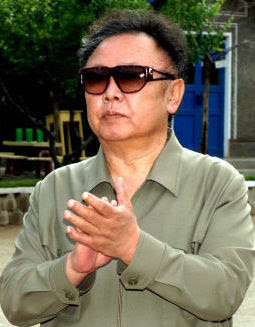
This may seem puzzling given that the leader Kims - and only the leader Kims - are often shown wearing sunglasses. Actually Kim Il Sung never wore them, but Kim Jong Il began wearing them from the 1990s (reportedly for medical reasons). This excerpt from the 2002 novel Successor by Paek Nam Nyong gives some idea of how this was interpreted domestically. In the novel's first chapter, which takes place in the 1970s, KJI has just returned from a guidance tour of remote Chagang Province, and his father was waiting up for him:
   The Great Leader walked back over to the sofa where Comrade Kim Jong-il was sitting and stopped.  “Take off your glasses.”
  "Hmm?... "
  Comrade Kim Jong-il hesitated for a moment and then took off his tinted lenses [연한 색안경].
  “Your eyes are bloodshot. You’re not in good health. You knew I’d be worried, so you put on sunglasses.”
  “It’s nothing.”
    The Great Leader could not take His loving eyes off Comrade Kim Jong-il. “It’s been ten years since you started working with the Party Central Committee…” When the Great Leader thought of Comrade Kim Jong-il working so hard to lighten His burden, dedicating so much energy to pulling the locomotive of the Party and revolution without rest, His eyes welled up with tears.
I haven't seen any overt references to KJU wearing sunglasses in stories, but he appears with them in domestic media images often enough. This 2016 article recounts how KJI wore sunglasses to conceal his bloodshot eyes and prevent people from worrying about him, and the implication may be that KJU now suffers the same problem.  

With these few exceptions, sunglasses are generally only worn by foreign characters (often associated with looking "like a mafia boss" [ 마피아두목처럼]), or occasionally by blind people.